News Headline
Regulate, not ban adult content


The regulatory environment is quite strict in India when it comes to adult content as India is largely a country driven by heritage and culture. The government has in the past taken strict action against channels for showing adult content.
Transmission of a leading fashion & lifestyle channel was stopped for a few days and resumed only after the channel’s management gave an assurance to the then I&B minister that the code of conduct will be followed. Consumer bodies and local action group’s have often raised the issue of adult content been shown on national and niche channels. TV19, an adult channel proposed to the Government in 1995-96 is still pending.
 By western standards, Indian TV is remarkably chaste with no full frontal nudity and not much kissing. The country’s most risque channel is a lifestyle channel, which shows models gliding down the catwalk, while Indian actresses are required to do nothing more suggestive in Hindi movies than to gyrate in the oft repeated wet sari scene. And of course multiple kissing scenes between the lead pair in select movies. However, regulation is lenient with adult content between 11.30 pm and 4 am.
However, the reality outside the public realm is much different and public acceptance is scarce. Wide interest in adult content exists in India primarily because sex is a taboo in the heartland of India. However, urban life witnesses extremely high traffic with the Internet coming of age. Cyber cafe’s are usually packed with people surfing and downloading adult videos. The same demand for porn is seen with private Internet connections.

A rather high demand has been witnessed for adult VCD/DVD/VHS with a steep fall in the rates of VCD/DVD/VHS players. High demand also exists for subscription based adult streaming video’s and free-to-air channels that are downloaded and relayed at convenient times. Cable Operators are known to be showing adult content, usually XXX, post midnight till the wee hours of the morning, to a very ‘loyal’ viewership and often ‘on demand’.
 It is apparent that a huge market exists in India for adult content against an unfavourable regulation. Adult content is a part of daily urban life through movies, music videos, cable and other retail platforms. Adult content is freely available in the market in many forms (magazines, video parlours and even cinema halls in remote towns/villages etc). It is being shown on cable networks post midnight on their private channels and also on many TV channels.
Internet is one of the biggest sources of access to adult content and people are freely downloading and viewing porn. The recent MMS expose’ of students and the ‘smoochsensation’ of leading film stars is just a mild reflection of both acceptance and indulgence. The adult content industry generates a lot of revenue, which is usually unaccounted, thus the government is losing out on its due share.
When regulated, matured content has the potential of generating huge revenues and a part of this revenue can be utilized for social upliftment of women and issues concerning women welfare and AIDS. Unfortunately, it is just the TV channels that are being made scapegoats when we have a greater threat from the Internet, almost, knocking at every door and available freely.
Today unrestricted access to streaming XXX video’s, callgirl services, sex-dating is available at the stroke of a key and anyone having access to the Internet can and is, probably, using these services from the comfort of their homes. Television is not even a fraction ‘porn savvy’ as other services and unfortunately is being demonized. Indian television is still a family entertainer and will continue to be, however, with a dash of change in keeping with the changing times.
The fact is whether the Government regulates adult content or not, it will continue to be available on demand and has the potential of influencing ‘minds’. When we know and agree that adult content is available on demand then we might as well work together and use technology to regulate the flow.
The need is to create a common opinion that when adult content is freely available on demand then it must be regulated. A regulated broadcast of adult content will help the Government in exercising proper control thus restricting access to minds that are not ready for adult content. We are living in ‘technologically superior’ times with technology defining and redefining itself by the day. We must make best use of technology in the form of ‘conditional access’ to regulate this segment.
(The author, Ashish Kaul is Senior Vice President, Corporate Brand Development for Essel Group, a multi-venture corporate comprising of Zee Telefilms, Esselpropack, Playwin, Esselworld and Waterkingdom; Agrani Group among others and can be reached via kaula@esselgroup.com)
Picture courtesy for Jism: www.indiadaily.com
Ram Teri Ganga Maili: www.thehotspotonline.com






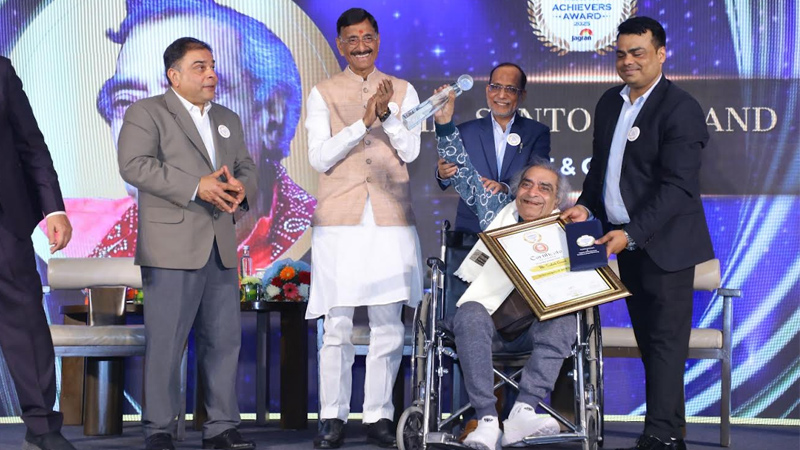
NEW DELHI: Hamdard Laboratories gathered a cross-section of India’s achievers in New Delhi on Friday, handing out the Hakeem Abdul Hameed Excellence Awards to figures who have left their mark across healthcare, education, sport, public service and the arts.
The ceremony, attended by minister of state for defence Sanjay Seth and senior officials from the ministry of Ayush, celebrated individuals whose work blends professional success with a sense of public purpose. It was as much a roll call of achievement as it was a reminder that influence is not measured only in profits or podiums, but in people reached and lives improved.
Among the headline awardees was Alakh Pandey, founder and chief executive of PhysicsWallah, recognised for turning affordable digital learning into a mass movement. On the sporting front, Arjuna Awardee and kabaddi player Sakshi Puniya was honoured for her contribution to the game and for pushing women’s participation onto bigger stages.
The cultural spotlight fell on veteran lyricist and poet Santosh Anand, whose songs have echoed across generations of Hindi cinema. At 97, Anand accepted the honour with characteristic humility, reflecting on a life shaped by perseverance and hope.
Healthcare honours spanned both modern and traditional systems. Manoj N. Nesari was recognised for strengthening Ayurveda’s place in national and global health frameworks. Padma shri Mohammed Abdul Waheed was honoured for his research-backed work in Unani medicine, while padma shri Mohsin Wali received recognition for his long-standing contribution to patient-centred care.
Education and social development also featured prominently. Padma shri Zahir Ishaq Kazi was honoured for decades of work in education, while former Meghalaya superintendent of Police T. C. Chacko was recognised for public service. Goonj founder Anshu Gupta received an award for his dignity-centred rural development initiatives, and the Hunar Shakti Foundation was honoured for empowering women and young girls through skill development.
The Lifetime Achievement Award went to former IAS officer Shailaja Chandra for her long career in public healthcare and governance, particularly in the traditional systems under Ayush.
Speaking at the event, Hamdard chairman Abdul Majeed said the awards were a tribute to those who combine excellence with empathy. “These awardees reflect Hakeem Sahib’s belief that healthcare, education and public service must ultimately serve humanity,” he said.
Minister Seth struck a forward-looking note, saying India’s young population gives the country a unique opportunity to become a global destination for learning, health and wellness by 2047.
The ceremony also featured the trailer launch of Unani Ki Kahaani, an upcoming documentary starring actor Jim Sarbh, set to premiere on Discovery on 11 February.
Instituted in memory of Unani scholar and educationist Hakeem Abdul Hameed, the awards have grown into a national platform that celebrates those building a more inclusive and resilient India. For one evening at least, the spotlight was not just on success, but on service with substance.






