iWorld
Regional OTT Stage‘s board clears preference share issue

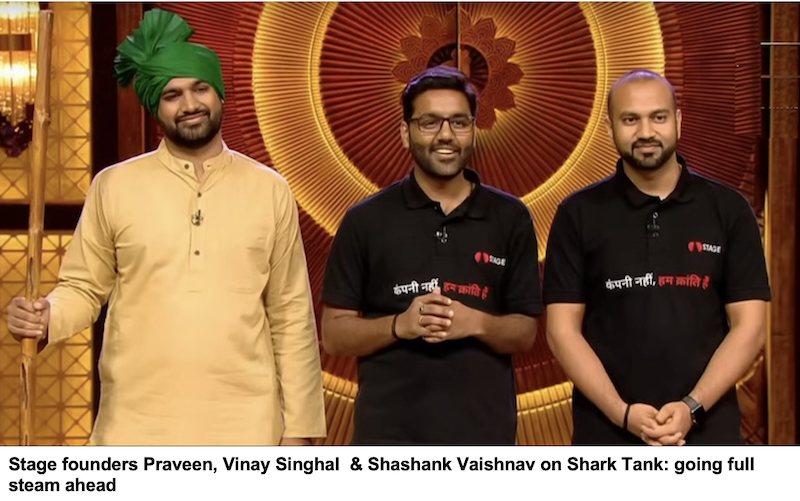
MUMBAI: It’s been staging a saleable story by riding on the regional language OTT fascination wave. Harayanvi and Rajasthani dialect streamer Stage recently got the go ahead from its board to issue 31,179 series B preference shares of face value Rs 10 and at an issue price of Rs 27,137 each.
This part of a funding raise of Rs 84.6 crore or $10 million in a round led by new investor Goodwater Capital along with existing backer Blume Ventures. The former’s contribution is Rs 41.95 crore, while the latter will be pumping in Rs 26.01 crore. Blume Ventures will end up with a 13.03 per cent stake making it the largest external investor while Goodwater Capital will have 6.24 per cent.
27 other investors are throwing their money into the investment pot. Among them figure: IA Growth Opportunities Fund I, TSM Ventures, LV Angel Fund and Brew Opportunities Fund.

The funds will be used to scale up its content slate, as well as to introduce Bhojpuri, Awadhi and Maithali languages streams, according to its founders Shashank Vaishnav, Praveen and Vinay Singhal.
The trio claims that the platform, which was founded in 2019 has three million subscribers, with 1.2 million of them in Haryana alone. New subs to the tune of 250,000 are being added every month.
When the round gets completed it would have raised $19 million in its current avatar. Of this, $4.83 million was raised in 2023 from Blume Ventures, NB Ventures and Dholakia Ventures. It had secured $2.5 million in a pre-series A round in January 2022 and $1.5 million from Venture Catalysts in November 2020. Additionally, javelin champion Neeraj Chopra has also invested in the venture and regularly appears in promos for it.

Stage began as a side project (competing with BuzzFeed) at WittyFeed,– a successful initiative that was shuttered in 2018, after Meta blocked its page on Facebook and Rs 7 crore per month in revenue simply vanished. The trio requested their employees to become their angel investors and help them come up with a reincarnation of the service.
More than 50 per cent of the work force agreed and even put in their savings as investments. Brainstorming with them allowed them to come up with the idea to create an OTT offering regional language content. Stage was born under Stage Technologies Pvt Ltd. And it is in this company that investors have been pouring their money.
Content in terms of originals at Stage is produced in house in the local language and dialect using local artistes at a cost of Rs 18-20 lakh per six to eight episodic series. Ditto is the cost for a two to three hour long film is what the trio had revealed on Shark Tank season 2 on SonyLiv and Sony Entertainment Television.
Around a year ago, the company brought in Harsh Mani Tripathi as a cofounder to further improve on the product. Earlier this week, its founders announced that it was being made available as an add-on to Zee-owned streamer Zee5 in the US.
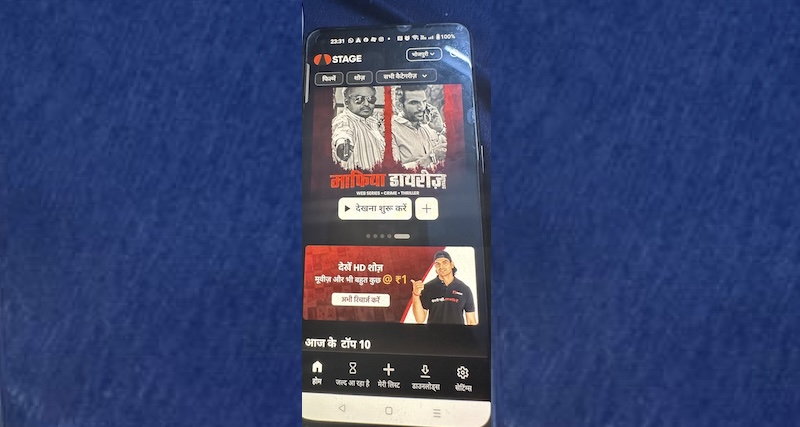
These days Stage is available at Re 1 for a seven day trial after being downloaded. The trio believe that once they sample the series and movies available on the streamer they would not mind paying Rs 199 for a three month subscription.
But the Singhal brothers and Shashank Vaishnav will have to spruce up their act on one front: Stage app’s download page on the Google Play store is flooded with complaints about subscribers getting their bank accounts deducted for Rs 199 even if they chose to cancel after the trial period.. So heavy is the stream of disgruntled subscribers, that Stage has put out a short teaser featuring Neeraj Chopra telling subscribers not to worry as only Rs 1 would be cut, and if more is, then those wanting to unsubscribe will get a refund into their bank accounts.
(Picture: Courtesy Shark Tank, Sony)

iWorld
Meta warns 200 users after fake Whatsapp spyware attack
Italy-targeted campaign used unofficial app to deploy surveillance spyware.

MUMBAI: It looked like a message, but it behaved like a mole. Meta has warned around 200 users most of them in Italy after uncovering a targeted spyware campaign that weaponised a fake version of WhatsApp to infiltrate devices. The attack, first reported by Agenzia Nazionale Stampa Associata, relied on classic social engineering with a modern twist: persuading users to download an unofficial WhatsApp clone embedded with surveillance software. The malicious application, believed to be developed by Italian firm SIO through its subsidiary ASIGINT, was designed to mimic the real app closely enough to bypass suspicion.
Meta’s security teams identified roughly 200 individuals who may have installed the compromised version, triggering immediate countermeasures. Affected users were logged out of their accounts and issued alerts warning of potential privacy breaches, with the company describing the incident as a “targeted social engineering attempt” aimed at gaining device-level access.
The malicious app was not distributed via official app stores but circulated through third-party channels, where it was presented as a legitimate WhatsApp alternative. Once installed, it reportedly allowed external operators to access sensitive data stored on the device turning a simple download into a potential surveillance gateway.
According to Techcrunch, Meta is now preparing legal action against the spyware developers to curb further misuse. The company, however, has not disclosed details about the specific individuals targeted or the extent of data compromised.
A Whatsapp spokesperson reiterated that user safety remains the top priority, particularly for those misled into installing the fake iOS application. Meanwhile, reports from La Repubblica suggest the spyware may be linked to “Spyrtacus”, a strain previously associated with Android-based attacks that could intercept calls, activate microphones and even access cameras.
The episode underscores a growing reality in the digital age, the threat is no longer just what you download, but where you download it from. As unofficial apps become increasingly convincing, the line between communication tool and covert surveillance is getting harder to spot and far easier to exploit.






