Hardware
Rajiv Kapur’s views on India scenario


MUMBAI: When it comes to content consumption, India is no different from the rest of the world. The Indian consumers’ appetite for content, for when to watch, for where to watch, and for how to watch, along with customisation is growing. With the internet, content consumers are becoming device agnostic, moving from one media to another and enlarging contact points to access content and information. Media consumption habits are changing. People in such a scenario will not be happy with just the basic offerings. In terms of phones which were primarily made for voice calls, people look for additional facilities like video, whereas for television which is meant for video, people want a wide variety of features.
Keeping the emerging scenario in mind, Broadcom has devised a number of technological innovations. These offerings can only be utilized fully if there is supporting broadband infrastructure and connectivity.

Broadcom MD Rajiv Kapur believes that Reliance Jio can emerge as disruptor in India. He says, “Reliance Jio, with whatever they are doing is going to be a game changer, and the competition should be worried. Its foresight and deep pockets make the future look extremely interesting.”
The cable industry is at a cusp. To start making money from avenues besides just carriage of television, the industry has to make the right technological upgradations. Internet data services must ride on the back of its existing infrastructure. Though all the players might not immediately realize the need for the right kind of upgradation, a few progressive minded ones can be the torch bearers, and their success will draw the rest in. Cable television or video ARPUs’ are not rising in India at the same rate as in the US or other geographies, where true high speed data ARPUs are a fraction, albeit quite a large fraction of Video ARPUs’. In India, it is the other way around- internet ARPUs’ are anything from twice to five plus times of cable television ARPUs’.
Kapur says, “In every country there are a set of progressive minded operators and there are a few who reactively catch up. All that is needed is a few operators adapting hybrid technology with a goal of providing enhanced satisfaction to the consumer and in return getting more returns in terms of higher ARPU.”
Broadcom now has devices based on DOCSIS 3.1 specifications, which obviously is an upgradation of the DOCSIS 3.0 version. DOCSIS 3.1 specifications hardware offer speeds of 1 gbps (Giga byte per second) as compared to the 100 mbps (Megabytes per second) or less that most DOCSIS 3 specification hardware is capable of. Kapur thinks “there is no real need of DOCSIS 3.1 in India at this stage” and he recommends that new innovators in the broadband space could start with DOCSIS 3.0.
He says, “Let’s be realistic about India as a country. 100 mbps to 1 gbps! There is no reason why India cannot talk about it, but as a country India still does not have the need for 1 gbps. But to begin with Docsis 2 today certainly makes no sense. It is like setting the ceiling lower than your own height.”
“Data consumption for video is still the heaviest usage of internet by Indian consumers. For quality 1080 p viewing experience consistent 15 to 20 mbps speed is more than enough. So DOCSIS 3.1 is yet not a necessity in India,” avers Broadcom fellow and vice president Sherman Chen
Kapur feels OTT will play a pivotal role in driving the need of broadband in India. Referring to the scenario five years back he says, “Today every hotel, coffee shop has Wi-Fi. Go back just five years and this was a rarity, so the evolution is happening. We are seeing taxi services offering Wi-Fi in their cabs during cab rides. OTT, telemedicine services will drive the need and the pipe will subsequently grow to meet the demand.”
Kapur believes that the default HD box should be a hybrid ready and rest can be customer defined. The DAS phase III deadline is knocking at the door, Kapur opines that the boxes placed should be in a position to serve the needs of consumers for at least five years. “If we place 100 million boxes and in a year we land up in a situation where we have to change the boxes that will be sad. So depending on the need we must deploy the best we can. I don’t want to see them replaced even in 5 to 7 years. Quality is my biggest concern as we do not have a situation of testing arrivals” he concludes.







Hardware
India clears Rs 1.6 lakh crore semiconductor projects under Semicon India
Ten projects cleared as production begins and design ecosystem gathers pace
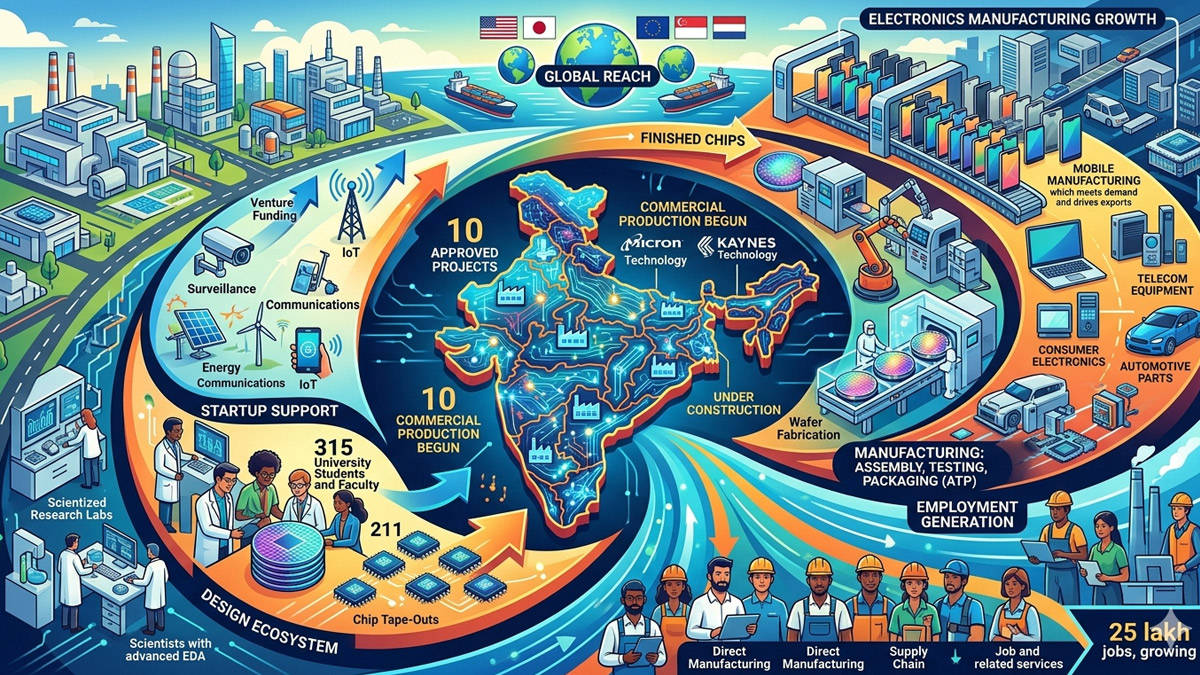
NEW DELHI: India’s push to become a global electronics powerhouse is gaining momentum, with the Semicon India Programme driving the creation of a full-fledged semiconductor ecosystem from design to manufacturing.
Launched in 2022, the programme aims to build capabilities across the entire value chain, including chip design, fabrication, assembly, testing and packaging. In just four years, the government has approved 10 semiconductor projects with a combined investment commitment of around Rs 1.6 lakh crore.
Two of these facilities have already begun commercial production, including units led by Micron Technology Inc. and Kaynes Technology India Limited. Two more plants are expected to go live later this year, signalling that India’s chip ambitions are moving from blueprint to factory floor.
The broader electronics manufacturing story has also seen sharp growth over the past decade. Production has jumped from roughly Rs 1.9 lakh crore in 2014-15 to about Rs 12 lakh crore in 2024-25, while exports have surged nearly eightfold. Mobile phone manufacturing, once heavily import-dependent, now meets almost all domestic demand and has become a major export driver.
Alongside manufacturing, the government is investing heavily in design capabilities. Through access to advanced chip design tools provided free to 315 universities, students and researchers have clocked over 200 lakh hours of usage. This effort has already resulted in 211 chip tape-outs from 75 institutions.
Support for startups is also picking up pace. Twenty-four chip design projects have been approved, targeting sectors such as surveillance, energy, communications and IoT. Of these, 14 companies have collectively raised over Rs 650 crore in venture funding, while several designs have progressed to fabrication, including at advanced nodes.
To strengthen supply chains, India has also signed semiconductor cooperation agreements with countries including the United States, Japan, the European Union, Singapore and the Netherlands. These partnerships aim to reduce global dependencies while boosting domestic capabilities.
The employment impact is equally significant. The electronics sector now supports an estimated 25 lakh jobs, with mobile manufacturing alone accounting for nearly half. As more semiconductor units come online under the India Semiconductor Mission, indirect job creation across supply chains is expected to rise further.
Sharing these updates in Parliament, Ministry of Electronics and Information Technology minister of state Jitin Prasada underscored the government’s focus on building a resilient, end-to-end semiconductor ecosystem.
With factories taking shape, designs moving to silicon and investments flowing in, India’s semiconductor story is steadily shifting gears from ambition to execution.






