News Broadcasting
Raj TV to celebrate 75 years of Tamil Cinema


MUMBAI: Tamil television channel Raj TV is celebrating 75 years of Tamil cinema with a slew of programmes from 5 April to 19 June, including screening of 75 best films in the language. The first Tamil talkie, Kalidas, was released on 14 March in 1931.
“We hold copy rights to nearly 2,000 films. We propose to telecast these 75 films as part of the celebrations,” Raj TV directors M Ravindran and M Raghunathan said.
The channel is also planning a glittering star-studded award function to culminate the celebration phase. The event will be held in Chennai on 24 June, where 75 veteran contributors to Tamil cinema would be honoured.

‘Chitra’ Lakshman, film producer-director, who is also associated with the celebrations, said each year on March 14 awards would be given away in the name of late Nataraja Mudaliar, the man who was responsible for the first silent Tamil movie Keeshavadam.
According to Lakshman, the channel will also institute an award of Rs 1,00,000 each to a dozen low budget movies in Tamil as an annual feature.




News Broadcasting
Network18 channels lead YouTube news viewership in March 2026
CNN-News18, News18 India and CNBC channels top categories with record views
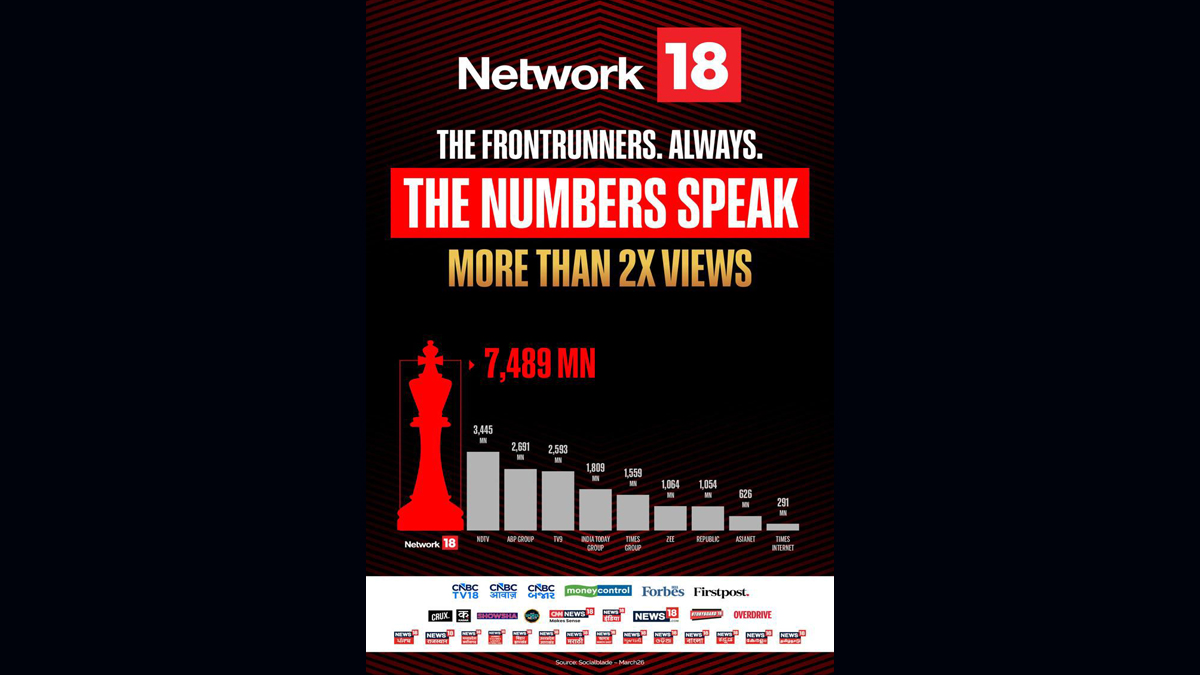
MUMBAI: When the world hit refresh on breaking news, Network18’s channels were already streaming ahead. As geopolitical tensions and war-driven headlines fuelled a surge in global news consumption, the network’s digital playbook delivered big clocking record Youtube viewership across English, Hindi and business news categories in March 2026.
At the forefront was CNN-News18, which emerged as the clear leader in the English news segment with 130 million live and video-on-demand views. The channel edged past competitors such as Times of India (126.5 million), Times Now (101.1 million), India Today (88.2 million) and NDTV (77.5 million), according to Databeings data for March.
In the Hindi news arena, News18 India delivered a commanding performance, racking up a staggering 3,297 million views on YouTube. The channel comfortably outpaced NDTV India, which recorded 3,119 million views, underlining its deep reach and consistent engagement with mass audiences, as per Playboard data.
The network’s dominance wasn’t confined to general news. In the Hindi business segment, CNBC Awaaz topped the charts with 92 million views, narrowly ahead of Zee Business (90 million) and well ahead of ET Now Swadesh (57 million). Meanwhile, its English counterpart CNBC-TV18 posted a strong 58 million views, reinforcing the network’s cross-category strength.
The spike in viewership reflects a broader shift in audience behaviour, with viewers increasingly turning to digital platforms particularly Youtube for real-time updates and in-depth coverage during high-intensity news cycles. For Network18, the numbers signal more than just scale; they underline the effectiveness of a multi-platform strategy that blends speed, credibility and continuous coverage.
In a month where the news never paused, it seems viewers chose to stay tuned where the stream never stopped.






