News Broadcasting
QUESTION AND ANSWER SESSION CHRIS DEERING AND PAUL MEYERS


Member of audience to Chris:
My question is that with the advent of gaming portals and onset of broad band internet do you see any threat to your business in future?
Chris Deering:
Well, I think if our business doesn’t evolve in the direction where consumers want it to of course there is a threat but I prefer to say this is an opportunity with online components of games perhaps with pre recorded element, perhaps one hundred percent online. Online portals right now are multi-player. Online gaming and real time persistent worlds is rather a niche business and I know because Sony has one of the most successful online games called “Ever Quest”. It’s successful and it has about hundred and fifty thousand subscribers. One before online gaming can become huge, huge and a mass market context atleast with games as we currently define them fast frame rate, full screen foremost video is gonna need to be of lot more broad band out there and till that time the connectivity part would be just to update information or to play fairly a slow latency games like may be gold or tax games or persistent world games.
I am not sure I am answering your question but clearly the technology moves on everyday and I think as soon as you move with it and there will be a growing part of the gaming world that has real time online connectivity.

Member of audience:
Shivjeet, I have a question for Paul of Asiacontent, a case is made for personalization on the net, customization being a stage before that what do you say about that, I mean what’s the trend, where is it gonna be, what are the problems, how soon are you going to get there?
Paul Meyers:
Personalization is certainly an important part of the internet especially on a content site whether it’s an MTV or a Yahoo or a sports site or any kind of a content driven site I think, we are seeing that happening increasingly in the States not so much yet in Asia, a basic technological reason in North Asia, many of the software products that allow you to do it simply cannot handle non-roaming characters ok, I think we will start to see that happen fairly soon but I don’t think its appropriate for all sites, I think may be with a MTV site absolutely you are gonna find out about the music you are interested in or a sports site if you want Cricket but you don’t want the NBA.
I don’ think it should be forced upon people because its not good for everybody I know I helped my dad get on the internet a couple of weeks ago back in Chicago, he didn’t wanted it all, he just wanted plain vanilla version he wanted what came out of the box it was good enough for him, he didn’t want to get into the personalization, yes its important yes we’ll see more of it I don’t think it will commute backwards anytime soon.
Nisha:
Mr. Paul my name is Nisha and I work for Quantum, All the figures that we have been told today or shown today pertain broadly to Asia we haven’t seen specific figures on India. It appears to me that access to the internet is very widely split between in home and out of home access.
How does that impact on behavior of the internet do you think, in what way do we need to take cognizance of people that are going out paying for one hour of internet time and therefore are very conscious about how they are spending vs somebody who is accessing the net at home?
Shivjeet:
I guess what she is asking about in-home vs cyber cafes vs these two users how does that effect content or does it?
Paul Meyers:
Well, on one hand now it doesn’t effect content and on the other hand yes it does. So let me explain one of the things we have to be very very careful of is that access speed and band width varies with in a country and from country to country ok, certainly everybody want to see a video on the internet today, they wanna have the ability to do that sometimes the infrastructure is simply not there to allow them to do it or sometimes there are kids who are willing to wait 22 minutes to get a 30 sec clip of a video ok, so band width is an issue there, that we pay attention to so we don’t force a lot of eye candy and a lot of full motion video and music downloads on everybody who make them available so if you have better access you are connecting from your office, or university, or some broader band access plate you can enjoy those features but we don’t make it necessary because we loose in many essences the broad base of the audience.
Vishal:
Hi! This is Vishal from India games the question to Asiacontent is you have not talked about conversions at all in your complete internet strategy conversions of media where you finally would be having the Internet the television and all this medias is talking together your thing was completely focused on internet but I think a lot of people over here would also be interested in knowing as to how a particular brand would position itself when conversions really happen because Asia is poised for a huge growth as far as broad band is concerned and if somebody can watch MTVS streaming on his website, so what happens to MTV as a channel on television?
Paul Meyers:
Good question, good question, first we have plans off course in certain countries and we are actually doing it in some countries like in Korea and Japan to make more streaming available, to make actual paper view downloads of music or videos available that way as well.
don’t think they were ever gonna conflict with the channel, the channel is a 24 hour stream and it has its own character and its own personality, and the way that it interacts with its audience I think its always gonna be there and there are some technological advances to it but I don’t see us competing with that. Again one of the key things in the internet is that it allows you as an audience member to do it when you want ok, and any portions you want so may be you are interested in J Pauper or may be you are interested only in Way Sis or may be only interested in boyband you can programme your own boyband channel even if the 98 percent of the rest of the world isn’t interested in doing that that’s what internet allows you to do and that’s how I see us moving to a broad band offering both on MTV and on other offerings as well.




News Broadcasting
India Today Group sweeps top honours at Ramnath Goenka Awards
Journalists recognised for fearless investigative and civic reporting.
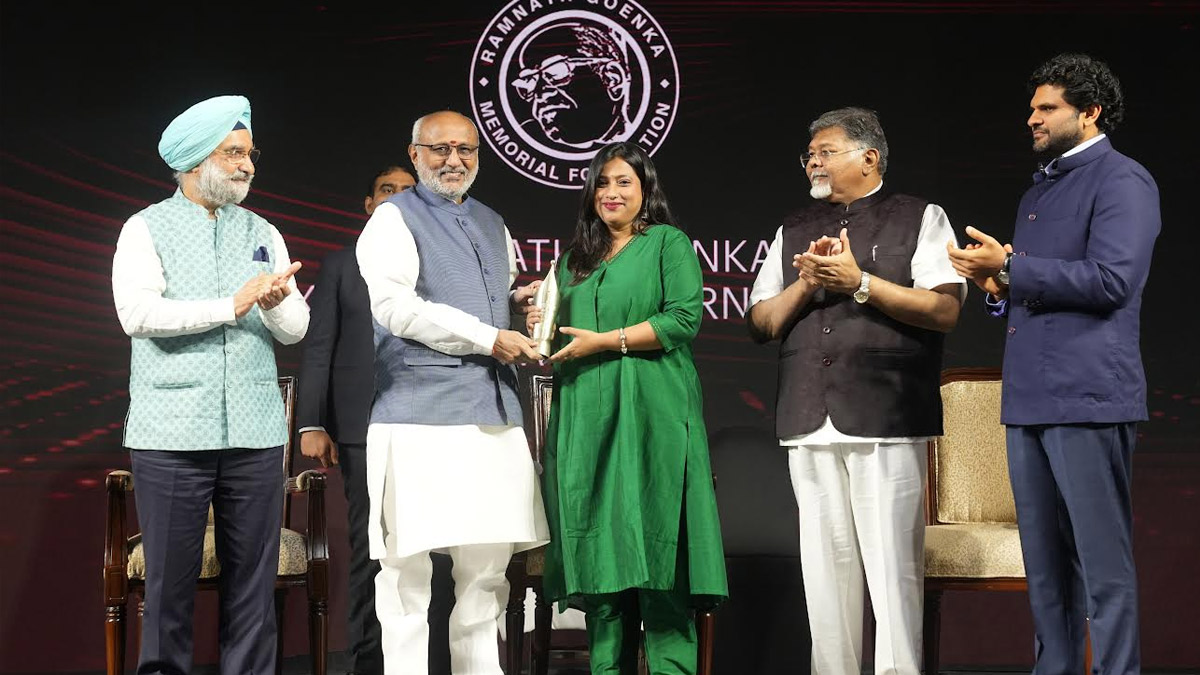
MUMBAI: India Today Group just turned the Ramnath Goenka Awards into its own trophy cabinet because when your reporters dig this deep, even the judges have to award a clean sweep. India Today Group journalists have secured multiple top honours at the latest edition of the prestigious Ramnath Goenka Excellence in Journalism Awards, reinforcing the network’s legacy as the gold standard of Indian journalism. The awards were conferred by vice president C. P. Radhakrishnan at a ceremony held on 27 March 2026.
Sreya Chatterjee won in the ‘Investigative Reporting – Broadcast’ category for her powerful India Today TV report ‘Operation Illegals: The Alarming Rise in Bangladeshi Infiltration Across India’s Fragile Eastern Frontier’. The investigation stood out for its depth, on-ground rigour and national relevance.
In the ‘Civic Journalism – Print/Digital’ category, Sreya Chatterjee along with Arvind Ojha were honoured for their indiatoday.in report on unregulated water extraction and the ‘Tanker Mafia’ in Delhi’s Bawana Industrial Area. The story exposed critical systemic gaps and environmental challenges affecting daily life.
Additionally, aajtak.in was recognised in the ‘Investigative Reporting – Print/Digital’ category for its hard-hitting exposé ‘The Surrogate Mother Market’, which highlighted the human, legal and ethical dimensions of the surrogacy ecosystem.
India Today Group emerged as the only network honoured in Investigative Journalism across both Print/Digital and Broadcast categories. The wins reflect the strength of its multi-platform newsroom and its unwavering commitment to credible, high-impact reporting that informs public discourse and drives accountability.
In an era when speed often trumps substance, these awards remind us that the most powerful stories are still the ones dug out with courage, told with clarity, and delivered with conscience, one fearless byline at a time.








