Cable TV
Punjab Govt falters in first leg of breaking cable monopoly

MUMBAI: Even as the Punjab government recently vowed to break the cable monopoly, the Municipal Corporation Bathinda (MCB) has been unsuccessful in completing its door-to-door cable survey in the city. As per the orders of the Local Bodies Department, the MCB was scheduled to complete its survey by 31 July, and submit its report to the department.
After receiving instructions from the local bodies minister Navjot Singh Sidhu to start a grassroots-level investigation against Fastway Cable, the MCB had sent officials of the rank of JE and SDO to conduct a door-to-door survey in the Bathinda, Tribune reported.
Even though the Congress government in Punjab made it clear it would not tolerate monopoly in information and news distribution via cable TV, the state government clarified no particular MSO company or TV channel would be targeted and action would be taken if found guilty of tax law violations.

Sidhu had alleged that Fastway had caused a loss of around Rs 6840 million to the state exchequer. The state government had ordered a tax evasion notice to be slapped on Fastway. Sidhu also demanded a separate investigation into the alleged under-reporting of TV connections and cable operators engaged by Fastway. Of over 8,000 cable operators in the state, 6,500 were working for Fastway, he alleged.
MSO Fastway, which holds sway in Punjab resulting virtually in a monopoly, is allegedly owned and operated by close aides of former Punjab chief minister’s family — the Badals. The decade-old MSO company also has sizable presence in neighbouring states of Himachal Pradesh, Haryana and Union territory of Chandigarh. In an official statement, the present CM Captain Amarinder Singh made it clear that action would be taken against media companies if charges of tax violations are proved to be correct.
Around 70 Bathinda officials were deputed for the survey. In the city, these officials were to collect information of cable network from around 70,000 households. After this survey, Sidhu planned to impose entertainment tax on cable network because, as per the Municipal Act, 1976, his department had the right to collect the tax. The Union Government had kept the cable business out of the GST. As per MCB record of the last 10 years, Fastway had not paid requisite charges for using poles. After the earlier record, many new connections and areas had increased manifold.
MCB commissioner Sanyam Aggarwal admitted that he did not know how much survey work had been completed.
ALSO READ :
Probe Punjab ‘cable mafia,’ demands minister, Fastway refutes charges
Hinduja’s NXT Digital enters Fastway-dominated Punjab
Punjab govt. studying Arasu & other regulatory models on distribution
Punjab govt. vows to break cable monopoly, rules out blocking MSO Fastway





Cable TV
Hathway Cable appoints Gurjeev Singh Kapoor as CEO
Leadership change comes as cable TV faces shrinking subscriber base and modest earnings pressure
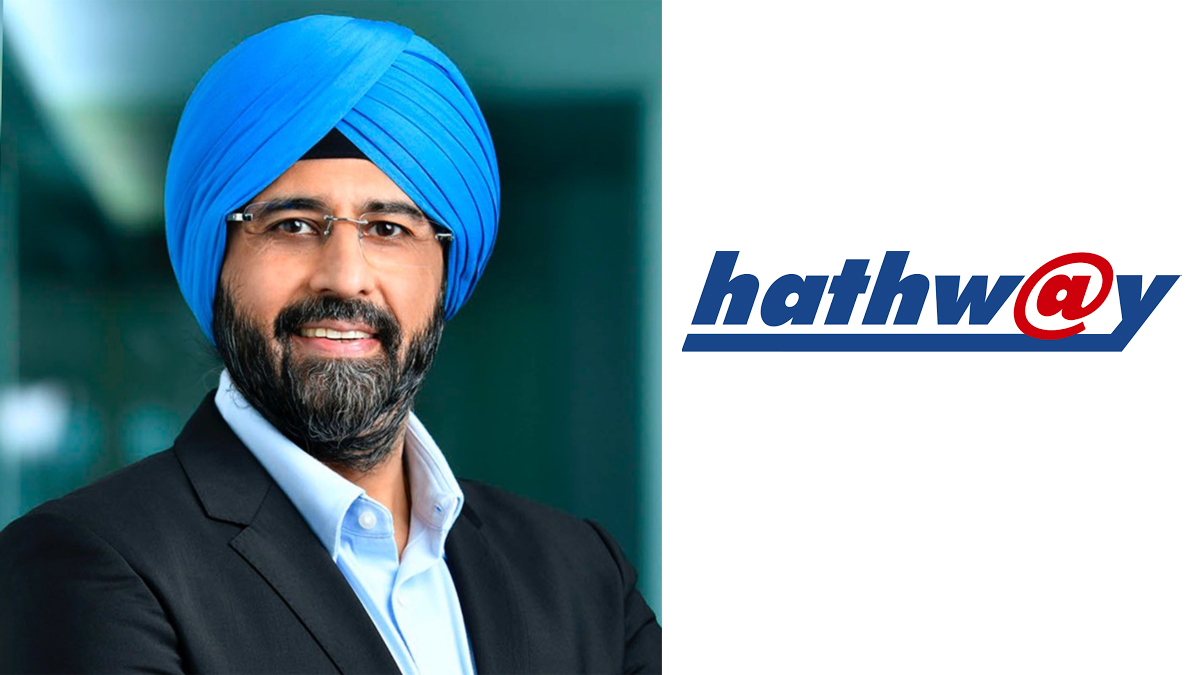
MUMBAI: Hathway Cable and Datacom has tapped industry veteran Gurjeev Singh Kapoor as chief executive officer, marking a leadership pivot at a time when India’s cable television business is under mounting strain.
Kapoor will take over from Tavinderjit Singh Panesar, who is set to retire in August after a long innings with the company. Panesar, chief executive since 2023, has held multiple leadership roles at Hathway, including his latest stint beginning in 2022.
Kapoor brings more than three decades of experience in media and entertainment. He most recently led distribution at The Walt Disney Company’s Star India business, now part of JioStar. His career spans television distribution and affiliate partnerships, with stints at Sony Pictures Networks India, Discovery Communications and Zee Entertainment.
Panesar, with over three decades in the industry, has worked across strategic planning, distribution and business development in media, broadcasting and manufacturing. His past associations include ESPN Star Sports, Star India, Apollo Tyres and JK Industries.
The transition lands as the cable sector grapples with structural disruption. Traditional operators are losing ground to streaming platforms, while telecom and broadband players tighten the squeeze with bundled offerings.
An EY report estimates India’s pay-TV base could shrink by a further 30 to 40 million households by 2030, taking the total down to 71 to 81 million. The slide follows a loss of nearly 40 million homes between 2018 and 2024, a contraction that has already wiped out more than 37,000 jobs in the local cable operator ecosystem.
Hathway’s numbers reflect the strain. The company reported a consolidated net profit of Rs 93 crore for FY25, down from Rs 99 crore a year earlier. Revenue inched up to Rs 2,040 crore from Rs 1,981 crore. As of December 2025, it had about 4.7 million cable TV subscribers and roughly 1.02 million broadband users.
Kapoor steps in with a familiar brief but a shrinking playbook. In a market where viewers are cutting cords faster than companies can reinvent them, the new chief executive inherits a business fighting to stay plugged in.







