Cable TV
Public authorities can deny cable laying permission to MSOs & LCOs

NEW DELHI: Stressing that multi-system operators (MSOs) and local cable operators (LCOs) are required to lay and establish cables and erect posts from time to time under, over, along, across, in or upon any immovable property under the control or management of a public authority, the operator can be directed to remove it or shift it or alter its position, as the case may be, at its own cost in the time frame indicated by the authority.
In new Guidelines to enable the State Governments to put in place an appropriate mechanism for speedy clearances of requests by operators for Right of Way, the Information and Broadcasting Ministry has said that operators can be asked by the public authority in public interest to remove or shift or alter the position.
In a letter sent to Chief Secretaries of all states, the Ministry said Cable Operators sometimes are required to lay and establish cables and erect posts from time to time under, over, along, across, in or upon any immovable property ever vested in or under the control or management of a public authority, after due permission.

Section 48(5) of the Cable TV Networks (Regulation) Act 1995 specifies that the Central Government may lay down appropriate guidelines to enable the State Governments to put in place an appropriate mechanism for speedy clearance of requests from cable operators for laying cables or erecting posts in properties with a public authority.
The Ministry has laid the basic guidelines for this purpose which covers the procedure and the obligations of both the operators and the public authority in this regard.
It has also made it clear that no application by an operator can be rejected unless has been given an opportunity of being heard on the reasons for such rejection. The permission will be deemed to have been granted if the public authority fails to either grant permission or reject the applicationwithin 65 days of the receipt of the application.
Where the public authority accepts the undertaking by the licensee to discharge the responsibility to restore any damage that be cause, it may seek a bank guarantee for an amount in lieu of expenses for restoration of such damage, as security for performance in the discharge of the responsibility.
Any application to a public authority will be accompanied by a copy of the registration granted by the Government – by the Head Post Master for LCOs under Rule 5, and Central Government for MSOs under Rule 11C of the Cable Television Networks Rules 1994;
The extent of land required for establishment of the overground cable infrastructure will also have to be indicated.
Also Read:
LCOs to get unique TRAI number to ensure fair deals, says advisor Gupta




Cable TV
Hathway Cable appoints Gurjeev Singh Kapoor as CEO
Leadership change comes as cable TV faces shrinking subscriber base and modest earnings pressure
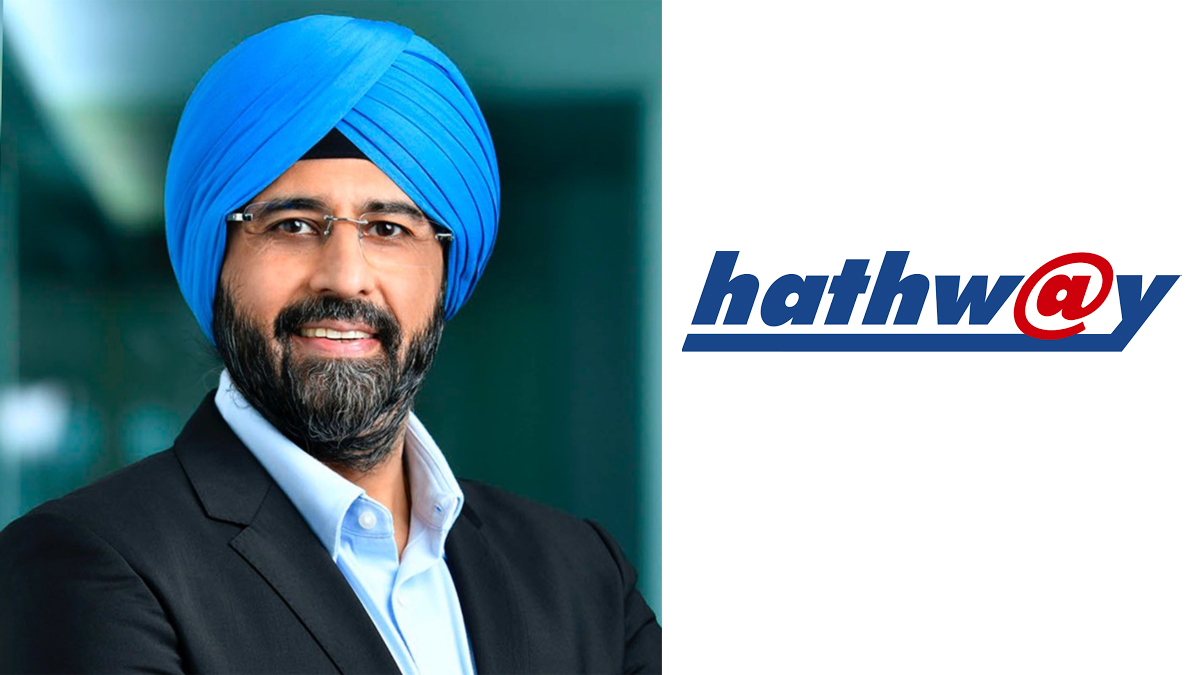
MUMBAI: Hathway Cable and Datacom has tapped industry veteran Gurjeev Singh Kapoor as chief executive officer, marking a leadership pivot at a time when India’s cable television business is under mounting strain.
Kapoor will take over from Tavinderjit Singh Panesar, who is set to retire in August after a long innings with the company. Panesar, chief executive since 2023, has held multiple leadership roles at Hathway, including his latest stint beginning in 2022.
Kapoor brings more than three decades of experience in media and entertainment. He most recently led distribution at The Walt Disney Company’s Star India business, now part of JioStar. His career spans television distribution and affiliate partnerships, with stints at Sony Pictures Networks India, Discovery Communications and Zee Entertainment.
Panesar, with over three decades in the industry, has worked across strategic planning, distribution and business development in media, broadcasting and manufacturing. His past associations include ESPN Star Sports, Star India, Apollo Tyres and JK Industries.
The transition lands as the cable sector grapples with structural disruption. Traditional operators are losing ground to streaming platforms, while telecom and broadband players tighten the squeeze with bundled offerings.
An EY report estimates India’s pay-TV base could shrink by a further 30 to 40 million households by 2030, taking the total down to 71 to 81 million. The slide follows a loss of nearly 40 million homes between 2018 and 2024, a contraction that has already wiped out more than 37,000 jobs in the local cable operator ecosystem.
Hathway’s numbers reflect the strain. The company reported a consolidated net profit of Rs 93 crore for FY25, down from Rs 99 crore a year earlier. Revenue inched up to Rs 2,040 crore from Rs 1,981 crore. As of December 2025, it had about 4.7 million cable TV subscribers and roughly 1.02 million broadband users.
Kapoor steps in with a familiar brief but a shrinking playbook. In a market where viewers are cutting cords faster than companies can reinvent them, the new chief executive inherits a business fighting to stay plugged in.







