News Headline
Producers Guild issues statement, slams attackers who are maligning film industry’s reputation


The Producers Guild of India (PGI) today issued a statement related to the countless attacks against the film industry. The guild has accepted that the Indian film industry has its own imperfections, but it also highlights that the industry is also one of the most important sources of soft power for the nation at a global level.
Following the death of Bollywood actor Sushant Singh Rajput, celebrities like Kangana Ranaut have re-ignited the nepotism debate and highlighted the drug abuse in Bollywood. While she has been targeting influential filmmakers for favouring celebrity kids, Ranaut recently claimed that 99 per cent of Bollywood was on drugs.
“The last few months have seen relentless attacks on the reputation of the Indian film industry across all media. The tragic death of a promising young star has been used by some as a tool to defame and slander the film industry and its members,” the statement read.

“A picture has been painted of the industry as a terrible place for outsiders to aspire to; a place that treats those who dare to enter it with contempt and derision; a murky den of substance abuse and criminality. This narrative is salacious enough for the media to exploit to great effect in order to boost its ratings, readership and page views. But it is not the truth” the guild added.
“Like any other sector, there is no doubt that the film industry has its imperfections, and there must always be an ongoing attempt by any industry to improve upon itself, learn and evolve while weeding out unsavoury elements or improper practices that hold it back. But to paint an entire industry with the same brush is a gross misrepresentation of reality,” the guild further said.
On the positive aspects of the industry, the guild shared, “The film industry employs hundreds of thousands of people, boosts travel and tourism and is one of the most important sources of soft power for India across the world. It has entertained hundreds of millions of people for over a century and has brought joy, honour, and glory to the nation. It has welcomed and embraced talent from across the country – from the worlds of literature, poetry, art and music – and has drawn them in to create a unique cinematic language.”
The statement read, “This has ensured that we are one of the few countries in the world to still have a vibrant and thriving local film industry across multiple languages, despite the decades-long onslaught of Hollywood.” It also mentioned that the industry has always contributed generously to national causes in times of need, and has offered its resources – name, recognition, time and funds – whenever needed.
The guild also agreed that it’s not easy to enter the industry.
“We do not negate the personal experiences of anyone from the industry, and undoubtedly many of those entering the business and seeking to establish themselves have faced numerous hardships, struggles and disappointments in the course of building a career here. But that is no different from the challenges and obstacles faced by new entrants in any field that they are not born into – be it politics, law, business, medicine or the media,” the guild further added.
It said, “However, a concerted effort has been made to single out the film industry as one that specifically inhibits and prohibits new talent from the outside from thriving. This could not be further from the truth.”
The letter also mentioned that there are scores of talented actors, directors, writers, musicians, cinematographers, editors, sound designers, production designers, costume designers, art directors, and numerous other film professionals across multiple disciplines who had absolutely no connection in the industry, but they have flourished and done pathbreaking work, which has redefined Indian cinema.
The statement further read: “Being born into the industry most definitely affords you the privilege of access and a first break, but after that it is up to each individual’s talent, hard work and drive to propel them forward. This is a place that ultimately rewards your talent, work ethic and ability to connect with an audience – regardless of your religion, gender, caste or economic strata.”
It agreed that the industry is undoubtedly more difficult for an outsider to get that first chance to display their talent. However, with perseverance, persistence and a little bit of luck – it could be achieved.
“These are difficult times for our country and the world, so rather than venting our fears and frustrations on each other with vile and vicious trolling, it is more important than ever to come together instead of tearing each other apart. Members of the industry on both sides of this debate, especially women, have been subjected to rape threats and death threats. This is unacceptable and must stop now,” the statement said.





NEW DELHI: Hamdard Laboratories gathered a cross-section of India’s achievers in New Delhi on Friday, handing out the Hakeem Abdul Hameed Excellence Awards to figures who have left their mark across healthcare, education, sport, public service and the arts.
The ceremony, attended by minister of state for defence Sanjay Seth and senior officials from the ministry of Ayush, celebrated individuals whose work blends professional success with a sense of public purpose. It was as much a roll call of achievement as it was a reminder that influence is not measured only in profits or podiums, but in people reached and lives improved.
Among the headline awardees was Alakh Pandey, founder and chief executive of PhysicsWallah, recognised for turning affordable digital learning into a mass movement. On the sporting front, Arjuna Awardee and kabaddi player Sakshi Puniya was honoured for her contribution to the game and for pushing women’s participation onto bigger stages.
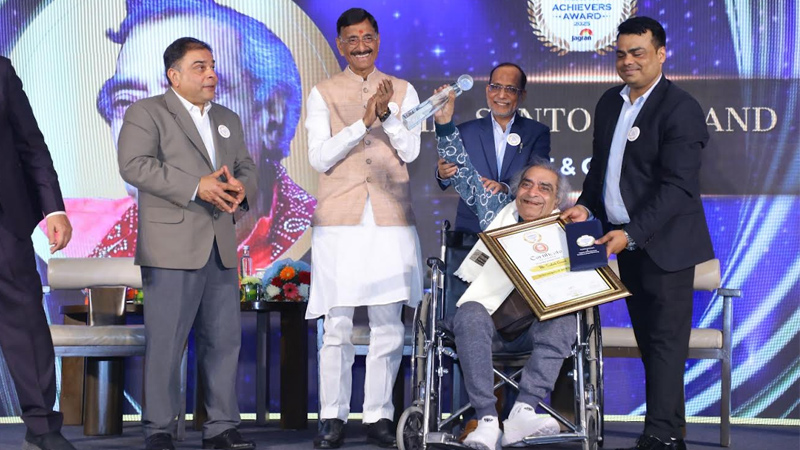
The cultural spotlight fell on veteran lyricist and poet Santosh Anand, whose songs have echoed across generations of Hindi cinema. At 97, Anand accepted the honour with characteristic humility, reflecting on a life shaped by perseverance and hope.
Healthcare honours spanned both modern and traditional systems. Manoj N. Nesari was recognised for strengthening Ayurveda’s place in national and global health frameworks. Padma shri Mohammed Abdul Waheed was honoured for his research-backed work in Unani medicine, while padma shri Mohsin Wali received recognition for his long-standing contribution to patient-centred care.
Education and social development also featured prominently. Padma shri Zahir Ishaq Kazi was honoured for decades of work in education, while former Meghalaya superintendent of Police T. C. Chacko was recognised for public service. Goonj founder Anshu Gupta received an award for his dignity-centred rural development initiatives, and the Hunar Shakti Foundation was honoured for empowering women and young girls through skill development.
The Lifetime Achievement Award went to former IAS officer Shailaja Chandra for her long career in public healthcare and governance, particularly in the traditional systems under Ayush.
Speaking at the event, Hamdard chairman Abdul Majeed said the awards were a tribute to those who combine excellence with empathy. “These awardees reflect Hakeem Sahib’s belief that healthcare, education and public service must ultimately serve humanity,” he said.
Minister Seth struck a forward-looking note, saying India’s young population gives the country a unique opportunity to become a global destination for learning, health and wellness by 2047.
The ceremony also featured the trailer launch of Unani Ki Kahaani, an upcoming documentary starring actor Jim Sarbh, set to premiere on Discovery on 11 February.
Instituted in memory of Unani scholar and educationist Hakeem Abdul Hameed, the awards have grown into a national platform that celebrates those building a more inclusive and resilient India. For one evening at least, the spotlight was not just on success, but on service with substance.






