I&B Ministry
Print media should adapt itself to digital technologies: Jaitley

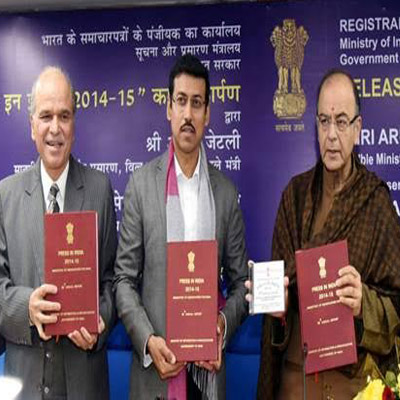
NEW DELHI: In the rapidly growing digital era, the print media needs to accept the challenges put forth by the Digital and Information age according to Information and Broadcasting Minister Arun Jaitley.
The internet revolution and fast changing technology presented a big challenge to the Print Media across the world to maintain its presence and sustained growth. However, India remained an exception wherein Print registered growth owing to an increasing demand and subscriber base for regional newspapers.
Releasing the 59th Annual Report on Print Media – “Press in India 2014-15” – prepared and compiled by Registrar of Newspapers for India here today, Jaitley said that Print Media had to contend with the information flow disseminating from electronic media which weakened the dividing line between news and opinion.

The emerging viewpoint had brought certain shrillness in the debates and discussions. Print Media, thus, had a role to play in maintaining objectivity and preserving the sacred nature of news. It was important to also understand that emerging viewpoints surfaced due to the vastness of the media universe where different perspectives were put forth on a given issue.
Minister of State for I&B Rajyavardhan Rathore was also present during the event.
The Minister said that it was time for magazine journalism to reinvent itself since the options for the readers were expanding due to alternatives such as digital and social media. Jaitley said the worldwide trends show that many popular magazines had shifted to the online digital edition, since it’s time for instantaneous news with fast changing world, news and technology. Hence, the shelf life for news being collated in magazines was considered outdated.
Special Secretary J S Mathur gave an overview of the publication and highlighted the journey of Press through history. He also touched upon the changes being brought forth in the media space, especially the Print Media.
The Annual Report “Press in India- 2014-15” was prepared on the basis of analysis of annual statements filed by the registered publications. The report provided broad analysis of the general trend of the Indian Press based on the claimed circulation.
The print media registered a growth of 5.80 per cent over the previous year as a total of 5,817 new publications were registered during 2014-15 and 34 publications ceased their operation. Out of the total 1,05,443 publications registered as on 31 March, 2015, the largest number of newspapers and periodicals registered in any Indian language was in Hindi with a figure of 42,493 publications followed by English with 13,661 registered publications. Out of 1,05,443 registered publications, 14,984 were dailies and bi-tri weeklies and remaining 90,459 were of other periodicities.
State-wise analysis shows that Uttar Pradesh with 16,130 publications was at top position at the end of 2014-15. Maharashtra with 14,394 publications and Delhi with 12,177 publications were at second and third position respectively.
The total claimed circulation of publications stood at 51,05,21,445 in 2014-15 as against 45,05,86,212 copies per publishing day in 2013-14. The number of Annual statements received in RNI for the year 2014-15 was 23,394 against 19,755 in 2013-14 registering an increase of 18.42 per cent. As per report, circulation-wise, Hindi Publications continued to lead with 25,77,61,985 copies per publishing day followed by English with 6,26,62,670 copies and Urdu with 4,12,73,949 copies per publishing day.
The report also carried different Chapters viz. ownership of newspapers, analysis of daily newspapers, language wise study of the press and analysis of registered newspapers.
Main highlights of the Indian Press in 2014-15 are as follows:-





I&B Ministry
Digital radio, D2M tech set to reshape broadcasting and public messaging
Govt pushes next-gen delivery while TRAI tightens grip on spam ecosystem
NEW DELHI: India’s broadcasting and telecom landscape is undergoing a quiet but significant upgrade, with digital radio and Direct-to-Mobile (D2M) technologies emerging as powerful tools for mass communication, while regulators step up efforts to tackle spam calls.
According to the Ministry of Information and Broadcasting, digital radio and D2M are poised to transform how content reaches audiences by making more efficient use of spectrum. In simple terms, multiple channels can now be delivered over a single frequency, opening the door to a wider range of free-to-air content.
D2M technology takes this a step further by enabling video, audio and data to be broadcast directly to mobile handsets without relying on SIM cards or mobile data. The result is a resilient and cost-effective data pipe that can deliver everything from entertainment and education to critical emergency alerts, even in low-connectivity scenarios.
At the same time, the Telecom Regulatory Authority of India is tightening its grip on unsolicited commercial communication, better known as spam calls. The regulator has deployed a distributed ledger technology platform to bring transparency and accountability into the system.
Through this blockchain-based setup, consumers can register their preferences on receiving promotional messages, while businesses and telemarketers must also sign up and operate within defined rules. The platform also includes a complaint mechanism that allows users to report spam, with complaints shared across telecom operators for coordinated action.
The government’s broader push is being supported by infrastructure upgrades under the Broadcasting Infrastructure and Network Development scheme. Implemented through Prasar Bharati, the initiative focuses on modernising networks such as Akashvani and Doordarshan, including digitisation and adoption of next-generation broadcast equipment.
In a written reply in the Lok Sabha, Ministry of Information and Broadcasting minister of state for information and broadcasting L. Murugan said these steps are part of a larger effort to promote emerging technologies and strengthen the country’s broadcasting backbone. The response came to a query raised by member of Parliament Rao Rajendra Singh.
Together, these developments point to a dual-track strategy: expanding access to reliable, low-cost content while cleaning up the communication ecosystem. As digital pipes get smarter and spam filters sharper, India’s airwaves may soon feel a lot less noisy and far more useful.






