News Broadcasting
Primetime : News vs TRP


KOLKATA: Major news channels in India have been criticised lately for turning primetime into a “farce”. The coverage of late actor Sushant Singh Rajput’s death has further tainted news media’s image, sparking the debate if they should relook at content. While some editors believe the industry needs to re-examine primetime, another section asserts they are doing it every day.
In a panel during NT Awards 2020 hosted by Indiantelevision.com and moderated by founder, CEO and editor-in-chief Anil Wanvari, renowned Indian journalists shared their views. Times Now editor in chief Rahul Shivshankar said that editors have always been singled out for the quality of news. But of late, a lot of control has been taken away from editors on what they can play. According to him, the industry is running on an unviable business model.
Shivshankar explained that news channels focus on TRP as it is intrinsically linked to advertising. He is of the view that if news business can be insulated from maniac TRP pressure and fluctuations, editors in the newsroom will be able to have control over the content. “The system for BARC to NBSA is very convoluted and needs to be brought down,” he added.

India Today and Aaj Tak news director Rahul Kanwal contradicted this view. He acknowledged that there is always pressure for ratings, business, advertising, but that is no reason to sell the soul. He emphasised that it is important to believe in the stories one is doing.
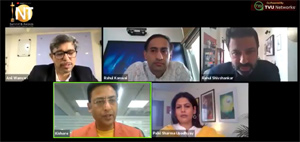
News channels have been roundly criticised for ignoring other important developing issues during the SSR incident, but Kanwal denied the charge. He said that it was not the only story covered by them and they gave equal importance to stories on the economy and the Covid2019 crisis. However, if something goes wrong, it is important to be open to fixing those mistakes, he added.
Wion executive editor Palki Sharma Upadhyay claimed that the TRP currency is flawed and the sample size is too small. Yet, some of the channels are dictated by the system. She also echoed Shivshankar’s view that the flaw of the system can’t be blamed entirely on editors. The blame is on viewers too because they watch those shows. But she also added that editors cannot deny the responsibility that comes with the position. She is of the view that there are various ways to bring revenue other than following the TRP model blindly.
Upadhyay also highlighted another issue that nowadays editors often follow social media agendas to decide primetime rather than applying their mind. Since the top editors themselves are influencers, they can prevent news content from turning into entertainment shows if they unite. Moreover, anchors need to stop being overdramatic as they are the face of news programmes, she added.
News18 India managing editor Kishore Ajwani agreed that primetime shows are identified with anchors. It is their opinion, and how they engage that leaves an impact. “I believe that all of us re-examine the prime time shows every day in all aspects – content, format, guests and others,” he said.
“At the end of the day, it’s a screen and you have got a remote. If you do not like a story, switch the screen. No one has put a gun to your head. We do what we believe should be done,” Ajwani declared.
Amid all the chaos, TRP and advertising have been blamed mostly for deterioration of news content. Times Now’s Shivshankar added that the channels should move to subscription led models gradually. He also noted that a huge chunk of Times Now’s revenue is coming from subscription.







News Broadcasting
Network18 channels lead YouTube news viewership in March 2026
CNN-News18, News18 India and CNBC channels top categories with record views
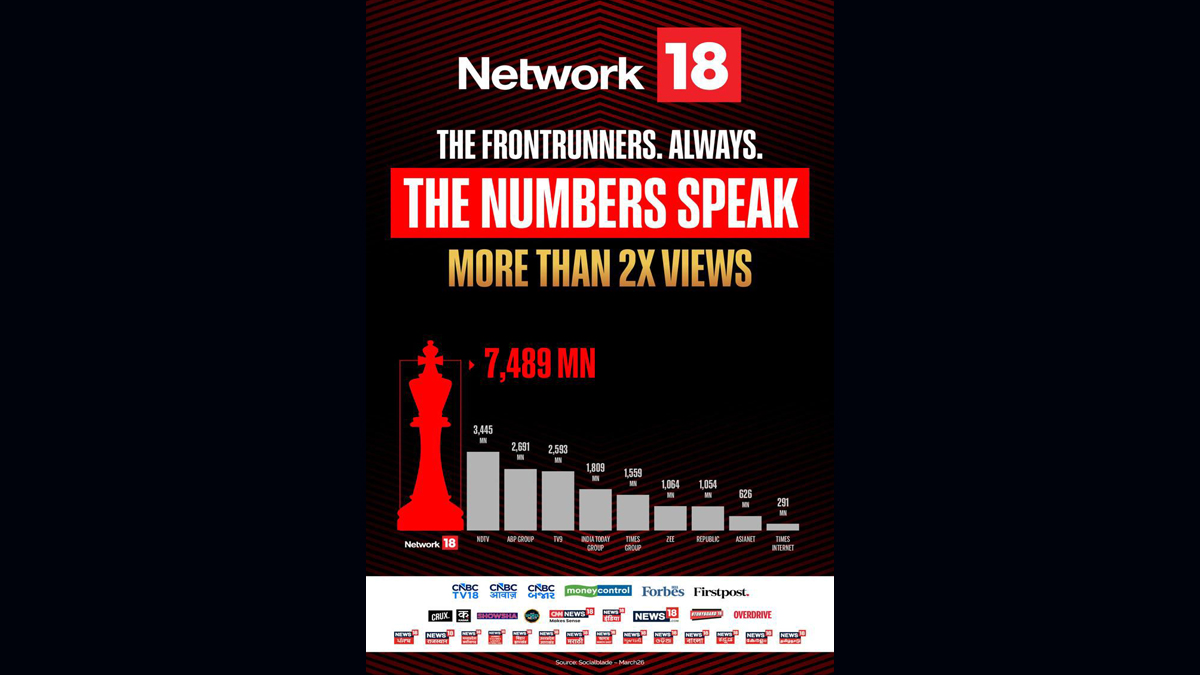
MUMBAI: When the world hit refresh on breaking news, Network18’s channels were already streaming ahead. As geopolitical tensions and war-driven headlines fuelled a surge in global news consumption, the network’s digital playbook delivered big clocking record Youtube viewership across English, Hindi and business news categories in March 2026.
At the forefront was CNN-News18, which emerged as the clear leader in the English news segment with 130 million live and video-on-demand views. The channel edged past competitors such as Times of India (126.5 million), Times Now (101.1 million), India Today (88.2 million) and NDTV (77.5 million), according to Databeings data for March.
In the Hindi news arena, News18 India delivered a commanding performance, racking up a staggering 3,297 million views on YouTube. The channel comfortably outpaced NDTV India, which recorded 3,119 million views, underlining its deep reach and consistent engagement with mass audiences, as per Playboard data.
The network’s dominance wasn’t confined to general news. In the Hindi business segment, CNBC Awaaz topped the charts with 92 million views, narrowly ahead of Zee Business (90 million) and well ahead of ET Now Swadesh (57 million). Meanwhile, its English counterpart CNBC-TV18 posted a strong 58 million views, reinforcing the network’s cross-category strength.
The spike in viewership reflects a broader shift in audience behaviour, with viewers increasingly turning to digital platforms particularly Youtube for real-time updates and in-depth coverage during high-intensity news cycles. For Network18, the numbers signal more than just scale; they underline the effectiveness of a multi-platform strategy that blends speed, credibility and continuous coverage.
In a month where the news never paused, it seems viewers chose to stay tuned where the stream never stopped.






