News Headline
Prasad underscores programme code implementation

NEW DELHI: India’s information and broadcasting minister Ravi Shankar Prasad has said there would be strict implementation of the programming code for TV channels.
In reply to a question by Shyama Singh and Subodh Ray in Lok Sabha (Lower House of parliament) today, Prasad said that the Programme Code provides that care should be taken to ensure that programmes meant for children do not contain any bad language or explicit scenes of violence. The Act also provides that programmes unsuitable for children must not be carried in the cable service at times when the largest numbers of children are viewing.
He said that any programming on TV channels transmitted or retransmitted through the cable television network is required to adhere to the Programme Code prescribed under the Cable Television Networks (Regulation) Act, 1995 and Rules framed there under.
The Programme Code, inter alia, provides that no programmes should be carried in the cable service, which is likely to encourage or incite violence or contains anything against maintenance of law and order or which promote anti-national attitudes, contravenes the provisions of the Cinematograph Act, 1952 and is not suitable for unrestricted public exhibition.
As far as pubcaster Doordarshan is concerned, Prasar Bharati, which is overseeing the functioning of DD and All India Radio, has informed that all serials scheduled for telecast are subjected to preview to ensure conformity with the broadcast code of Doordarshan and suitability for family viewing.
The Act provides that any authorized officer, that is district magistrate or commissioner of police or any other officer notified in the official gazette by the Central Government or the State Government may by order prohibit any transmission re-transmission of any programme or channel if it is not in conformity with the prescribed Programme Code.
The Central Government has also constituted an Inter-Ministerial Committee under Section 20 of the Cable Act to look into the violations of the Programme Code, either suo-moto or on receipt of a specific complaint. The government is vigilant in this regard and is committed to dealing expeditiously and effectively with any breach of the Programme Code, Prasad said.
As regards public exhibition of films, the same are released after certification from the Central Board of Film Certification (CBFC) under the provisions of the Cinematograph Act, 1952 and the guidelines framed there under. The guidelines under the Act, inter alia, provide that the scenes depicting anti-social activities, such as violent modus operandi of criminals, scenes tending to encourage, justify or glamourise drug addiction, glorifying drinking etc., are not depicted and these are being strictly adhered to.
Funds for Doordarshan
An amount of Rs. 10430 million has been provided for in the tenth Five-Year Plan for modernization of DD stations and replacement of old equipment.
Replying to a question by Nivedita Mane and Sadashivrao Dadoba Mandlik in Lok Sabha today, Prasad said that augmentation of facilities at Doordarshan Kendras and replacement of equipment is a continuous process and schemes in this regard are implemented from time to time, depending upon the availability of resources.
Newspaper circulation shrinks
The total circulation of newspapers has come down from over 130 million in 1999 to around 115 million in 2001 as per the claims of newspapers, Lok Sabha was informed today.
The number of newspapers from whom annual statements were received by the Registrar of Newspapers had also come down from 6,032 in 1999 to 4,780 in 2001, Prasad said during Question Hour. Their number in 2000 stood at 5,915.
He said the Economic Times Entertainment had cited the World Advertising Trends 2000 to report that the amount spent on advertisement in print media in 1998 was about Rs 38,200 million.
Asked as to what percentage of ad revenue was being spent for journalists welfare, Prasad said that while the managements of newspapers were primarily responsible for the welfare of their employees including journalists, the expenditure made by them on welfare measures was not reported to the I&B Ministry.
The government, he said, had set up a Journalists Welfare Fund to provide immediate relief to family of journalists who lose their life or suffer permanent disability.
However, the minister did not dwell on the fact whether the drop in newspapers’ circulation has resulted in increased television viewing or if there is some link between the trend in the print medium and the electronic medium.
Part-time correspondents
The government has proposed to engage 278 more part-time correspondents, raising their strength to 524. This will entail additional annual expenditure by approximately Rs. 89 lakhs. The Press Trust of India (PTI) and the United News of India (UNI), India’s two domestic wire services, are being paid annual fee at the rate of Rs 71.016 million and
Rs 57.678 millions respectively. The government is not doing away with the services of PTI and UNI. This was stated by Prasad while replying to a question by Suresh Ramrao Jadhav in Lok Sabha today.







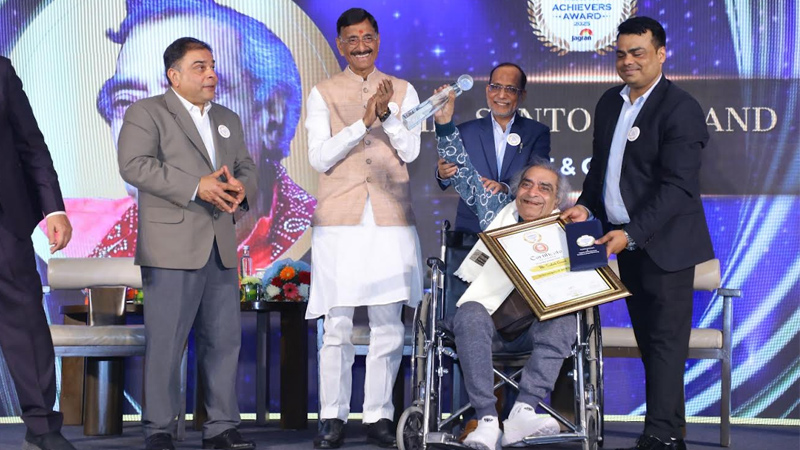
NEW DELHI: Hamdard Laboratories gathered a cross-section of India’s achievers in New Delhi on Friday, handing out the Hakeem Abdul Hameed Excellence Awards to figures who have left their mark across healthcare, education, sport, public service and the arts.
The ceremony, attended by minister of state for defence Sanjay Seth and senior officials from the ministry of Ayush, celebrated individuals whose work blends professional success with a sense of public purpose. It was as much a roll call of achievement as it was a reminder that influence is not measured only in profits or podiums, but in people reached and lives improved.
Among the headline awardees was Alakh Pandey, founder and chief executive of PhysicsWallah, recognised for turning affordable digital learning into a mass movement. On the sporting front, Arjuna Awardee and kabaddi player Sakshi Puniya was honoured for her contribution to the game and for pushing women’s participation onto bigger stages.

The cultural spotlight fell on veteran lyricist and poet Santosh Anand, whose songs have echoed across generations of Hindi cinema. At 97, Anand accepted the honour with characteristic humility, reflecting on a life shaped by perseverance and hope.
Healthcare honours spanned both modern and traditional systems. Manoj N. Nesari was recognised for strengthening Ayurveda’s place in national and global health frameworks. Padma shri Mohammed Abdul Waheed was honoured for his research-backed work in Unani medicine, while padma shri Mohsin Wali received recognition for his long-standing contribution to patient-centred care.
Education and social development also featured prominently. Padma shri Zahir Ishaq Kazi was honoured for decades of work in education, while former Meghalaya superintendent of Police T. C. Chacko was recognised for public service. Goonj founder Anshu Gupta received an award for his dignity-centred rural development initiatives, and the Hunar Shakti Foundation was honoured for empowering women and young girls through skill development.
The Lifetime Achievement Award went to former IAS officer Shailaja Chandra for her long career in public healthcare and governance, particularly in the traditional systems under Ayush.
Speaking at the event, Hamdard chairman Abdul Majeed said the awards were a tribute to those who combine excellence with empathy. “These awardees reflect Hakeem Sahib’s belief that healthcare, education and public service must ultimately serve humanity,” he said.
Minister Seth struck a forward-looking note, saying India’s young population gives the country a unique opportunity to become a global destination for learning, health and wellness by 2047.
The ceremony also featured the trailer launch of Unani Ki Kahaani, an upcoming documentary starring actor Jim Sarbh, set to premiere on Discovery on 11 February.
Instituted in memory of Unani scholar and educationist Hakeem Abdul Hameed, the awards have grown into a national platform that celebrates those building a more inclusive and resilient India. For one evening at least, the spotlight was not just on success, but on service with substance.