News Headline
Poll ads: EC lobs ball back to I&B min

NEW DELHI: Even as the Election Commission today lobbed the ball back into the government’s court today saying that the law is adequate in dealing with the issue of political advertisement on the electronic medium, the information and broadcasting ministry is in a bind as a broad policy decision cannot be taken based on isolated complaints of surrogate
advertising.
The EC has also directed that the government should revert with an action plan by Monday, 29 March on surrogate political ads that have started surfacing on various TV channels.
The EC’s stand on the issue was conveyed journalists today by one of the three election commissioners in the wake of a recent Andhra Pradesh high court ruling quashing EC and the government stand on banning political ads on the electronic medium.
Assistant Commissioner A N Jha told newspersons, “The law under the Cable TV Networks (Regulation) Act 1995 was adequate to deal with the issue.”

India’s elections regulator took up the issue of surrogate political advertisement after the Congress lodged a formal complaint with it, saying that some surrogate political ads on channels made a direct attack on the foreign origin of the party chief, Sonia Gandhi.
One particular ad concerned, issued by a little-known NGO, depicts fleeting images from the freedom movement with the wordings being that once again some people are getting ready to hand over the governance of the country to
foreigners, meaning Italian-born Sonia who is married into the Nehru-Gandhi family and is trying to revive the flagging fortunes of Congress.
A senior Delhi-based advertising personality, on condition of anonymity, lashed out at some of the surrogate ads put out by Bharatiya Janata Party front organisations. “There are ways to slug it out, but the ad on the foreign origin of Sonia Gandhi does not leave anything to the imagination and is bad in taste.”
Taking advantage of the Congress complaint, the EC has also directed the ministry to look into other complaints, some of them that involve those from South India and regional political parties and channels.
Contacted by indiantelevision.com, a senior official of the I&B ministry admitted that some ads, even though surrogate, did not leave anything to the imagination as to who they were targeting and did border on personal attack.
“But to think on a broader plain, the government cannot do much on isolated cases,” the official said, pointing out that may be it is made mandatory to have all political ads for TV channels vetted by the censor board or some such organisation (like Telecom Regulatory Authority of India) to make them palatable under the programming and advertising code of the Cable TV Act.
Though I&B minister Ravi Shankar Prasad could not be reached for comments as he was said to be on a tour outside Delhi, it would be worthwhile to remember what he had said in the past, often: The ban on political ads (on electronic medium) should continue as it would be very difficult to monitor each and every channel and ad for the sake of decency.

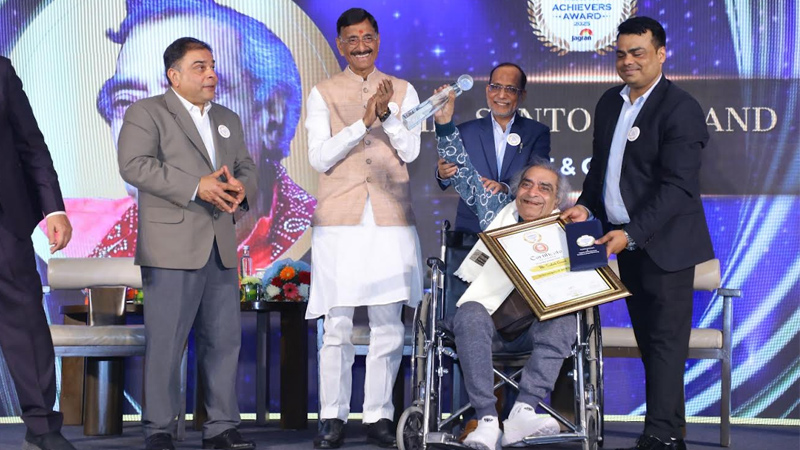
NEW DELHI: Hamdard Laboratories gathered a cross-section of India’s achievers in New Delhi on Friday, handing out the Hakeem Abdul Hameed Excellence Awards to figures who have left their mark across healthcare, education, sport, public service and the arts.
The ceremony, attended by minister of state for defence Sanjay Seth and senior officials from the ministry of Ayush, celebrated individuals whose work blends professional success with a sense of public purpose. It was as much a roll call of achievement as it was a reminder that influence is not measured only in profits or podiums, but in people reached and lives improved.
Among the headline awardees was Alakh Pandey, founder and chief executive of PhysicsWallah, recognised for turning affordable digital learning into a mass movement. On the sporting front, Arjuna Awardee and kabaddi player Sakshi Puniya was honoured for her contribution to the game and for pushing women’s participation onto bigger stages.
The cultural spotlight fell on veteran lyricist and poet Santosh Anand, whose songs have echoed across generations of Hindi cinema. At 97, Anand accepted the honour with characteristic humility, reflecting on a life shaped by perseverance and hope.
Healthcare honours spanned both modern and traditional systems. Manoj N. Nesari was recognised for strengthening Ayurveda’s place in national and global health frameworks. Padma shri Mohammed Abdul Waheed was honoured for his research-backed work in Unani medicine, while padma shri Mohsin Wali received recognition for his long-standing contribution to patient-centred care.
Education and social development also featured prominently. Padma shri Zahir Ishaq Kazi was honoured for decades of work in education, while former Meghalaya superintendent of Police T. C. Chacko was recognised for public service. Goonj founder Anshu Gupta received an award for his dignity-centred rural development initiatives, and the Hunar Shakti Foundation was honoured for empowering women and young girls through skill development.
The Lifetime Achievement Award went to former IAS officer Shailaja Chandra for her long career in public healthcare and governance, particularly in the traditional systems under Ayush.
Speaking at the event, Hamdard chairman Abdul Majeed said the awards were a tribute to those who combine excellence with empathy. “These awardees reflect Hakeem Sahib’s belief that healthcare, education and public service must ultimately serve humanity,” he said.
Minister Seth struck a forward-looking note, saying India’s young population gives the country a unique opportunity to become a global destination for learning, health and wellness by 2047.
The ceremony also featured the trailer launch of Unani Ki Kahaani, an upcoming documentary starring actor Jim Sarbh, set to premiere on Discovery on 11 February.
Instituted in memory of Unani scholar and educationist Hakeem Abdul Hameed, the awards have grown into a national platform that celebrates those building a more inclusive and resilient India. For one evening at least, the spotlight was not just on success, but on service with substance.







