I&B Ministry
PIB’s fact check unit to track fake news for central govt (updated)

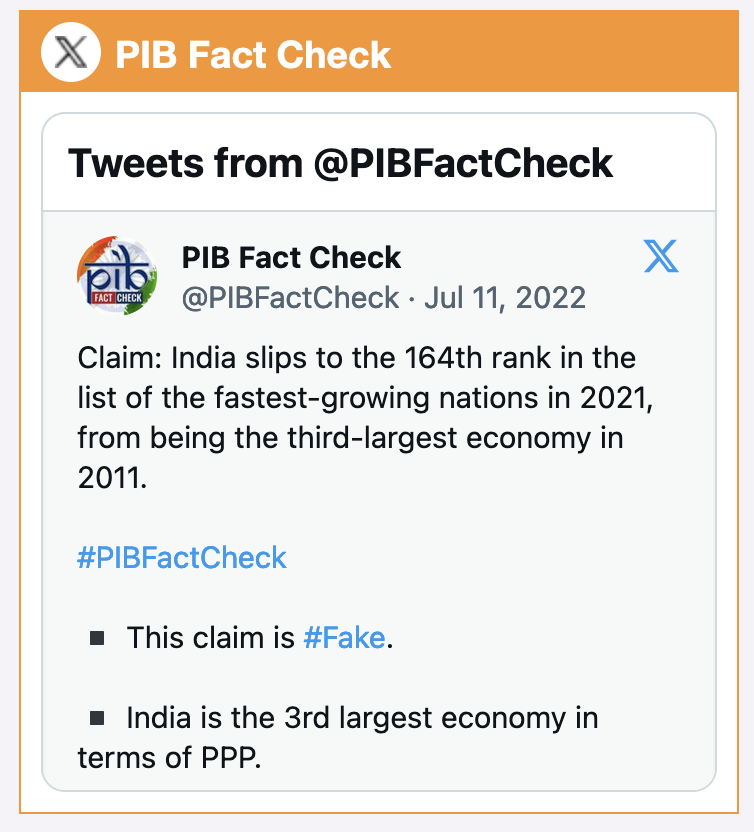
MUMBAI: Fake news perpetrators against the government in Delhi – whether on television, online or in print – had better watch out. The ministry of electronics and information technology (MeitY) along with the ministry of information and broadcasting has notified that the fact check unit (FCU) under the Press Information Bureau (PIB) shall be the central government’s watch dog. This has been done so under rule 3(1)(b)(v) of the of the Information Technology (Intermediary Guidelines and Digital Media Ethics Code) Rules, 2021 (IT Rules 2021).
Since November 2019, the FCU established under PIB has been effectively working with the purpose of tackling fake news pertaining to government policies, schemes, rules and regulations, programmes, initiatives, etc. Through an established rigorous fact-checking procedure, the PIB FCU’s goal is to help in dispelling myths, rumours and false claims, and provides accurate and reliable information to the public.
Meanwhile in an update, the chief justice of India today stayed the notification of the FCU, stating that a challenge to the impugned rule involves serious constitutional questions. “The impact of rule on freedom of speech and expression will fall for analysis by the high court.”

(updated at 3:43 pm on 21 March 2024.)







MUMBAI: When the numbers go silent, the noise on screen gets a little harder to measure. Ministry of Information and Broadcasting has extended the suspension of television rating data for news channels, directing Broadcast Audience Research Council (BARC) to withhold TRPs for another four weeks. The latest order, issued on March 31, 2026, builds on an earlier directive from March 6 that had paused ratings for a month. The ministry has clarified that the blackout will continue for four weeks or until further instructions are issued whichever comes earlier keeping the industry in a prolonged state of data drought.
The reasoning, officials suggest, lies far beyond domestic screens. With geopolitical tensions in West Asia continuing to escalate, the government has flagged concerns over how such developments could influence news consumption and presentation. The move is aimed at curbing excessive sensationalism and speculative coverage during what it describes as a sensitive global moment.
For the broadcast ecosystem, the absence of Television Rating Points (TRPs) is more than symbolic, it removes the industry’s primary scorecard. Ratings dictate advertising flows, shape editorial strategies and fuel the competitive pecking order among news channels. Without them, broadcasters are effectively operating without a public performance benchmark.
The timing only adds to the complexity. Amid a high-intensity global news cycle, channels must now navigate audience engagement without the weekly feedback loop that typically drives programming decisions. Advertisers, too, are left recalibrating, leaning on proxies such as brand strength, reach and distribution instead of hard viewership data.
While framed as a temporary regulatory intervention tied to maintaining public order, the extended suspension underscores a broader unease about the tone and direction of news coverage. For now, the ratings race is on pause but the battle for attention continues, just without a scoreboard.






