News Headline
Parliament standing committee makes a CASe for deferment

NEW DELHI: The Indian Parliament’s Standing Committee on Information Technology, which also looks into issues related to broadcasting and convergence, in its latest report, has made a case for deferment of conditional access system (CAS).
“The committee is of the view that CAS should be implemented systematically in a given time frame by deferring the date fixed, if necessary, keeping in view the interests of the people without disrupting telecast of quality programmes in any manner,” the report says.
Coming down heavily on the government, especially the Information and Broadcasting ministry, the parliamentary panel, headed by Communist Party of
India (Marxist)’s Somnath Chatterjee, states that it is seriously concerned to find that the ministry “arbitrarily decided the cut off date for introduction of CAS without making any in-depth study about the availability of and price of set top boxes.”
Pointing out that import of STBs in large numbers would result in avoidable drain of foreign exchange reserves of the country, the panel, in a scathing criticism of the I&B ministry, has opined: “The committee fails to share the optimism of the ministry that a smooth rollout of CAS will be possible.”
According to the Standing Committee, going by the I&B ministry’s assertion that only one third of the cable TV households would opt for STBs, the number of boxes needed would be 20 lakhs (two million) against the total viewership of 56 lakhs in the four metros. Flaying the ministry for being na?ve, the Standing Committee has noted that the multi-system operators (MSOs) have assured the government of having placed orders for 27 lakh boxes (2.7 million) to be imported, which has not been independently verified by the ministry.
“There appears to be no credible data available with the ministry as regards arrival of the STBs into the country and, it is now, after sensing the serious concern of the committee that the ministry has assured to monitor weekly arrival of STBs,” the parliamentary panel has noted in its report released today, adding that the modest number of 20 lakh boxes to be imported “will amount to outgo of Rs 600 crores (Rs 6 billion).”
The committee has also noted that it is “deeply concerned” that even though CAS is to be rolled out within the next few days, yet many of the important issues agitating the public and having financial implications have not been resolved.
Dwelling on the basic tier of free to air channels, the parliamentary panel has said it fails to understand why the government has kept the number of minimum number of FTA channels to 30 when broadcasters are ready to provide upto 90 FTA channels.
“The consumer would have no choice with regard to channels to be provided in the basic tier,” it has been pointed out by the panel that has further said the government ought to ensure that the subscribers are able to exercise choice in matters of channels to be available in the basic tier and make suitable amendments in the law in this regards.
Some of the other issues that have been listed by the committee as concerns are as follows:
* In addition to the high cost of the boxes, its inapplicability in case a subscriber shifts residence and switches over to another MSO has not been resolved.
* Though the MSOs/cable operators cannot force the consumer to buy a particular type of box, it becomes clear from the ministry’s submission that MSOs would opt for costly digital boxes.
* Lack of complaint redressal mechanism in the relevant Act and/or in the subsequent notifications.
* As per an Indian Broadcasters Foundation submission, availability of boxes would only be to the tune of four to five per cent of the requirement, which is likely to lead to a blackout.
* Pay channels’ rates are transparent and bundling is avoided.






NEW DELHI: Hamdard Laboratories gathered a cross-section of India’s achievers in New Delhi on Friday, handing out the Hakeem Abdul Hameed Excellence Awards to figures who have left their mark across healthcare, education, sport, public service and the arts.
The ceremony, attended by minister of state for defence Sanjay Seth and senior officials from the ministry of Ayush, celebrated individuals whose work blends professional success with a sense of public purpose. It was as much a roll call of achievement as it was a reminder that influence is not measured only in profits or podiums, but in people reached and lives improved.
Among the headline awardees was Alakh Pandey, founder and chief executive of PhysicsWallah, recognised for turning affordable digital learning into a mass movement. On the sporting front, Arjuna Awardee and kabaddi player Sakshi Puniya was honoured for her contribution to the game and for pushing women’s participation onto bigger stages.

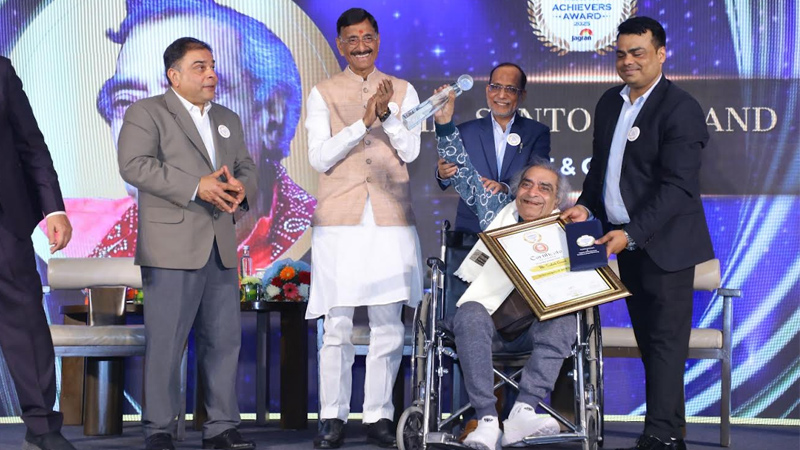
The cultural spotlight fell on veteran lyricist and poet Santosh Anand, whose songs have echoed across generations of Hindi cinema. At 97, Anand accepted the honour with characteristic humility, reflecting on a life shaped by perseverance and hope.
Healthcare honours spanned both modern and traditional systems. Manoj N. Nesari was recognised for strengthening Ayurveda’s place in national and global health frameworks. Padma shri Mohammed Abdul Waheed was honoured for his research-backed work in Unani medicine, while padma shri Mohsin Wali received recognition for his long-standing contribution to patient-centred care.
Education and social development also featured prominently. Padma shri Zahir Ishaq Kazi was honoured for decades of work in education, while former Meghalaya superintendent of Police T. C. Chacko was recognised for public service. Goonj founder Anshu Gupta received an award for his dignity-centred rural development initiatives, and the Hunar Shakti Foundation was honoured for empowering women and young girls through skill development.
The Lifetime Achievement Award went to former IAS officer Shailaja Chandra for her long career in public healthcare and governance, particularly in the traditional systems under Ayush.
Speaking at the event, Hamdard chairman Abdul Majeed said the awards were a tribute to those who combine excellence with empathy. “These awardees reflect Hakeem Sahib’s belief that healthcare, education and public service must ultimately serve humanity,” he said.
Minister Seth struck a forward-looking note, saying India’s young population gives the country a unique opportunity to become a global destination for learning, health and wellness by 2047.
The ceremony also featured the trailer launch of Unani Ki Kahaani, an upcoming documentary starring actor Jim Sarbh, set to premiere on Discovery on 11 February.
Instituted in memory of Unani scholar and educationist Hakeem Abdul Hameed, the awards have grown into a national platform that celebrates those building a more inclusive and resilient India. For one evening at least, the spotlight was not just on success, but on service with substance.






