iWorld
OTT experts discuss future of India’s hybrid market

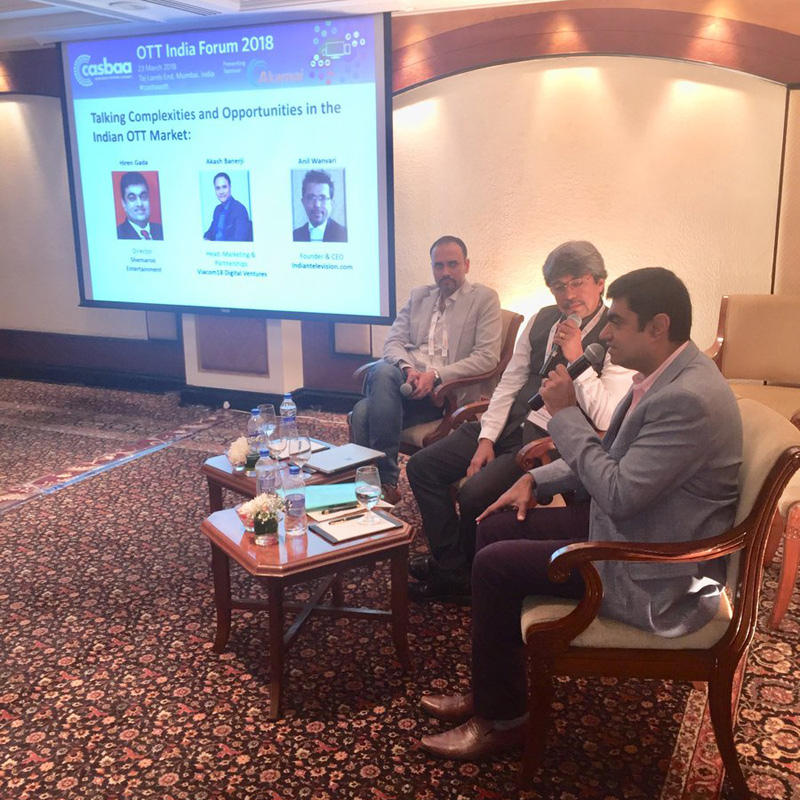
MUMBAI: The new dawn of media industry in India is experiencing a complex co-existence of traditional and digital media. With enhanced internet penetration, over the top (OTT) players have started gaining a strong foothold as well as being challenged by the threat from international leaders of the game. The OTT industry is maturing by exploring new opportunities in the hybrid Indian market.
To discuss the complexity of the market including problems like piracy, lack of regulatory practices, monetisation, business models, and emerging technologies, experts from different sectors convened at the Cable and Satellite Broadcasting of Asia (CASBAA) OTT India forum 2018.
Network18 Digital CEO Manish Maheshwari started off the session with a keynote by explaining how data explosion in the last two years has changed the scenario of video consumption in India. The launch of Reliance Jio in September 2016 led to widespread adoption of 4G technology. Consumption pattern has become more individualised, something that most speakers agreed upon. OTT services have directly jumped to mobile, giving better user interactivity.

During this tricky transition, the platforms are experimenting with various kinds of business models. Foreign players heavily depend on SVOD but Indian players mainly use AVOD but intend to shift to SVOD in the future. A new B2B2C model is also emerging.
Indiantelevision.com founder, CEO and editor in chief Anil Wanvari moderated the session with Shemaroo Entertainment CEO Hiren Gada, Viacom18 senior VP, head of marketing, licencing and partnerships at Voot Akash Banerji and ZEE5 digital head Archana Anand. Speaking on the issue of monetising properties, Banerji said that it has to be looked at as an opportunity and not a challenge. Experts agreed that if content creators can come up with quality content, subscribers will not hesitate to pay with Netflix being a classic example.
Internet’s reach to even the remotest parts of the country has not restricted OTT to be just an urban phenomenon. The rural appetite for content is growing and so not just local players but even international names like Amazon and Netflix are eager to feed them. They are even banking on blockbuster content. The myth that the internet was only reserved for short format content has been broken and so longer ones are on the rise.
Due to factors like social category and economic status, Indian consumers won’t pick a single type of content or model. “Hybrid market will exist as long as India continues to be hybrid,” said ZEE5 digital head Archana Anand.
Other than content, the low-latency end user experience is also very important to satisfy the audience. Though the infrastructure is still evolving in India, the content delivery market is in a promising state. Many measures are also being taken to curb the issue of piracy. Discussions are also going on to bring the OTT players under a regulation but with liberty.
By creating content of different flavours, experimenting with business models, discussions on a regulatory body and developing infrastructures, the OTT market in India is maturing with both opportunities and challenges. To sustain in the race, the platforms should choose either a niche strategy or a way to reach the mass but not a midway definitely.
Also Read:
OTT driving Taiwan multichannel video: CASBAA study
CASBAA elects new board directors
CASBAA lauds India; calls for more broadcast, satellite reforms







iWorld
Cineflicks set to enter India’s OTT market with community-first focus
New platform aims to blend streaming content with interactive viewing experiences

MUMBAI: A new player is gearing up to join India’s crowded streaming arena, with Cineflicks preparing to launch as a community-driven OTT platform aimed at redefining how audiences engage with digital entertainment.
The platform plans to offer a mix of movies, series and digital content, while placing equal emphasis on building an interactive ecosystem where viewers can connect, share and participate beyond passive viewing.
India’s OTT market has seen explosive growth over the past decade, fuelled by rising smartphone penetration and affordable internet access. As streaming becomes the default mode of content consumption, new entrants are increasingly looking to differentiate themselves not just through content libraries but through user experience.
Cineflicks appears to be positioning itself within this next phase of evolution. Instead of focusing solely on scale, the platform is aiming to create a space where audiences can engage more deeply with the content they watch, turning entertainment into a shared experience rather than a solo activity.
While details around its content slate remain under wraps, people familiar with the development say the platform is currently building out features and partnerships ahead of a phased rollout. The broader strategy suggests a blend of content discovery, community interaction and digital participation.
The timing is notable. With global and regional streaming platforms competing intensely for attention, the emphasis is slowly shifting towards engagement and retention rather than just acquisition. Platforms that can foster stronger audience connections may have an edge in this evolving landscape.
Cineflicks’ entry reflects the continued expansion of India’s digital entertainment ecosystem, where innovation is increasingly being driven by how content is experienced, not just what is offered.
As the platform moves closer to launch, the real test will be whether it can translate its community-first pitch into a compelling, everyday habit for viewers.







