News Broadcasting
‘Oswald the Lucky Rabbit’ returns to Disney from NBCc

MUMBAI: Disney president and CEO Robert A. Iger announced the return of Oswald the Lucky Rabbit to The Walt Disney Company by agreement with NBC/Universal, the company that had previously owned the rights to Oswald since its theatrical debut in 1927.
“As the forerunner to Mickey Mouse and an important part of Walt Disney’s creative legacy, the fun and mischievous Oswald is back where he belongs, at the home of his creator and among the stable of beloved characters created by Walt himself,” said Iger.
“When Bob was named CEO, he told me he wanted to bring Oswald back to Disney, and I appreciate that he is a man of his word. Having Oswald around again is going to be a lot of fun,” said Walt Disney’s daughter Diane Disney Miller.

When Walt Disney opened his animation studio in 1923, he spent four years producing The Alice Comedies, a popular series of shorts featuring a live girl in a cartoon world. After four years, Walt created a new character – Oswald the Lucky Rabbit.
Walt Disney produced 26 Oswald cartoons, which were distributed by Universal and well-received by audiences. However, on a trip to New York to renew his contract for Oswald, he discovered a clause in his contract that gave Universal ownership of his popular new character. On the train ride back to Hollywood, he was devastated but realised he needed to create a new character – one that he would own entirely – and during that long trip across the country, Mickey Mouse was born.
This transfer of ownership is part of an agreement permitting sportscaster Al Michaels to contract with NBC. In the transaction ESPN also acquired significant programming and promotional rights, including telecast rights to the live Friday coverage of four Ryder Cup golf championships through 2014, expanded video highlights for the Olympics through 2012, video promotion for ESPN’s Monday Night Football during NBC’s Sunday night football through 2011, and expanded highlight rights for other NBC Sports properties through 2011.






News Broadcasting
Network18 channels lead YouTube news viewership in March 2026
CNN-News18, News18 India and CNBC channels top categories with record views
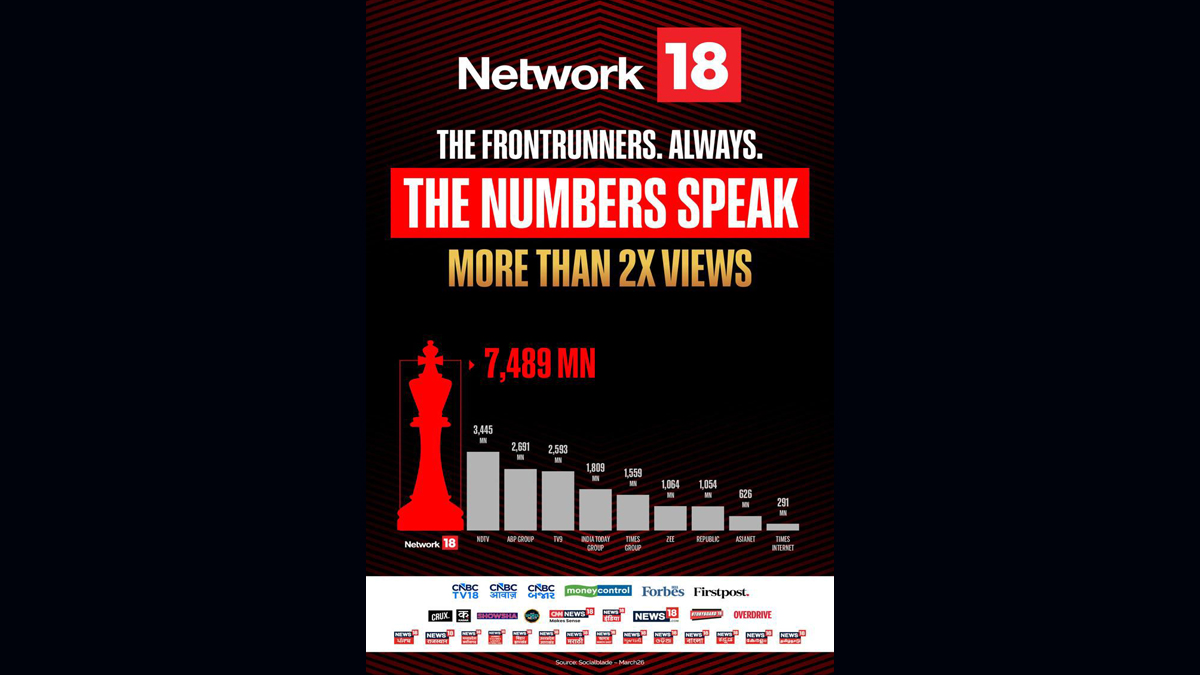
MUMBAI: When the world hit refresh on breaking news, Network18’s channels were already streaming ahead. As geopolitical tensions and war-driven headlines fuelled a surge in global news consumption, the network’s digital playbook delivered big clocking record Youtube viewership across English, Hindi and business news categories in March 2026.
At the forefront was CNN-News18, which emerged as the clear leader in the English news segment with 130 million live and video-on-demand views. The channel edged past competitors such as Times of India (126.5 million), Times Now (101.1 million), India Today (88.2 million) and NDTV (77.5 million), according to Databeings data for March.
In the Hindi news arena, News18 India delivered a commanding performance, racking up a staggering 3,297 million views on YouTube. The channel comfortably outpaced NDTV India, which recorded 3,119 million views, underlining its deep reach and consistent engagement with mass audiences, as per Playboard data.
The network’s dominance wasn’t confined to general news. In the Hindi business segment, CNBC Awaaz topped the charts with 92 million views, narrowly ahead of Zee Business (90 million) and well ahead of ET Now Swadesh (57 million). Meanwhile, its English counterpart CNBC-TV18 posted a strong 58 million views, reinforcing the network’s cross-category strength.
The spike in viewership reflects a broader shift in audience behaviour, with viewers increasingly turning to digital platforms particularly Youtube for real-time updates and in-depth coverage during high-intensity news cycles. For Network18, the numbers signal more than just scale; they underline the effectiveness of a multi-platform strategy that blends speed, credibility and continuous coverage.
In a month where the news never paused, it seems viewers chose to stay tuned where the stream never stopped.






