Cable TV
Ortel to increase cable TV penetration, broadband with IPO funds


MUMBAI: Odisha based last mile owner (LMO) Ortel Communications, which filed its Red Herring Prospectus (RHP) for a public issue on 21 February, has now announced the price band of Rs 181-Rs 200 per equity share.
As reported first by Indiantelevision.com, the LMO will open the public issue of up to 12 million equity shares of face value of Rs 10 each including a share premium per equity share on 3 March. The issue comprises a fresh issue to the public of up to six million equity shares and an offer for sale up to six million equity shares by New Silk Route (NSR). The bid will close on 5 March.

The minimum bid lot is 75 equity shares and in multiples of 75 equity shares thereafter. The issue constitutes 39.25 per cent of the fully diluted post-issue paid up equity share capital of the company.
In a press conference, held in Mumbai on 24 February, the LMO said that the company and the selling shareholder may, in consultation with the Book Running Lead Manager, allocate up to 60 per cent of the QIB portion to anchor investors at the Anchor Investor Allocation Price, on a discretionary basis, out of which at least one-third will be available for allocation to domestic mutual funds only. Anchor investors can bid on 2 March.
“The issue is being made through the Book Building Process in compliance with the provisions of Regulation 26(2) of the Securities and Exchange Board of India (Issue of Capital and Disclosure Requirements) Regulations, 2009, as amended, wherein at least 75 per cent of the issue shall be allotted on a proportionate basis to Qualified Institutional Buyers (QIB). In the event of under-subscription or non-allocation in the Anchor Investor Portion, the balance equity shares shall be added to the net QIB potion. Such number of equity shares representing five per cent of the net QIB portion shall be available for allocation on a proportionate basis to mutual funds only. The remainder of the net QIB portion shall be available for allocation on a proportionate basis to QIBs,” says the company release.
“However, if the aggregate demand from mutual funds is less than 180,000 equity shares, that is five per cent of the net QIB portion, the balance equity shares available for allocation in the mutual fund portion will be added to the net QIB portion and allocated proportionately to QIBs in proportion to their bids. If 75 per cent of the issue cannot be allocated to QIBs, all the application monies will be refunded forthwith. Further, not more than 15 per cent of the issue shall be available for allocation on a proportionate basis to non-institutional bidders and not more than 10 per cent of the issue shall be available for the allocation to retail individual bidders, subject to valid bids being received from them at or above the issue price,” it further reads.
Ortel Communications, through the IPO, is looking at strengthening its presence in the current four states, including Odisha, Chhattisgarh, West Bengal and Andhra Pradesh as well as expanding to other neighbouring regions. The LMO currently offers services in 48 towns with over 21,600 km of cable supported by 34 analogue and five digital headends.
When asked about the reason for raising capital, Ortel Communications chairman BJ Panda said, “We have already gone for three rounds of private equity funding. Ours is a CAPEX heavy business. As we go forward, it is essential to have public presence. The time has come, when the company has some currency to scale up.”
The revenue generated through the IPO will be used for:
– Deeper penetration: Ortel plans to expand its penetration in not only the existing markets, but also new geographies. “The plan is to grow the number of subscribers,” said Panda.
– Increasing penetration of digital TV: As the nation is moving towards digitisation, Ortel Communications currently has converted 20 per cent of analogue homes to digital homes. The revenue generated will be used at slowly increasing the number of digital homes.
– Increasing Broadband: Currently 11 per cent of Ortel’s total subscribers are broadband consumers. The aim now is to take this up. The LMO currently provides data services at a speed of up to 42.88 mbps through the use of cable modem with DOCSIS 2.0. “We are in the process of upgrading the modems to DOCSIS 3.0. This is currently being tested, and has the capacity of providing broadband at a speed of over 340 mbps,” informed Ortel Communications president and CEO Bibhu Prasad Rath.
– Expand: By buyout of local cable operators and networks. The company so far has entered into agreements with over 490 MSOs/LCOs between April 2009 to December 2014, resulting in an acquisition of 221,155 cable television subscribers.
– Leasing fibre infrastructure to corporates.
As of 31 December, 2014, the company has 372,979 retail subscribers for analogue cable TV services, 95, 295 retail subscribers for our digital cable services and 58,277 broadband subscribers, including 121 corporate customers with provisioned bandwidth of 806 mbps adding up to 526,551 Revenue Generating Units (RGUs).
For the six months period ending 30 September, 2014, the company’s total income was Rs 719.34 million and its PBDIT was Rs 252.39 million. In the same period, carriage and placement revenue contributed 17.11 per cent of the total revenues from operations. The trade receivables were at Rs 216.50 million i.e. 15.05 per cent of total income annualised, which according to the company, was substantially lower than other listed national MSOs.






Cable TV
Hathway Cable appoints Gurjeev Singh Kapoor as CEO
Leadership change comes as cable TV faces shrinking subscriber base and modest earnings pressure
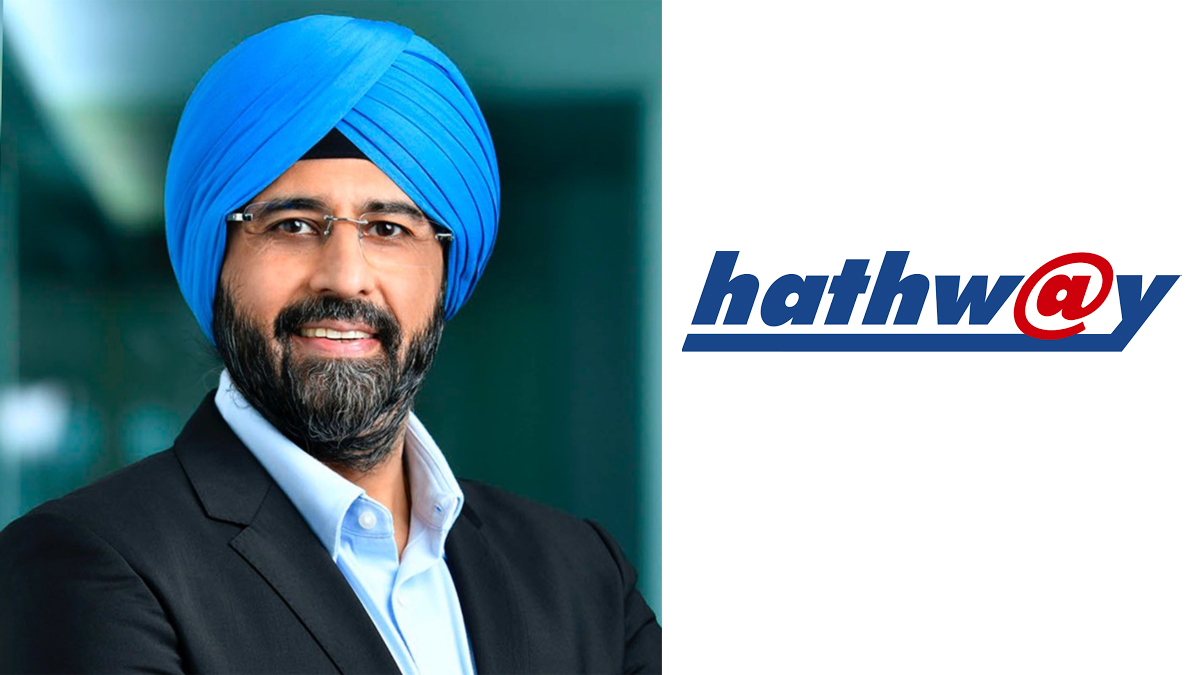
MUMBAI: Hathway Cable and Datacom has tapped industry veteran Gurjeev Singh Kapoor as chief executive officer, marking a leadership pivot at a time when India’s cable television business is under mounting strain.
Kapoor will take over from Tavinderjit Singh Panesar, who is set to retire in August after a long innings with the company. Panesar, chief executive since 2023, has held multiple leadership roles at Hathway, including his latest stint beginning in 2022.
Kapoor brings more than three decades of experience in media and entertainment. He most recently led distribution at The Walt Disney Company’s Star India business, now part of JioStar. His career spans television distribution and affiliate partnerships, with stints at Sony Pictures Networks India, Discovery Communications and Zee Entertainment.
Panesar, with over three decades in the industry, has worked across strategic planning, distribution and business development in media, broadcasting and manufacturing. His past associations include ESPN Star Sports, Star India, Apollo Tyres and JK Industries.
The transition lands as the cable sector grapples with structural disruption. Traditional operators are losing ground to streaming platforms, while telecom and broadband players tighten the squeeze with bundled offerings.
An EY report estimates India’s pay-TV base could shrink by a further 30 to 40 million households by 2030, taking the total down to 71 to 81 million. The slide follows a loss of nearly 40 million homes between 2018 and 2024, a contraction that has already wiped out more than 37,000 jobs in the local cable operator ecosystem.
Hathway’s numbers reflect the strain. The company reported a consolidated net profit of Rs 93 crore for FY25, down from Rs 99 crore a year earlier. Revenue inched up to Rs 2,040 crore from Rs 1,981 crore. As of December 2025, it had about 4.7 million cable TV subscribers and roughly 1.02 million broadband users.
Kapoor steps in with a familiar brief but a shrinking playbook. In a market where viewers are cutting cords faster than companies can reinvent them, the new chief executive inherits a business fighting to stay plugged in.







