iWorld
Online video thrives: Local content vital for subscriber growth


Mumbai: The Asia Video Industry Association held its annual OTT Summit in Singapore on 5 December, where over 90 per cent of the speakers were senior female executives from across the video industry in Asia Pacific. This year’s summit was designed to try and redress the gender imbalance seen in many industry conferences.
The Summit opened with Media Partners Asia lead analyst, head of content & platform insights Dhivya T presenting an overview of the state of streaming in Asia, a market where competition was very much driven by a battle for share of time, with premium video on demand (VOD) fighting with social media and user-generated content (UGC).
Competition was also giving rise to new business models and strategies beyond the traditional AVOD and SVOD models, including mobile gaming, e-commerce and bundle subscriptions becoming more common. And with a higher focus on increasing ARPUs, price increases have also become prevalent.

Ex-China, online video revenues in Asia Pacific were expected to hit US$46 billion in 2028, up from US$29 billion this year. While SVOD was expected to have a CAGR of 6.4 per cent, premium AVOD will see a growth rate of almost 18 per cent, led by Japan, India, and Korea. In Southeast Asia, Indonesia was emerging as the leading market for AVOD, with Thailand for SVOD.
In terms of content trends and investment, although pay TV remained the largest vertical, online video was the growth engine of video content investment, with local and Asian content leading premium VOD viewership with the highest reach. Hence local content remained key to acquiring subscribers in the region, and constantly over-indexing with new users.
In the world of streaming, Free Ad-Supported Streaming TV (FAST) was also much talked about at the summit as the new kid on the block, as it mimicked the experience of linear TV, delivering scheduled content, with advertising included. Driving the growth of FAST in Asia was the penetration of Smart TVs in the region, with 80 per cent of OTT viewers in APAC using Connected TV (CTV), and with one-third of OTT viewing on CTV, shared Samsung Ads APAC Head of Product Marketing Samantha Cooke, But FAST channels were not always about making money, as FAST was also used for marketing, outreach and brand building, added Brightcove senior product marketing manager Roberta Cambio.
Senior marketers from the major platforms too chimed in on the importance of brand building, as the mantra was no longer acquiring subscribers at all costs but focusing on keeping the ones you have. For Shemaroo Entertainment chief marketing officer Anuja Trivedi, marketing was now more aligned with the business, as consumers who saw campaigns engaged better as well. And partnerships which build more value can only build more excitement for the product and engagement for the platform, said Trivedi Akamai Technologies Senior Solutions Engineer Sarah Lim also added that people, platform and technology were what will help drive your strategy forward for the future. “Marketing is greater than the sum of its parts,” said Lim.
With 71 per cent of viewers in APAC watching advertising-supported streaming on top of linear TV viewing, Chair for Media & Measurement, AAMS & CEO, OMG Singapore Chloe Neo was also seeing growth from regional clients with a greater inclination to look at branding, with the reallocation of budgets into OTT tending to be from the big brands, due to their expectations on quality content. While 20/F Leighton Centre, 77 Leighton Road, Causeway Bay, Hong Kong | 5008 Ang Mo Kio Avenue 5, #04-09 Techplace II Singapore 569874 avia.org investment was coming from the linear TV side, more clients were now embracing CTV and addressability for strategic benefit, and not just for incremental reach, added GroupM CIO Southeast & North Asia, Chair, APAC Investment Committee Anita Munro.
A strong focus on content closed off the Summit, with panellists agreeing that Asian content could not be lumped together. There was a huge variety within what is labelled Chinese or Indian content. ZEE5 chief content officer Hindi originals Nimisha Pandey emphasised that storytelling trumped investment. “Audiences don’t care how much money has gone into content, if it connects, it connects,” she said.
Viu chief of content acquisition and development Marianne Lee noted, “Each local market has their own strategy which complements the regional strategy. While it is important for the content to travel outside, the content must also do well locally,” said Lee. In agreement, ASTRO director of content Agnes Rozario added, “There will always be certain types of content that travel better than others. But it has to work in the home market first.”
One market which saw things a little differently was Thailand where True Corporation deputy director of planning & business development strategic content group Kirana Cheewachuen saw huge potential in the overseas growth and popularity of Thai content, and international success was her primary goal.
Sharing her strategy for the Pacific Rim in the closing session, Paramount ANZ, EVP chief content officer head of paramount + Beverly McGarvey said that Australia was a mature market at a pivotal point now as audiences were adjusting between more traditional legacy media and streaming. Hence accelerating growth in streaming while maintaining linear businesses and making content that can work across platforms was what was needed to remain viable.
The OTT Summit is proudly sponsored by Gold Sponsors Brightcove, INVIDI, Nagra, Warner Bros Discovery; Silver Sponsors Akamai, Broadpeak, CDNetworks, Irdeto, Moloco, Publica, PubMatic, Shemaroo; Bronze Sponsor Dolby.




Gaming
India’s broadcasters say no to Fifa World Cup 2026
Fifa has slashed its asking price by 65 per cent but India’s broadcasters are still not buying

MUMBAI: The world’s biggest sporting event cannot find a single taker in the world’s most sports-mad nation. Fifa’s television rights for the 2026 World Cup remain unsold in India, and the clock is ticking loudly.
To shift the property, world football’s governing body has already swallowed hard and cut its asking price from $100m to $35m, bundling in the 2030 edition as a sweetener. It has not worked. Indian broadcasters have looked at the offer, done the sums and quietly walked away.
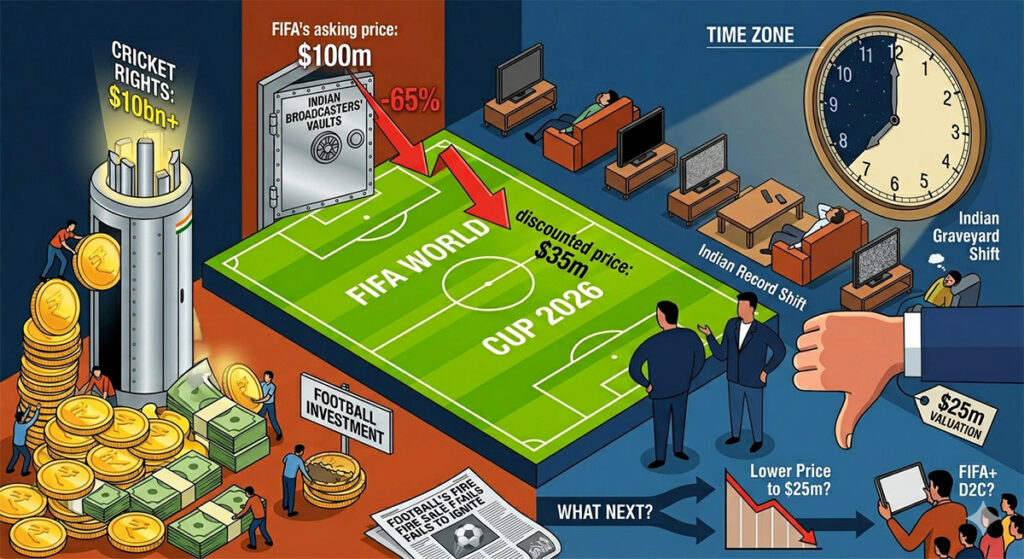
The reasons are brutally simple. The 2026 tournament, co-hosted by the United States, Canada and Mexico, kicks off in a time zone that turns India’s primetime into a graveyard shift. Most matches will air between midnight and 7am IST, a scheduling catastrophe for advertisers chasing mass reach. The 2022 Qatar edition was a gift by comparison, with matches dropping neatly into Indian evenings. North America offers no such luxury.
The market itself has also changed beyond recognition. The merger of Star India and Viacom18 into JioStar has gutted the competitive tension that once sent sports rights prices soaring. Where rival bidders once slugged it out, there is now a single dominant buyer, and it is in no hurry. JioStar has valued the rights at roughly $25m, a full $10m below Fifa’s already-discounted floor price. That gap has so far proved unbridgeable.
Broadcasters are also nursing a ferocious cricket hangover. Between 2022 and 2023, Indian media houses committed well over $10bn to cricket rights alone, covering IPL, ICC events and BCCI domestic fixtures combined. After a binge of that scale, appetite for a football package that delivers a fraction of the ratings, in the dead of night, is close to zero.
The economics of football broadcasting make the maths even harder. Cricket, with its natural breaks every few overs, is an advertiser’s paradise. Football offers a 15-minute halftime and precious little else. Recovering a nine-figure rights fee from a single half-hour ad window is a stretch at the best of times. These are not the best of times: the Indian government’s tightening grip on real-money gaming and gambling advertising has vaporised a category that once underwrote the economics of big sporting events.
Nor is the World Cup an anomaly. Indian Super League valuations have cratered. English Premier League rights have softened across successive cycles. The cooling of football as a broadcast commodity in India is structural, not cyclical.
With the tournament opening on 11th June, Fifa is running out of road. It may yet blink and meet JioStar at $25m. Or it may go direct, streaming the entire tournament on its own platform, Fifa+, or cutting a digital deal with YouTube, and hoping that a generation of Indian football fans finds its way there without a broadcaster to guide them.
Either way, the beautiful game’s Indian chapter is looking decidedly ugly.







