News Broadcasting
Online and mobile players go for the goal


MUMBAI: With the biggest event in the global sporting calendar, the 2006 Fifa World Cup in Germany, just four days away, web sites and mobile phone platforms have beefed up their football content to attract viewers and advertisers.
For websites, it is an opportunity to attract Indian sports buffs and for advertisers it will be a classic opportunity to get their message across. According to estimates by the Internet and Mobile Association of India, for larger portals, the incremental jump in advertising revenues will be anywhere between 8 – 15 per cent.
Internet use in India has grown exponentially since 2002, when the last World Cup tournament was held. In 2002, the number of internet users were about eight million as compared to today’s 38.5 million. Consumption of sports infotainment online too has grown significantly in the last four years in India.

Yahoo! India director sales Pearl Uppal is upbeat about the prospects for the event. “We see high potential in online advertising for the soccer World Cup. Yahoo! is hosting the official site of the 2006 Fifa World Cup. Further, we expect an estimated 32 million unique users to consume over four billion pages of the 2006 official Fifa World Cup site. We see high engagement of our users with Yahoo! India Sports.”
As an official Fifa World Cup partner, Yahoo! is bringing unique World Cup experience both online and on mobile. This will provide advertisers with a proposition and consistent platform with which to tap into audiences’ passion for football and the Fifa World Cup. Yahoo! is offering opportunities to advertisers to immerse the brand within an engaged content experience and to run innovative promotions on their online and mobile platforms.
Rediff.com India Ltd chief media revenue officer Aravindra Kanwal said, “Traffic will be strong and we should see a 50 – 100 per cent spike (visitors to the web site) for some matches.”
Rediff.com, besides having match schedules online, also has trivia related to the World Cup, a countdown to the beginning of the activity, full coverage of past tournaments, international and national and also an online football store to enable users to purchase their favourite football memorabilia. There is a Fifa World Cup 2006 Gaming Zone, which allows a user to participate in a game to test their memory and concentration.
“Web sites are pulling out the stops to attract viewers and advertisers. At Rediff.com, editorial teams are working on different formats and plan to offer advertisers opportunities to integrate mobile and internet mediums with print, TV and radio. HT plans to create more than 100 pages of micro-sites promoted across the site,” said HT Media Ltd head sales and alliances Salil Kumar.
Sify.com head of consumer channels Ajay Nambiar said, “Corporates are showing a very high degree of interest in the World Cup focused websites, knowing full well that the World Cup has captured the imagination of the youth in particular. Maruti Swift is one of the sponsors on Sify. Several other corporates are talking to us and Sify’s special section will see multiple advertisers and sponsors targetting the football fan.”
The Sify World Cup special on the web site features videos of venues, teams, players, past tournaments and preparations, apart from news reports and features, off-beat stories, contests, best of blogs, interactives, video-based quizzes, etc. During the cup, live tickers, news reports, features, image galleries, audio commentary and videos will capture the excitement of the Cup.
The 2006 football World Cup in Germany also represents an opportunity to promote 3G. However, according to a study ‘World Cup 2006: Scoring with mobile content and services’ published by research company Visiongain, it will be established content, such as text-based services that will generate the most significant revenue.
The study found that the one-month long tournament will generate $6.35 billion in revenue, with text-based services and downloads, such as ring tones and logos, being the most significant.
Gaming will also contribute to profits earned by World Cup related content. The industry will also look to generate revenue through interactive video messaging, video clips and even blogging services. The key revenue generators will be tried and tested text services, ring tones and logos. The content of the World Cup lends itself well to highlights clips, which operators have been busy purchasing the rights for, as well as mobile gambling.
Airtel in India, thanks to it being a member of the Bridge Mobile Alliance and Mobile ESPN partnership, has been providing its users with a dedicated news section on the World Cup 2006 from 23 May to 9 July 2006. For example, ESPN Here We Go will provide the latest match insights from ESPN Star Sports presenters and football pundits as they bring match previews, predictions, analysis, previous day highlights and team news from the World Cup.
SportsCenter will enable fans to keep track of the latest sports in action, around-the-world coverage on top sports stories, with special reports on the World Cup match updates, summaries and results. Other sports content service offerings available for download include Java games, wallpapers of popular football players and player tunes to name a few.







News Broadcasting
Network18 channels lead YouTube news viewership in March 2026
CNN-News18, News18 India and CNBC channels top categories with record views
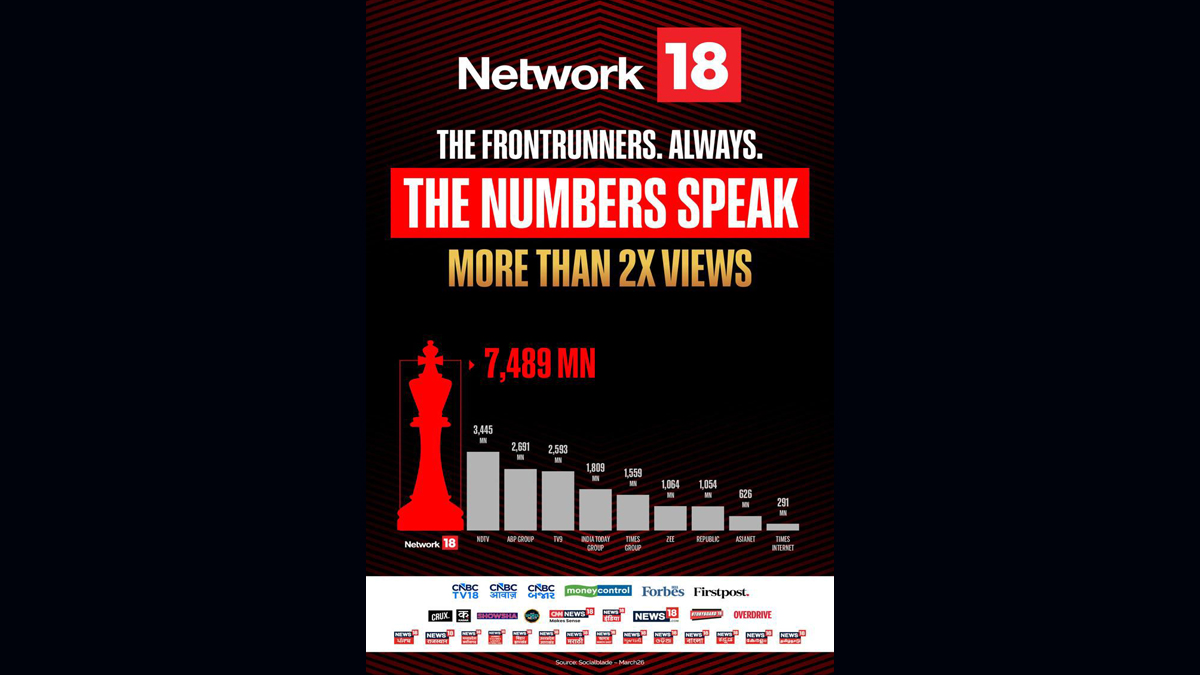
MUMBAI: When the world hit refresh on breaking news, Network18’s channels were already streaming ahead. As geopolitical tensions and war-driven headlines fuelled a surge in global news consumption, the network’s digital playbook delivered big clocking record Youtube viewership across English, Hindi and business news categories in March 2026.
At the forefront was CNN-News18, which emerged as the clear leader in the English news segment with 130 million live and video-on-demand views. The channel edged past competitors such as Times of India (126.5 million), Times Now (101.1 million), India Today (88.2 million) and NDTV (77.5 million), according to Databeings data for March.
In the Hindi news arena, News18 India delivered a commanding performance, racking up a staggering 3,297 million views on YouTube. The channel comfortably outpaced NDTV India, which recorded 3,119 million views, underlining its deep reach and consistent engagement with mass audiences, as per Playboard data.
The network’s dominance wasn’t confined to general news. In the Hindi business segment, CNBC Awaaz topped the charts with 92 million views, narrowly ahead of Zee Business (90 million) and well ahead of ET Now Swadesh (57 million). Meanwhile, its English counterpart CNBC-TV18 posted a strong 58 million views, reinforcing the network’s cross-category strength.
The spike in viewership reflects a broader shift in audience behaviour, with viewers increasingly turning to digital platforms particularly Youtube for real-time updates and in-depth coverage during high-intensity news cycles. For Network18, the numbers signal more than just scale; they underline the effectiveness of a multi-platform strategy that blends speed, credibility and continuous coverage.
In a month where the news never paused, it seems viewers chose to stay tuned where the stream never stopped.






