Music and Youth
One year on, InSync plans to beef up content, go worldwide

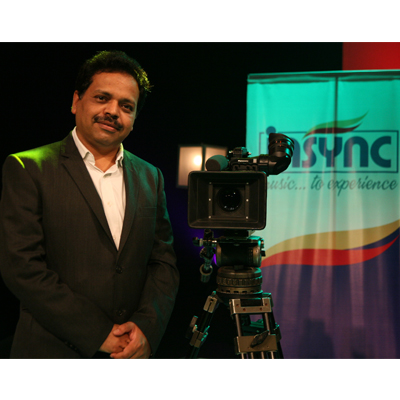
MUMBAI: Classical Indian music lovers have a reason to rejoice. A year after India’s first 24 hour classical music channel launched, InSync has plans to strengthen its offering to its viewers.
The channel, owned by Perfect Octave Media, an event management company that specialises in organising music concerts, plays vocal, instrumental, dance and fusion formats of classical music.

On the occasion of one year anniversary, InSync founder and CEO Ratish Tagde says that he is happy the way InSync has managed to squeeze itself into the hundreds of channels. “InSync is not just ‘one more’ music channel, but it an entirely non film and classical music genre.”
The channel which reaches out to 12 million households has access to concerts by musical stalwarts like the Late Pandit Ravi Shankar, Late Jagjit Singh and many others. Starting off with just 150 hours of content, it now has 500 hours in all. According to Tagde, the biggest challenge is that the content is not readily available in the market. The channel had to create content right from the scratch. “Other music channels get readymade content from film producers. This is the only channel which I would call as a music GEC.”
Sources peg the investment in the channel as Rs 20 crore due to the need of content creation. The channel telecasts music genres such as ghazal, sufi, fusion, spiritual, music education and others and has recorded and preserved 500 hours of HD quality music for music aficionados. The content features India’s maestros such as Pt Shivkumar Sharma, Pt Hariprasad Chaurasia, Ustad Rashid Khan, Ustad Shahid Parvez, Pt Rajan Sajan Mishra and many young and budding artists.
It airs programs like Gunj where semi classical music is played, Nazrana where Gazal and Sufi songs are played and Fusion Cafe (fusion music of different genres). Live concerts are aired every weekend. It also has a dedicated slot called Raga where short compositions are played. In the upcoming months, the channel plans to come up with youth targeted programs.
For the future, the research department of nearly eight people is also engaged in ideating for creating 200 short films of five minutes each on various subjects like Sitar, Gazal, Raga etc. These audio videos will explain each and every subject in simple language for a layman to understand.
Research has been crucial for this channel since it involves not just creating content but a new type of genre itself. Tagde believes that the Indian TV market is not yet content driven. “If you study the international pattern for a niche channel, it has content driven viewership which we were hoping that with digitisation will create that good scope for our channel. Carriage fees have substantially come down and people have started realising that content is the king.”
It can be viewed on MSOs Hathway, Digi Cable, 7 Star, DEN, JPR, Sai Vision, IN PCMC, PCSS , UCN, Home Cable, Baba Cable, Swami Cable, Satellite Vision, Inspire Infotech, DEN RCC in the areas of Maharashtra, Delhi, Kolkata, Gujarat, Madhya Pradesh and Jabalpur.
The channel is FTA as of now but plans to turn a pay channel soon. Tagde also wishes to keep it ad free. Tagde is confident that people will want to pay for the content that InSync offers to them.
From October, music lovers across the world will be able to enjoy the non-stop musical experience as it plans to spread geographically across countries like USA, Canada, Singapore, Australia and New Zealand.
A year on, it still has no advertisers on board because of lack of any TAM data till now. “We have not been approaching advertisers so far because we are waiting for the channel to spread across India and are still waiting to get our numbers. At the right time we will start approaching the advertisers,” he says.
A non government organisation will be flagged off on 23 August called Global Community of Indian Music (GCIM) by InSync and CRPIM initiatives. GCIM’s mission would be to preserve, protect and promote various genres of Indian classical music and create a sustainable Indian music eco-system across the world.
“Our music lovers are scattered which is why the corporate world and others are unable to gauge how many people would like this kind of music. We will be creating centres worldwide where music education will be imparted and music concerts will be happening on a big scale,” highlights Tagde.
With over 30,000 likes on Facebook, it will now begin focussing on the digital medium aggressively. Tagde feels that unlike television, the digital medium has fixed mechanisms for subscriptions and ad revenues. Moreover, it will soon develop its own Insync app and is in the process of tying up with many digital stores across the world.
The channel which had plans to launch an FM radio station on the lines of the TV channel, is yet awaiting licence approval from the ministry. “Yes we were planning to launch hoping that the FM licensing will be liberalised in India. But FM channels’ third and fourth phase of licensing is not yet open. We are in touch with the government to support us in that front,” he says.
Over the next five years, InSync has ambitious plans to create at least 10000 hours of content.


Music and Youth
TLC launches ‘World On My Plate’ with Shipra Khanna
New travel-food series premieres 29 March at 7:00 PM.

MUMBAI: Shipra Khanna just packed her bags and her flavours because when a celebrated chef takes you on a global plate tour, even the couch starts feeling like first-class. Warner Bros. Discovery India has announced the launch of World On My Plate with Shipra Khanna, a new travel and food series set to premiere on TLC on 29 March at 7:00 PM. Hosted and curated by the popular chef and television personality, the show blends food, travel and culture through an intimate and immersive lens.
Across three visually rich episodes, Shipra journeys to global destinations to explore not just what people eat, but why they eat it, uncovering the stories, traditions and human connections behind every dish. The series opens in London, weaving its iconic landmarks with diverse culinary scenes, before moving to Spain’s vineyards, olive orchards and coastal kitchens.
Warner Bros. Discovery head of advertising revenues for South Asia Tanaz Mehta said: “At TLC, our focus has always been on bringing authentic stories that reflect how people live and connect. World On My Plate builds on this by using food as a lens to explore shared traditions across geographies. We’re excited to collaborate with Chef Shipra Khanna, whose perspective brings both depth and relatability to these narratives.”
Shipra Khanna added, “Food has always been my way of connecting with people and understanding cultures. With World On My Plate, I’ve had the opportunity to step into new worlds, learn from incredible individuals, and share stories that go far beyond the plate. This show is very special to me.”
The series promises strong visual storytelling, meaningful interactions and a fresh perspective on global cuisine celebrating flavours alongside the emotions and traditions that shape them.
In a world where travel shows often feel like distant postcards, Shipra Khanna is serving up something far more personal: a passport to cultures through their kitchens, proving that the best way to understand a place is still through the plate. Tune in to World On My Plate with Shipra Khanna starting 29 March at 7:00 PM on TLC.