News Broadcasting
NT Summit & Awards: Experts discuss the importance and relevance of authentic news coverage

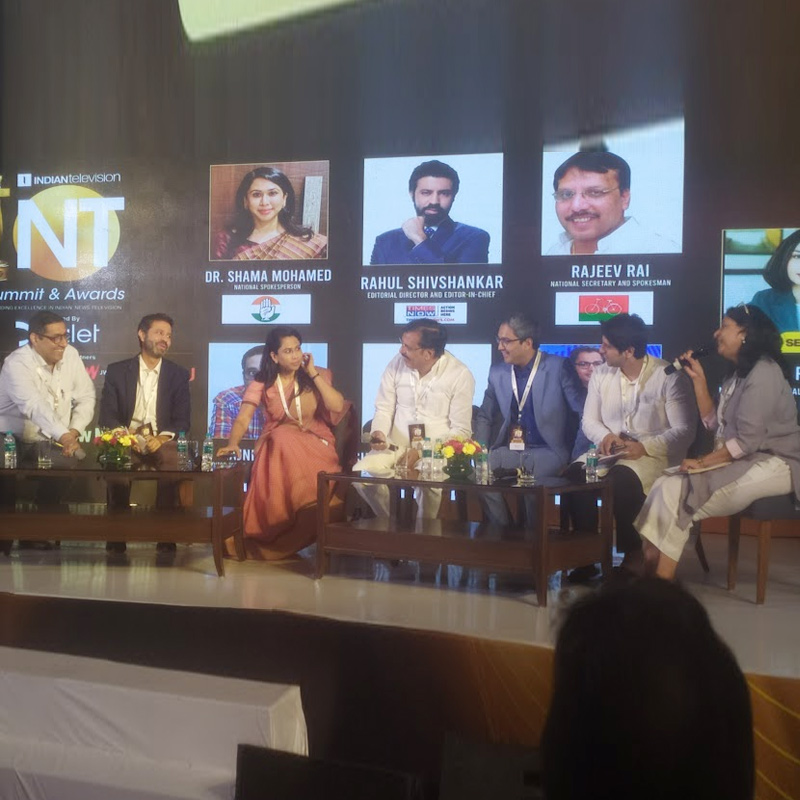
Mumbai: Is television new coverage balanced or has news journalism become a business? Should news broadcasters present the facts clearly while programming it? Do you think that the coverage of TV news is becoming more communal veering away from national issues such as inflation, rising liquid petroleum gas (LPG) prices and unemployment? Experts & opinion leaders in the news broadcast industry deliberated their views and talked about these tough questions head-on at the recently held News Television (NT) Summit in New Delhi.
The powerful session was joined by Indian National Congress national spokesperson Dr Shama Mohamed; Times Now editorial director & editor-in-chief Rahul Shivshankar; Zee Media Corporation editor Rajnish Ahuja; Samajwadi Party national secretary & spokesman Rajeev Rai; BJP national spokesperson Shehzad Poonawalla; CNN-News18 managing director Zakka Jacob and moderated by media professional & former editor of Star News Ravina Raj Kohli.
Mohamed highlighted some data and mentioned that in May, 65 percent of primetime news was dedicated to communal issues and only one percent to LPG price rise. In April, 23 percent of primetime airtime was given to communal issues and seven per cent to the petrol price rise. The coverage of the film ‘The Kashmir Files’ accounted for 20 per cent of primetime news and eight per cent was allotted for fuel hike coverage. In December 2021, 22 percent of primetime coverage was on communal issues.

She pointed out that there are well-known examples of both historical and modern media’s role in amplifying hate and leading to atrocities such as genocides such as ‘Radio Rwanda’ and the role of ‘Facebook in the massacre of Rohingyas’.
Mohamed also stated that the role of the media is to ask difficult questions from the established government. “In the US, when a CNN reporter was struck out of a press conference by ex-president Donald Trump, he took the matter to the Supreme Court of the United States. Even right-wing news channels such as Fox News stood by the reporter. The media stood its ground and that’s why Trump is out,” she added further.
Times Now’s Editor-in-chief Rahul Shivshankar noted that every government is worried about the influence of unregulated media. There are troves of misinformation sent via WhatsApp but by the time someone points it out, the fake news has made the damage.
BJP’s Shehzad Poonawalla remarked that in the past journalists always had an incestuous relationship with politics and power. “Every media house has to cater to certain compulsions whether it be commercial or political,” he said. “Today, we are in an era of democratisation thanks to prime minister Modi and digital India. Everyone has access to a cheap data connection and fast data. I don’t think the media needs lectures from anybody, especially the opposition or the people in power. They do a fine job.”
CNN-News18’s managing director Zakka Jacob was of the view that the agenda on TV was not dictated so much by politics and commercial factors as much by what made a great picture. He said, “The best pictures are those that make it to TV. All the news channels were covering the Rajya Sabha elections but due to a picture story, everyone’s agenda had changed in an hour or two. We tend to confuse news with top bands and ticker bands but at the end of the day it is about great pictures.”
“It is easy to belittle news channels but at the end of the day, it is the easiest medium to switch off from or change the channel. If viewers are not watching opinion shows on TV, then we’ll be the first ones to cut it from the programming. We are answerable to what the viewer wants to know about,” he further added.
The event was supported by Dalet who was ‘co-powered by’ partner as well as industry support partners GTPL Hathway, Hill+Knowlton Strategies, JW Player and Live U.





News Broadcasting
UDF poised to return to power in Kerala, says Manorama-CVoter survey
Massive opinion poll projects shift in Kerala politics ahead of 2026 Assembly elections.
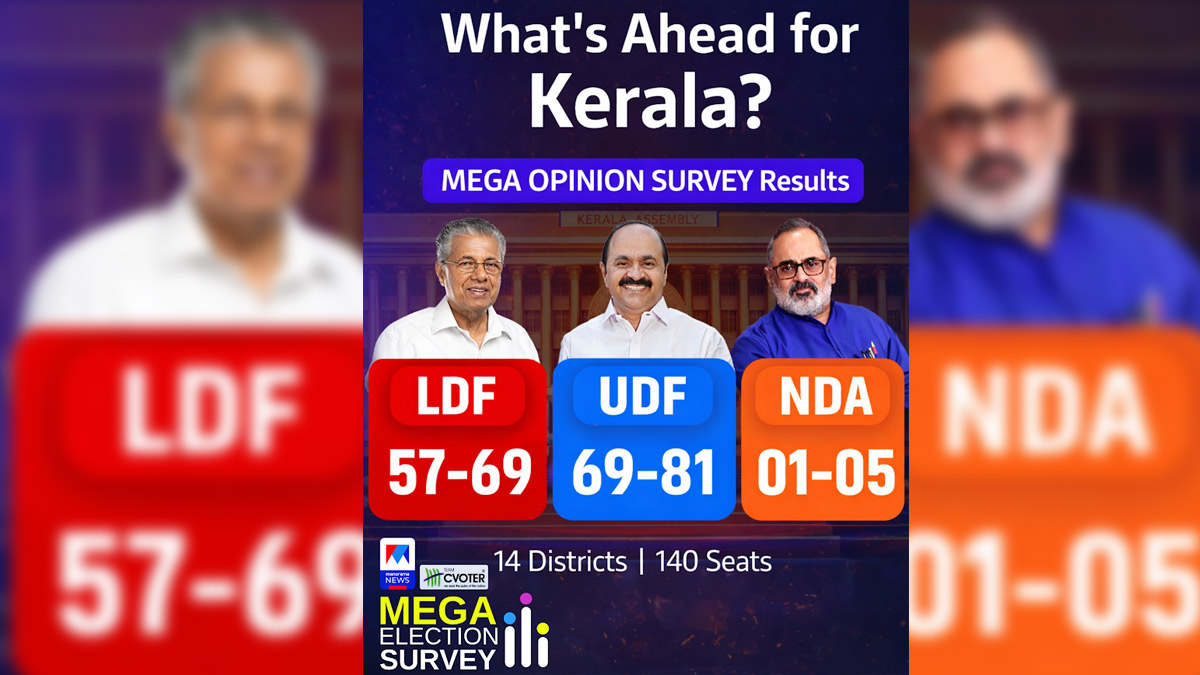
MUMBAI: The winds of change appear to be blowing through Kerala’s political landscape and this time, they seem to favour the United Democratic Front. A comprehensive mega opinion survey conducted by Manorama News in partnership with CVoter projects a potential comeback for the UDF in the upcoming Kerala Legislative Assembly Elections 2026. The survey, covering all 140 constituencies with a massive sample size of nearly 90,000 respondents, predicts the UDF could win between 69 and 81 seats.
The ruling Left Democratic Front (LDF) is expected to secure 57 to 69 seats, a significant drop from the 99 seats it won in the 2021 elections. This would mean the LDF losing 30 to 42 of its sitting seats. Meanwhile, the National Democratic Alliance (NDA), which drew a blank in 2021, is projected to open its account with 1 to 5 seats.
Region-wise, the UDF is expected to make strong gains in Malabar, winning 25 to 34 out of 48 seats, and in Central Kerala, where it could bag 29 to 33 out of 53 seats. In South Kerala, the LDF is likely to retain an edge with 21 to 25 seats, while the UDF may improve to 12 to 16 seats. The NDA could pick up 1 to 3 seats in the southern region.
The survey was conducted between 14 and 26 March 2026, with additional tracker and snap polls carried out from December 2025 to March 2026. A total of 89,693 respondents participated, ensuring representation across all demographics and social segments.
Manorama News has a strong track record of accuracy, with its previous projections closely matching the actual results of the 2019 and 2024 Lok Sabha elections as well as the 2021 Kerala Assembly polls.
In Kerala’s famously fierce political battles, this survey suggests the pendulum may be swinging back. Whether the final verdict matches these numbers or throws up another surprise, one thing is clear, the 2026 Assembly elections are shaping up to be one of the most keenly watched contests in the state’s history.






