News Broadcasting
Now BBC trains its lens on Indian elections


MUMBAI: Not only political parties but news channels of every hue are gearing up for what is being billed as the mother of all general elections witnessed by this country.
The latest to hit the 2014 election trail is BBC World News, a broadcasting network that needs no prior introduction. For the first time, BBC will be broadcasting live from India with three of its best-known anchors flown into the country to present their shows from the subcontinent – Jon Sopel with Global, Mishal Hussain with Impact, and Babita Sharma with Newsday.

A week of special programming will lead into the main programming starting on the first day of polling on 7 April. This will continue for a week with the three anchors, along with special editions of India Business Report and Talking Business with Linda Yueh. Thereafter, it will rely on the expertise and knowledge of BBC teams in Delhi and Mumbai and the BBC Hindi service.
Alongside the television programming, an Indian version of the bbc.com mobile site will be created for users to land directly on the India page upon clicking the main url. The online content will be trilingual, with predominantly English content along with some in Hindi and Tamil. Among others, the shows will explore angles such as what the election means for India’s neighbours like Pakistan and China and what it means for the rupee.
“India is a massive market. The mobile penetration here is close to 200 million users. Our mobile traffic is up by 350 per cent in three years and there are profound changes going on here. The new India mobile edition will provide a tailored experience, including top India news stories along with global news headlines, video, business, sport and the best from our features content,” says BBC Global News CEO Jim Egan. “It’s a very big editorial undertaking for us. We haven’t taken the channel on the road like this. Topics that interest world audiences such as politics, economy, defence and culture, will be covered. We won’t do it superficially or trivially but bearing in mind that a majority of our viewers are outside India, we won’t do in-depth analysis like local channels.”
BBC correspondent-anchor Sopel is excited to be covering elections live in India. “Election in India is important because India is important. We have a polling day and you have a polling month! That’s because your total electorate is 840 million and the UK just has 48 million,” he says.
While adding a local flavour to its programming, the global broadcaster will ensure it serves BBC values such as impartiality, fairness and balance. “No other international channel has the network of specialist language correspondents that we have,” says Sopel.
On the cards is a marketing campaign in major metros like Delhi, Mumbai, Bangalore and Chennai to let audiences know about BBC’s election coverage both on- and off- air. As of now though, BBC is busy figuring out whether to place the satellite dish in Mumbai or the national capital, depending on costs and feasibility.







News Broadcasting
Rajesh Sundaram joins NDTV Profit as senior editor, assignment
The 32-year newsroom veteran has launched channels on three continents and covered everything from 9/11 to South African television
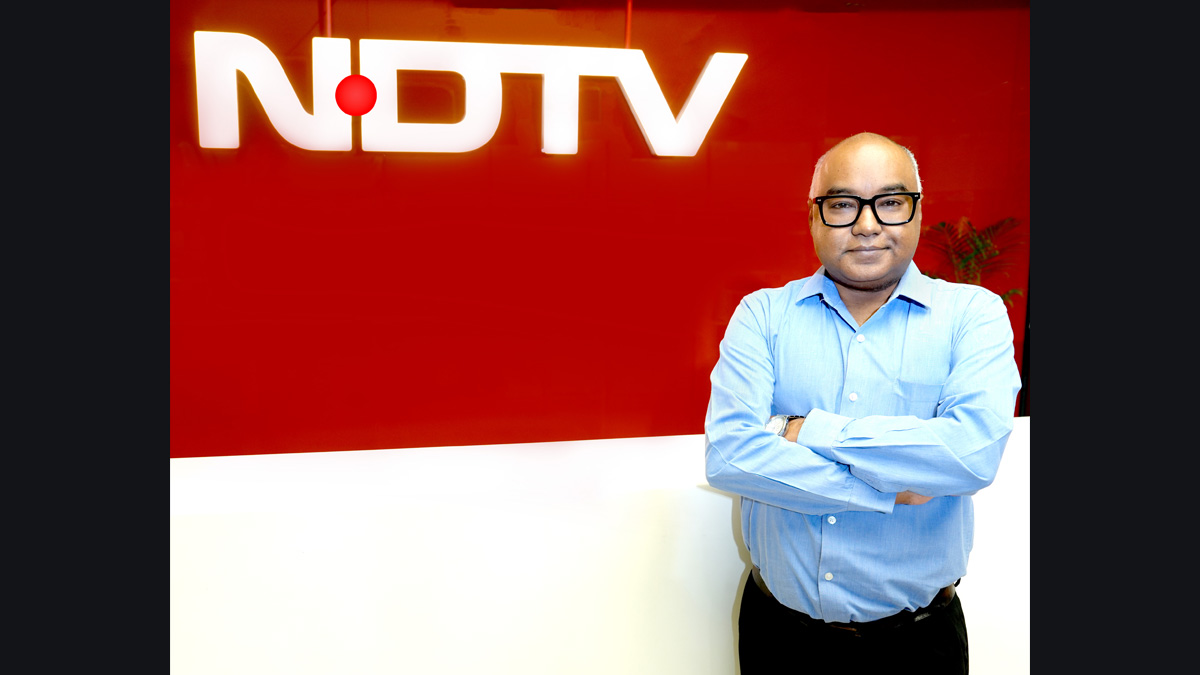
MUMBAI: NDTV Profit has bolstered its newsroom with a hire who has done rather more than most. Rajesh Sundaram, a journalist with over three decades of editorial, managerial and consultative experience across India and international markets, joins as senior editor, assignment, tasked with sharpening the network’s newsgathering and real-time response.
Sundaram’s career reads like a tour of Indian media’s most formative moments. He began at Businessworld in 1994, moved to Zee News as bureau chief across Mumbai and Chennai, then joined NDTV in 2002 as part of its political bureau during a particularly febrile period in Indian politics. A stint as India correspondent for Al Jazeera International followed, where he covered key geopolitical developments and got his first serious taste of the global newsroom.
What sets Sundaram apart, however, is his serial channel-launching habit. At NewsX, he helped get the operation off the ground. At Headlines Today, part of the India Today Group, he served as editor. At News Nation, he helped launch the Hindi news channel and its digital ecosystem. He then crossed continents to lead the launch of ANN7 in South Africa as editor-in-chief, overseeing both television and digital. Back in India, he launched Tamil news channels News7 Tamil and Cauvery News, and later served as principal consultant for the launch of Marathi channel Lokshahi. Most recently, he helped build and lead the Press Trust of India’s video service and content studio, before stints consulting for Business Today and The Himalayan Times.
Rahul Kanwal, chief executive and editor-in-chief of NDTV, left little doubt about what Sundaram is expected to deliver. “The assignment desk is where a newsroom’s intent becomes action,” he said. “Rajesh brings a rare combination of field experience and leadership in building news operations at scale.”
Sundaram has reported from across India and the world, covering elections, civil conflicts, the aftermath of the 9/11 attacks and the 2008 US presidential election.
At NDTV Profit, he will lead the assignment desk, driving editorial coordination and real-time response across markets and breaking developments. For a business news network sharpening its focus on speed and multi-platform delivery, it has hired a man who has built newsrooms from scratch on three continents. The assignment desk is in good hands.







