News Headline
No exclusive pacts with telcos: TRAI to building-owners; CTI mooted

MUMBAI: The Telecom Regulatory Authority of India (TRAI) has issued its recommendations on “In-Building Access by Telecom Service Providers”.
An effective telecommunications infrastructure is an essential component of any building for its connectivity to the outside world. Telecommunications services such as voice, data and wideband multimedia services are indispensable in the modern society. In order to improve in-building coverage and to offer quality high data rate services, installation of in-building solutions (IBS) for wireless services and laying of cables such as copper cables, optical fibre cables (OFC),LANcables etc. is required.
To lay cables or install telecom infrastructure inside the building, Telecom Service Providers (TSP) lnfrastructure Providers (lP-I) require permission of the owner of the building. However, it is seen that generally restrictive practices are adopted by building owners while giving access to the building due to commercial. interests. In many cases, these owners enter into exclusive agreement with one of the TSPs for providing telecom services to dwellers and deny access to other TSPs, thus creating an artificial entry barrier for other TSPs. Such practices not only limit competition, it also leaves no choice to consumers except to avail services from the TSP with whom the contract is done; taking away choice and flexibility from the consumers which they would have had in terms of quality of service (QoS), tariff, redundancy etc.

In view of the above, a need was felt for policy intervention and to evolve a framework applicable to in-building facilities to enable the telecom operators to obtain efficient access on reasonable terms and conditions. Therefore, the Authority, suo-motu, decided to initiate a consultation process on the issue. Accordingly, a Consultation Paper on “In-Building Access by Telecom Service Providers” was released on 6 June 2016 seeking the comments of the stakeholders. An Open House Discussion (OHD) on the issue was also convened on 30 September 2016 at New Delhi.
Based on the comments received and further analysis, draft recommendations on ‘In-Building Access by Telecom Service Providers’ have been issued and the same have also been placed on TRAI’s web site. Some of the main recommendations are:
(i) TSPs/IP-ls be mandated to share the in-building infrastructure (IBS, OFC and other cables, ducts etc) with other TSPs, in large public places, commercial complexes and residential complexes in transparent, fair and non-discriminatory manner.
(ii) Indulgence into exclusive contract prohibiting access to other TSPs may be treated as violation of the license agreement / registration.
(iii) Suitable provisions for the creation of Common Telecom Infrastructure (CTI) inside the building should form part of the Model Building Bye-Laws.
(iv) The essential requirement for telecom installations and the associated cabling should be formed part of National Building Code of India (NBC), being amended by Bureau of Indian Standards (BIS).
(v) Completion certificate to a building to be granted only after ensuring that the CTI as per the prescribed standards is in place.
(vi) Access to building including CTI facilities be available to the TSPs on a fair, transparent and non-discriminatory manner and minimum three TSPs/IP-Is should have presence in the building.
Also Read:
“There would be a lot on TRAI’s plate in 2017” – RS Sharma
Wi-fi proliferation, Net Telephony discussion in January







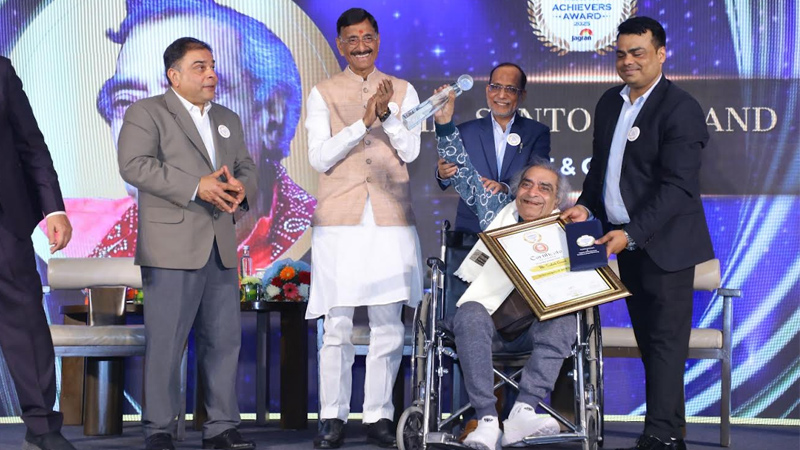
NEW DELHI: Hamdard Laboratories gathered a cross-section of India’s achievers in New Delhi on Friday, handing out the Hakeem Abdul Hameed Excellence Awards to figures who have left their mark across healthcare, education, sport, public service and the arts.
The ceremony, attended by minister of state for defence Sanjay Seth and senior officials from the ministry of Ayush, celebrated individuals whose work blends professional success with a sense of public purpose. It was as much a roll call of achievement as it was a reminder that influence is not measured only in profits or podiums, but in people reached and lives improved.
Among the headline awardees was Alakh Pandey, founder and chief executive of PhysicsWallah, recognised for turning affordable digital learning into a mass movement. On the sporting front, Arjuna Awardee and kabaddi player Sakshi Puniya was honoured for her contribution to the game and for pushing women’s participation onto bigger stages.
The cultural spotlight fell on veteran lyricist and poet Santosh Anand, whose songs have echoed across generations of Hindi cinema. At 97, Anand accepted the honour with characteristic humility, reflecting on a life shaped by perseverance and hope.
Healthcare honours spanned both modern and traditional systems. Manoj N. Nesari was recognised for strengthening Ayurveda’s place in national and global health frameworks. Padma shri Mohammed Abdul Waheed was honoured for his research-backed work in Unani medicine, while padma shri Mohsin Wali received recognition for his long-standing contribution to patient-centred care.
Education and social development also featured prominently. Padma shri Zahir Ishaq Kazi was honoured for decades of work in education, while former Meghalaya superintendent of Police T. C. Chacko was recognised for public service. Goonj founder Anshu Gupta received an award for his dignity-centred rural development initiatives, and the Hunar Shakti Foundation was honoured for empowering women and young girls through skill development.
The Lifetime Achievement Award went to former IAS officer Shailaja Chandra for her long career in public healthcare and governance, particularly in the traditional systems under Ayush.
Speaking at the event, Hamdard chairman Abdul Majeed said the awards were a tribute to those who combine excellence with empathy. “These awardees reflect Hakeem Sahib’s belief that healthcare, education and public service must ultimately serve humanity,” he said.
Minister Seth struck a forward-looking note, saying India’s young population gives the country a unique opportunity to become a global destination for learning, health and wellness by 2047.
The ceremony also featured the trailer launch of Unani Ki Kahaani, an upcoming documentary starring actor Jim Sarbh, set to premiere on Discovery on 11 February.
Instituted in memory of Unani scholar and educationist Hakeem Abdul Hameed, the awards have grown into a national platform that celebrates those building a more inclusive and resilient India. For one evening at least, the spotlight was not just on success, but on service with substance.






