News Broadcasting
NK Singh panel for FDI in news programming


NEW DELHI: The NK Singh committee on foreign direct investment (FDI), which presented its report yesterday to the Prime Minister, has recommended that FDI should also be encouraged in the category of news and current affairs and news programmes but with riders.
In its report, the Sing panel has said: “Thus FDI equity limits in terms of individual companies in this field could eventually be replaced by limits of the aggregate market share – 25 per cent to 49 per cent – that can accrue to foreign controlled news and current affair companies taken together.”
A copy of the media-specific suggestions is available with indiantelevision.com.

Dwelling on this subject, along with suggesting that the media cap of 20 per cent in a Ku-band DTH venture should be hiked to 49 per cent, the panel has said some element of restriction can also be applied to foreign entrants in the field of current affairs and news programmes. “Reporting of international affairs is strongly influenced by nationality, as demonstrated by reporting of the war in Afghanistan and related issues of Pakistani involvement in terrorism in South Asian region,” the panel has observed.
Taking a line that was adopted by the Cabinet while approving inflow of FDI in the print medium – hitherto a restricted area fro foreign companies – the Singh panel has said editorial control (in the electronic medium), in the sense of control over editorial policy and content must vest with Indian nationals. “The business managers and those who control commercial decision can, however, be foreigners. Over a time a more liberal policy that can focus on controlling dominance in terms of share of market for news and current affairs is desirable,” the panel has pointed out.
However, sounding a word of caution, the panel has said that in the name of globalisation, “globalisation of media cannot merely mean that all the existing cultural (for example soap operas) and nationalistic (for example war news) content created in democratic USA or the UK and other English-speaking countries is merely transferred to India.”
In the same vein it has also been pointed out that India’s experience with the opening of TV media has demonstrated “the strength of Indian culture” in that most foreign companies have been forced by the market to increase content based on Indian cultural and entertainment traditions and reduce transplanted foreign culture sensitive programmes.
In an observation, the Singh panel seems to suggest that terrestrial TV should also be opened to private participation.
The panel has noted that the experience of opening of terrestrial TV (a fact that can be debated as the government is yet to allow private sector involvement in terrestrial TV, though in FM radio broadcasting it has been allowed) has demonstrated that private domestic and foreign entry is beneficial for citizens in terms of both information access and consumer choice.
“DTH broadcasting competes with terrestrial TV transmissions and is a competitive service with high capital costs and risks,” the Singh panel has observed, adding, “Given the current 20 per cent foreign equity limit (in a KU band venture) foreign companies have little or no interest in entering this sector. This limit should be raised to 49 per cent (KU band, etc) so that foreign companies with the capital, technical competence and risk appetite can enter the country.”




News Broadcasting
Kamlesh Singh receives Haldi Ghati Award from MMCF
India Today Group editor honoured for three decades of journalism at Udaipur ceremony.
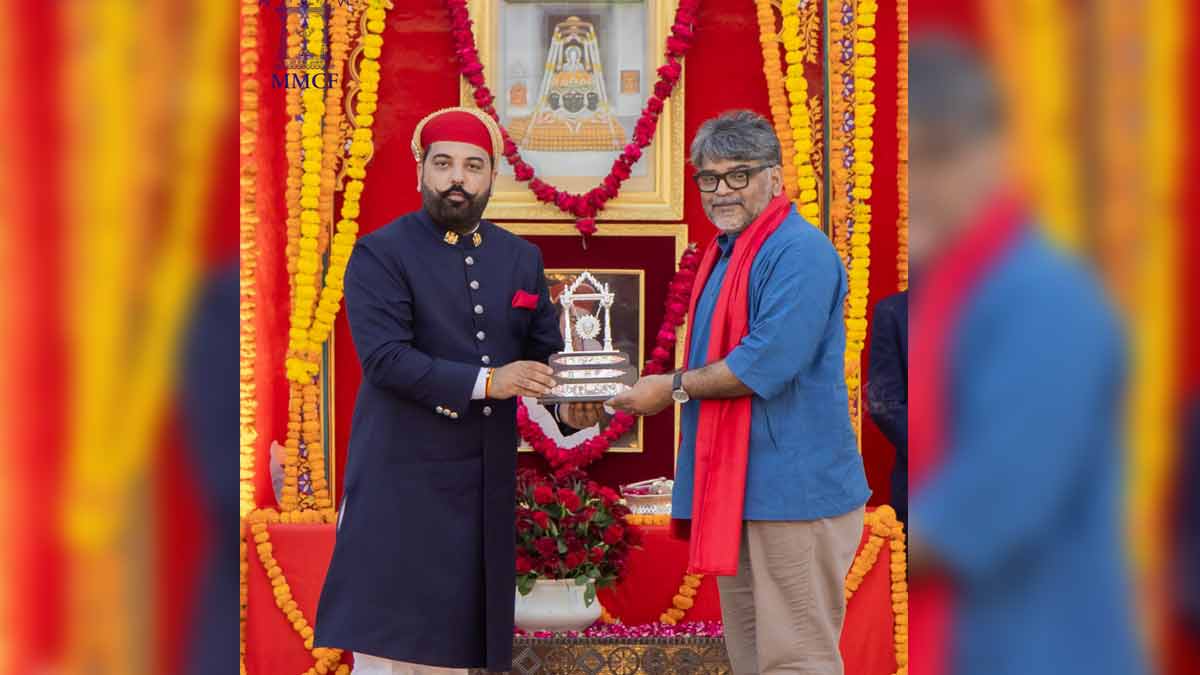
MUMBAI- Kamlesh Singh just turned a lifetime of sharp words into a shiny shield because when journalism wakes up a society, even the Maharana of Mewar wants to pin a medal on it.
The Maharana of Mewar Charitable Foundation (MMCF) conferred its prestigious Haldi Ghati Award on Kamlesh Singh, a senior editor at the India Today Group, during a ceremony in Udaipur on 15 March 2026. The national award, instituted in 1981-82, recognises “work of permanent value that initiates an awakening in society through the medium of journalism.”
Singh, who leads several editorial initiatives including Aaj Tak Radio, the Teen Taal community and The Lallantop, was presented the honour by Lakshyaraj Singh Mewar, Managing Trustee of MMCF. The citation highlighted his three decades of contributions to Indian media, innovations in digital journalism, mentoring young reporters, and his popular podcast persona “Tau” on Teen Taal, which fosters thoughtful public discourse.
The Haldi Ghati Award, named after the historic Battle of Haldighati symbolising valour and resilience, is one of four national awards given annually by MMCF. Past recipients include Tavleen Singh, Piyush Pandey and Raj Chengappa.
Other honourees this year included Padma Vibhushan Pt Hari Prasad Chaurasia, Vedamurti Devvrat Rekhe, Treeman of India Marimuthu Yoganathan, Vir Chakra Capt Rizwan Malik, and US-based researcher Molly Emma Aitken, who received the Colonel James Tod Award for contributions to understanding Mewar’s spirit and values.
In an era where headlines often shout louder than substance, the MMCF quietly reminded everyone that real journalism isn’t about noise, it’s about the quiet, persistent work that stirs society awake, one thoughtful story at a time.







