Hindi
NFDC announces Satyajit Ray poster design contest winners

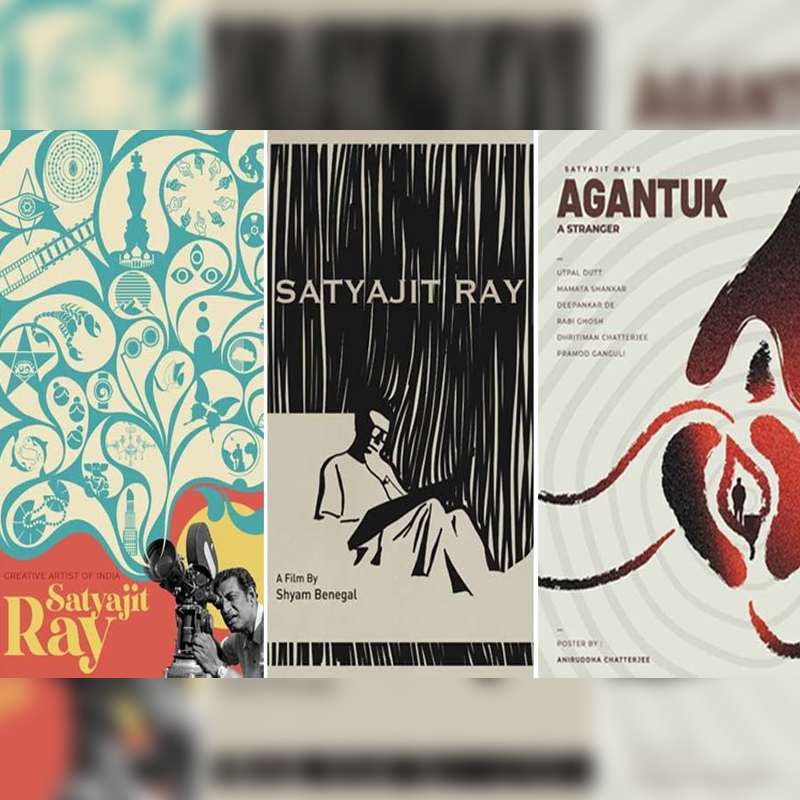
Mumbai: National Film Development Corporation Limited (NFDC) held an online film poster design contest in honour of the legendary filmmaker Satyajit Ray, who will be honoured at the 53rd International Film Festival of India (IFFI) in Goa from 20 to 28 November. The contest’s theme was The One and Only Ray.
Information & Broadcasting minister Anurag Thakur expressed his appreciation and said, “I extend my congratulations to the three winners whose posters were selected out of hundreds of entries and the 75 top poster designers who meticulously created such imaginative film poster designs for the ‘One & Only Ray’ contest. I further extend my appreciation to the jury for their time and thoughtful selections. This 53rd IFFI is set to bring in a whole new experience for movie lovers from around the world, the excitement is catching on!”
Artist Sayak Das was the winner of the contest while Varad Godbole was the first runner up and Aniruddha Chatterjee was the second runner up

NFDC India managing director Ravinder Bhakar informed, “In honour of Azadi Ka Amrit Mahotsav and the 100th anniversary of Ray and 39th birth anniversary, we held this contest for creative professionals with knowledge of art, visual communication, graphic design, and illustrative skills. Everything came together, and we now have our top 75 winners. We hope the general public will praise the film poster designs that will be on display at the 53rd IFFI.”
The International Film Festival of India (IFFI) aims to provide a common platform for filmmakers from around the world to showcase their talent and the best of cinema from around the world. As the country commemorates the 75th anniversary of its hard-won independence with Azadi Ka Amrit Mahotsav flags swaying in every state, 75 film poster designs from across the country have been chosen to be displayed for audiences in a unique exhibition of the legendary Satyajit Ray at the 53rd International Film Festival of India 2022.
The jury, composed of renowned artists from the fields of art, cinema, and painting, selected the 75 best film posters from a total of 635 submissions. The entire process, including the jury and evaluation, was conducted online. The top three winners will receive cash prizes, as well as a souvenir created from the winning film poster designs, which will be presented to dignitaries during the 53rd IFFI.
Filmmaker Shyam Benegal said, “The One and Only Ray film poster design contest at the 53rd IFFI honours Ray’s legacy both as a filmmaker as well as his considerable work as a typographer, and graphic designer-the last but not the least of the great masters of the Bengal Renaissance.”
Indian painter & muralist Anjolie Ela Menon said, “I am obliged to be a member of the jury for the ‘One and Only Ray’ contest, the applicants and the innovative work reflected their sharp efforts. It is a proud moment for India; since we have a wealth of talent. I hope that applicants will hone their creative abilities and wish their earnest efforts will all be recognized in future. Adulation for the winners of the contest.”
Veteran artist and animation film designer Dhimant Vyas shared his views, “Overwhelmed by the calibre of the applicants, NFDC has done an outstanding job toward its objective of providing a platform for emerging film poster creative artists and designers and paying homage to the renowned Ray. I wish success to everyone who took part, the creatives were remarkable.”
The jury, which included renowned artists from the fields of art, film, and painting, chose the 75 best film posters from 635 submissions. The entire process, including the jury and evaluation, was conducted online. The top three winners will receive monetary prizes, with the winner receiving Rs 1,000,000/-, the first and second runners up receiving Rs 75,000 and Rs 50,000, respectively, as well as a souvenir created from these three winning film poster designs, which will be presented to dignitaries and eminent personalities attending the 53rd IFFI.
Each jury panelist was given a unique login and password, and a scoring criteria was used to determine the winners: creativity and originality, theme relevance, visual contest, and visual impact.
Imafoundation.com founder, artist and curator Radha Binod Sharma stated, “I am honoured and privileged to serve and conduct national duty for the NFDC organisation. This is a great initiative which has helped to bring prominence to the present and past cultural riches that exist in India. I come from a rich, and derp culture in the North-East of India, namely Manipur and Tripura and beyond my artistic work I am committed to identifying talented artists in India and worldwide. I appreciated and enjoyed viewing the exceptional works from the varied regions of our culturally diverse country and I was uplifted by how the applicants rose to the challenge of the contest and theme. As a result, I saw a lot of emerging talent with some impressive film poster designs which filled me with immense pride. Vande Mataram.”
Artist Prakash Bal Joshi told, “Was joyous to be part of the esteemed jury & glad to adjudicate commendable artworks of the film poster designs inspired by Ray. Gratitude to all the efforts from the applicants as well as the team NFDC for this unique contest and ease of evaluation process.”
Multi-media visual artist and academic Shukla Sawant said, “I had the opportunity to view the artists and creations while reviewing entries for this movie poster design contest, which was an absolutely wonderful experience. I am hoping that the audiences will find them equally appealing during the display. I congratulate the organizers of the 53rd IFFI for their unwavering support to the creative community.”
The festival promotes understanding of various social and cultural ethos, as well as appreciation for world cinema, by bringing film cultures together. The NFDC received an overwhelming response to the contest, and the applicants’ level of creativity was exceptional, adhering to the contest’s theme. NFDC encourages everyone to be inspired by Ray’s work and legacy. During the 53rd IFFI 2022, the film poster designs will be on display at the Festival Mile.



Hindi
Remembering Gyan Sahay, the lens behind film, television and advertising
From a puppet rabbit selling poppadums to Hindi cinema, he framed it all.
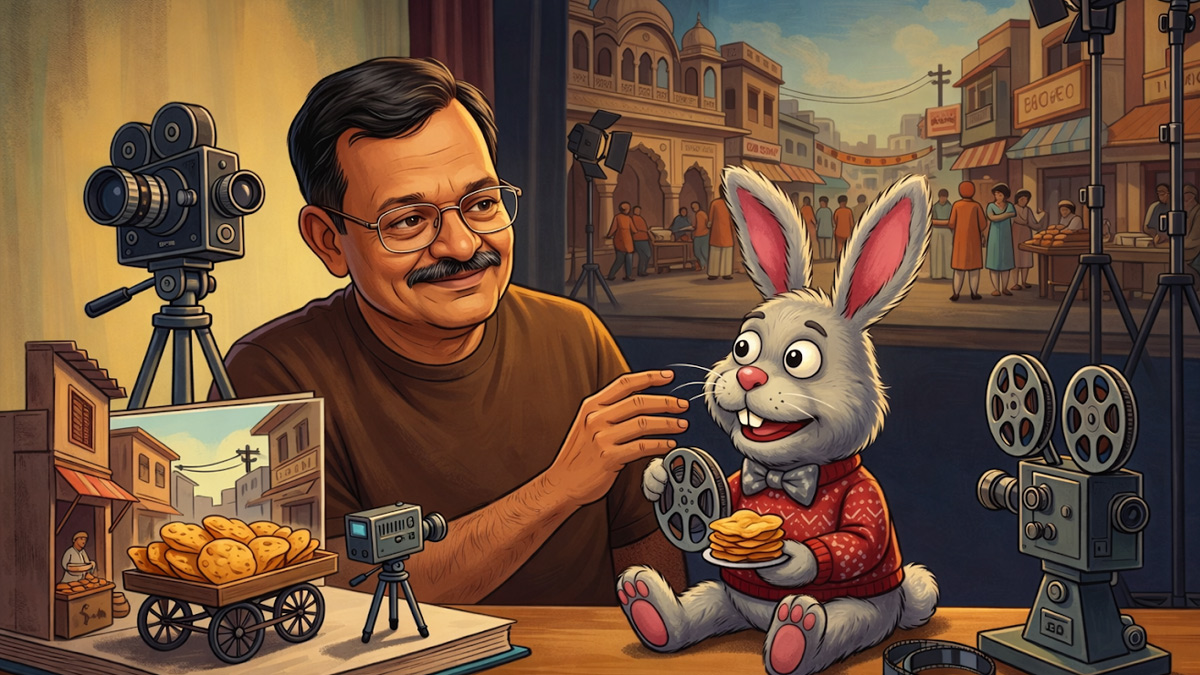
MUMBAI: There are careers, and then there are canvases. Gyan Sahay, the veteran cinematographer, director, and producer who passed away on 10 March 2026 in Mumbai, had one of the latter. Over several decades in the Indian film and television industry, he turned lenses, lights, and the occasional puppet rabbit into something approaching art.
A graduate of the Film and Television Institute of India (FTII) in Pune, Sahay built his reputation as a director of photography across a career that stretched from the early 1970s all the way to the digital age. He was the kind of craftsman who understood that a well-composed shot is not merely a technical achievement but a quiet act of storytelling.
For most Indians of a certain age, however, Sahay will forever be the man behind the rabbit. His direction of the iconic long-running television commercial for Lijjat Papad, featuring its now-legendary puppet bunny, gave the country one of its most cheerfully persistent advertising images. It was the sort of work that sneaks into the national subconscious and takes up permanent residence.
His big-screen credits as cinematographer include Anokhi Pehchan (1972), Pagli (1974), Pas de Deux (1981), and Hum Farishte Nahin (1988). In 1999, he stepped behind a different kind of camera altogether, making his directorial debut with Sar Ankhon Par, a drama that featured Vikas Bhalla and Shruti Ulfat, with a cameo by Shah Rukh Khan for good measure.
On television, Sahay was particularly prized for his command of multi-camera production setups, a skill that made him a go-to technician for large-scale shows and reality programmes. In an industry that has never been especially patient with complexity, he was the calm hand on the rig.
In later life, Sahay turned teacher. He participated regularly in masterclasses and Digi-Talks, often hosted by organisations such as Bharatiya Chitra Sadhna, sharing hard-won wisdom on cinematography, the comedy of timing in a shot, and the sweeping changes brought by the shift from celluloid to digital. He was also said to have been involved in a project concerning a biographical film on Infosys co-founder N.R. Narayana Murthy.
Tributes from the film industry poured in following the news of his passing, with colleagues remembering him as a senior cameraman who served as a rare bridge between two entirely different eras of Indian cinema. That is, perhaps, the finest thing one can say of any craftsman: he kept up, and he brought others along with him.