GECs
New media to lead growth for south Indian media and entertainment industry

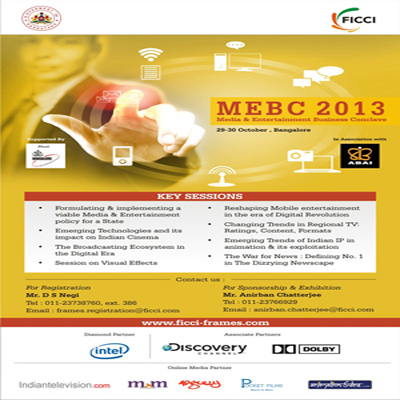
BENGALURU: The Digital March-Media and Entertainment in South India, a Deloitte-FICCI report was released on the eve of FICCI-MEBC 2013 in Bengaluru. The two day event commences on 29 October.
Note: This is for the year ended 31 March 2013.

The report says that the South Indian Media and Entertainment (SIM&E) industry is slated to grow from its current estimated size for FY-2013 of Rs 23,900 crore to Rs 43,600 crore in FY-2013 at an CAGR of 16 per cent.
The internet continues to have a profound effect on consumers’ viewing habits and the proliferation of devices is altering their media consumption behavior. With the increasing popularity of mobile broadband (3G) and the impending launch of 4G LTE services, mobile phones are expected to emerge as the preferred platform for consuming content. India already has over 65 million smartphone users currently.
In south India, new media, with an estimated size of Rs 690 crore in FY-2013 will grow at 23 per cent CAGR to reach Rs 1600 crore in size by FY-2017, followed by television which will grow at a CAGR of 20 per cent from a present estimated size of Rs 13,470 crore to Rs 27,960 crore.
The television industry in south India is on a transformation path, driven by the government’s digitisation mandate, says the report. It is one of the most flourishing regional media segment in terms of availability of content, reach and distribution. Over the years, it has seen increased action from regional as well as national advertisers. In fact, regional advertisers now contribute almost 40 per cent of the TV industry’s advertisement revenues in states such as Tamil Nadu and Kerala.
Radio will grow at a CAGR of 19 per cent from an estimated present size of Rs 420 crore to Rs 830 crore by FY-2017. The radio industry enjoys greater acceptance in the south than in the rest of the country and thus stands out amongst its peers. This is indicated by relatively higher average radio listenership in cities like Bengaluru where people spend about 20 hours / week on radio while those in Delhi and Mumbai spend 13-14 hours / week says the report.
Films with a present estimated size of Rs 2,680 crore will grow at a CAGR of 12 per cent to reach Rs 4,220 crore by FY- 2017. The report says that the south Indian film industry with 831 films, accounted for over 50 per cent of total films certified across India. The number of films certified increased by 36 per cent over 2011, primarily driven by a spike in cable and satellite (C&S) rights’ prices. However, the number of films released increased by only eight per cent during the same period as some producers chose not to release their films due to the high marketing costs associated, and as a result of a correction in the C&S rights’ prices in some of the markets.
Print, a laggard relatively, will grow at eight per cent from the present Rs 6,880 crore to Rs 9,020 crore by FY-2017. South India, driven by a high literacy rate and a sizable vernacular readership base (30 per cent of total readership in India) is one of the strongholds of the Indian print industry. Amongst the four regional states, Tamil Nadu and Andhra Pradesh account for about 58 per cent of the total revenue. Most of the markets in the region are dominated by English print in terms of revenue except Kerala, where vernacular prints accounts for nearly 90 per cent of the revenue. However, the advertising revenue from vernacular print in the region is estimated to grow at twice the pace of that of English, largely driven by local advertisers and increasing focus of national advertiser’s beyond tier I cities.
Among the four southern states or southern sisters as they are known, Tamil Nadu with a FY-2013 SIM&E estimated size of Rs 8,420 crore will grow at a CAGR of 17 per cent to reach Rs15,850 crore by FY-2017. SIM&E in Andhra Pradesh with a FY-2013 estimated size of Rs 7,140 crore will reach an estimated size of Rs 12,740 crore by FY-2017 at a CAGR of 16 per cent.
SIM&E in Karnataka with an estimated FY-2013 size of Rs 4,340 crore will grow at a CAGR of 15 per cent to reach Rs 7,710 crore by FY-2017. The smallest in terms of size of SIM&E, Kerala with a FY-2013 estimated size of Rs 3,350 crore will grow to Rs 5,7,30 crore by FY-2017 at a CAGR of 14 per cent.






GECs
Asianet Television Awards 2026 celebrates women power in Malayalam TV
“She is the Colour” theme honours icons as ceremony airs on March 14 and 15 at 7 PM.

MUMBAI: If television lights up living rooms, this year Asianet decided to let women provide the colour. The Asianet Television Awards 2026 turned the spotlight firmly on women empowerment with the theme “She is the Colour”, celebrating the strength, resilience and achievements of women who continue to shape society and the Malayalam entertainment industry.
The ceremony honoured several distinguished personalities whose journeys have left a lasting cultural imprint. Among them was legendary playback singer Vimala Varma, widely recognised as the first Malayalam playback singer. The evening also paid tribute to Padma Shri awardees Devaki Amma and Vimala Menon for their exceptional contributions in their respective fields.
Leading women from the Malayalam film industry were also recognised during the event, including actor Shweta Menon, who currently serves as president of the Association of Malayalam Movie Artists, and National Award winning actor Surabhi Lakshmi.
The awards ceremony brought together a glittering lineup of actors and industry figures, including Jayasurya, Vijay Babu, Asha Sarath, Lena, Esther Anil, Anumol, Akhila Bhargavan, Sarayu Mohan, Prajod Kalabhavan, Gayathri Suresh, Sabumon Abdusamad, Swasika, Tini Tom, Sijoy Varghese, Kailash, Veena Nandakumar, Sabareesh Varma, Ansiba Hassan and Dinesh Prabhakar. Kishan Kumar, executive vice president Malayalam at JioStar, was also present at the event.
Beyond individual recognitions, the awards celebrated excellence across Malayalam television, acknowledging artists and technicians whose work continues to drive the industry forward.
The evening also offered plenty of spectacle, with elaborate dance performances, stunt acts and comedy skits performed by popular television and film personalities, turning the ceremony into a full fledged entertainment showcase.
Viewers will get to watch the celebrations when the Asianet Television Awards 2026 air on Asianet on March 14 and 15, Saturday and Sunday, from 7 pm onwards, bringing the star studded tribute to homes across Kerala and beyond.







