News Broadcasting
Network18’s India – China Dialogues discusses key issues & bilateral ties

MUMBAI: During Prime Minister Narendra Modi’s recent visit to China, Network18 hosted The India-China Dialogues, which successfully mirrored the emerging dynamism in bilateral policy making and reflected on areas of mutual cooperation between India and China.
The event witnessed top policymakers from both India and China and discussed challenges and common goals in an effort to chart a blueprint for an ambitious and constructive partnership with the two nations.

The dialogue hosted detailed discussion where some of the respected names in the industry put forth their views on significant topics such as technology cooperation, business prospects with Make in India, trade and investment and potential of the bilateral ties.
Some of the key people representing the Chinese were Elion Group chairman and member of the Communist Party of China Wang Wenbiao; Development Research Center, State Council senior economist Ding Yifan; former Chinese Counsellor to India Deng Junbing; China Center for Contemporary World Studies senior researcher Wang Dong and CIIS senior researcher Jia Xiudong.
Meanwhile, Indian policy makers and influencers in attendance were India Foundation director and BJP national general secretary Ram Madhav; economist Arvind Virmani; Institute of Chinese Studies, India assistant director Jabin Jacob and former ambassador of India to France and Germany Amb TCA Rangachari.
Department of Industrial Policy & Promotion secretary Amitabh Kant and former minister of Rural Development Jairam Ramesh made an important contribution to the dialogue by means of audio-visual messages.
Some of the key highlights from the conclave:
Speaking at the dialogues, CNN-IBN managing editor Radhakrishnan Nair said, “Success happens when preparation and opportunities meet. In China, we say that there is preparation and execution. In India, we find that execution is where we lack. In terms of trade and economy, India should learn from the Chinese, and the question for China is, should China invest in India? Challenges are there but opportunities are immense if India and China come together.”
BJP general secretary Ram Madhav added, “President Xi Jinping and Prime Minister Modi are making serious efforts to take our bilateral relations to newer levels. With two strong governments and two strong leaders, we should now engage with each other in registering what I call gradual progress on all outstanding issues. We also need to create more freedom and relaxation in visa regimes. As our PM highlighted during the visit of President Xi Jinping to India, we also have to register some progress on issues like our border. We have to ensure that peace is restored on the border.”
Government of India DIPP secretary Amitabh Kant said, “India and China are the two most dynamic economies of the world. What we are witnessing today is the revival of these Asian economies at the centre stage of the global economy. China & Indian economies are not competitive in nature but complimentary to each other. China has been the factory of the world, India has been the back office of the world and it is important that both of us work together. The strategy for China should be ‘Invested by China but Made in India.”
Former Minister of Rural Development Jairam Ramesh touched upon areas of investment, water resource planning, green economy and people to people collaboration. He said, “Green economy is an area of strategic leadership for both China and India. This is an area in which both countries can work together and learn from each other. Similarly, water resource planning between the two countries is crucial. People-to-people collaboration between the two countries has tremendous possibilities. Clearly India and China must work together. We have our differences which are being discussed and hopefully they will get sorted out.”
The dialogue served as a critical platform to discuss key issues pertaining to Asia’s two leading economies and the way forward for both. The dignitaries gave a fresh perspective to Indo-china relations and the scope of their working together.
The dialogue was hosted on 12 May, 2015 at Park Hyatt, Beijing and broadcast across the leading Network18 channels including CNN-IBN and IBN7.






News Broadcasting
UDF poised to return to power in Kerala, says Manorama-CVoter survey
Massive opinion poll projects shift in Kerala politics ahead of 2026 Assembly elections.
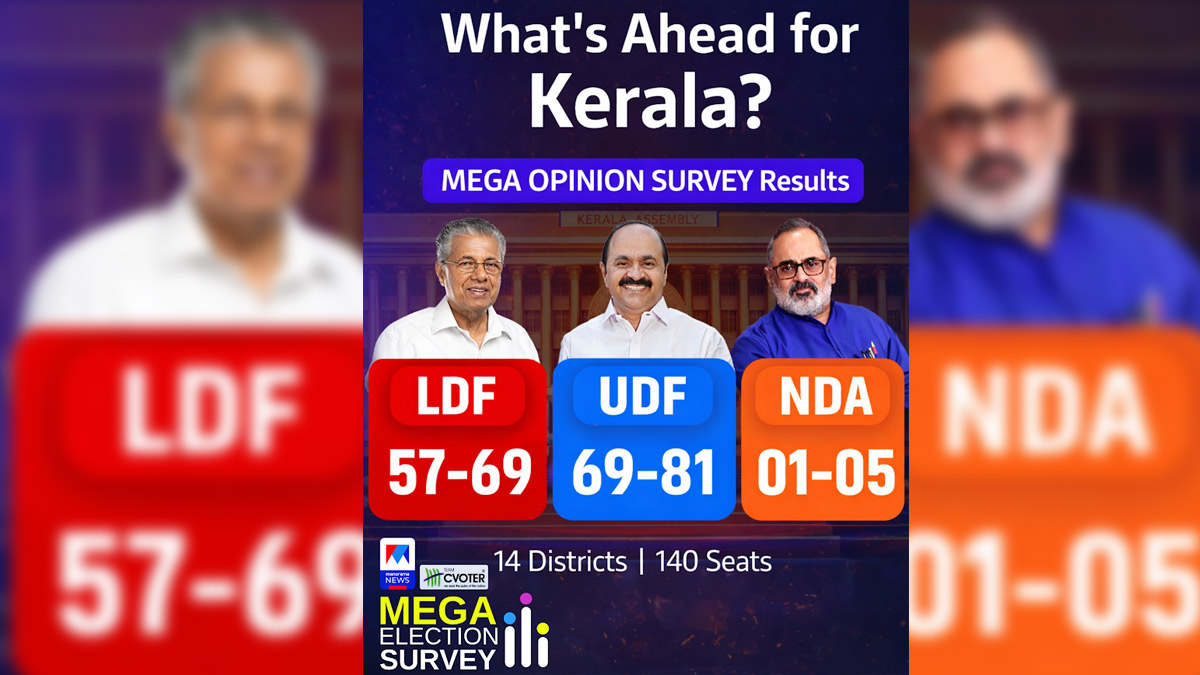
MUMBAI: The winds of change appear to be blowing through Kerala’s political landscape and this time, they seem to favour the United Democratic Front. A comprehensive mega opinion survey conducted by Manorama News in partnership with CVoter projects a potential comeback for the UDF in the upcoming Kerala Legislative Assembly Elections 2026. The survey, covering all 140 constituencies with a massive sample size of nearly 90,000 respondents, predicts the UDF could win between 69 and 81 seats.
The ruling Left Democratic Front (LDF) is expected to secure 57 to 69 seats, a significant drop from the 99 seats it won in the 2021 elections. This would mean the LDF losing 30 to 42 of its sitting seats. Meanwhile, the National Democratic Alliance (NDA), which drew a blank in 2021, is projected to open its account with 1 to 5 seats.
Region-wise, the UDF is expected to make strong gains in Malabar, winning 25 to 34 out of 48 seats, and in Central Kerala, where it could bag 29 to 33 out of 53 seats. In South Kerala, the LDF is likely to retain an edge with 21 to 25 seats, while the UDF may improve to 12 to 16 seats. The NDA could pick up 1 to 3 seats in the southern region.
The survey was conducted between 14 and 26 March 2026, with additional tracker and snap polls carried out from December 2025 to March 2026. A total of 89,693 respondents participated, ensuring representation across all demographics and social segments.
Manorama News has a strong track record of accuracy, with its previous projections closely matching the actual results of the 2019 and 2024 Lok Sabha elections as well as the 2021 Kerala Assembly polls.
In Kerala’s famously fierce political battles, this survey suggests the pendulum may be swinging back. Whether the final verdict matches these numbers or throws up another surprise, one thing is clear, the 2026 Assembly elections are shaping up to be one of the most keenly watched contests in the state’s history.






