News Broadcasting
Network18 widens lead over Times Internet with digital and TV dominance

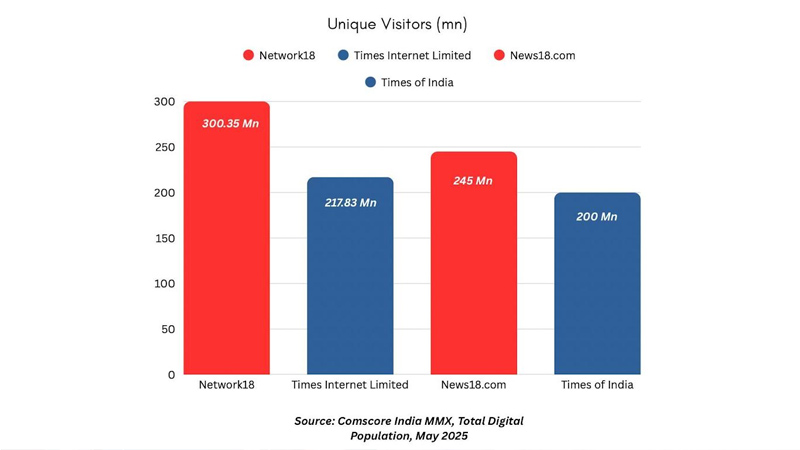
MUMBAI: If news were a contact sport, Network18 just scored a digital hat-trick while keeping its closest rival, Times Internet, firmly on the defensive. Network18 has cemented its status as India’s undisputed news juggernaut, clocking a towering 300.35 million unique visitors (UVs) in May 2025, according to the latest ComScore MMX data. With a 67 per cent digital reach, it outpaced Times Internet Limited by over 82 million UVs, with the latter trailing at 217.83 million UVs (48 per cent reach).
The digital scoreboard shows a clear trend: Network18 has led for three straight months, with UVs peaking at 321 million in April and 315 million in March, compared to Times Internet’s 196 million and 203 million in the same periods.
It’s not just the network flexing its muscles News18.com, the flagship digital brand, has been leaving The Times of India in the dust. With 245 million UVs in May, News18 maintained a consistent lead over TOI’s 200 million UVs. And the margin’s been widening: April saw News18 at 283 million UVs to TOI’s 173 million, while March posted 251 million vs 182 million, respectively.

But the domination doesn’t stop at pixels. On television, CNN-News18 has held the No. 1 position in English news for over three consecutive years, a feat unmatched in the industry. In the Hindi news universe, News18 India remains the most-watched across the country. Add to that Network18’s reach across regional languages, and the brand’s influence begins to look not just dominant but pan-Indian.
While digital players grapple with fractured attention spans and changing algorithms, Network18 seems to have found the secret sauce reach, consistency, and trust across screens, languages, and formats.
In a media ecosystem obsessed with virality, Network18’s steady, multiplatform march to the top is less flash, more firepower. And in the battle for eyeballs, it’s clear who’s setting the pace and who’s still trying to catch up.







News Broadcasting
Network18 channels lead YouTube news viewership in March 2026
CNN-News18, News18 India and CNBC channels top categories with record views
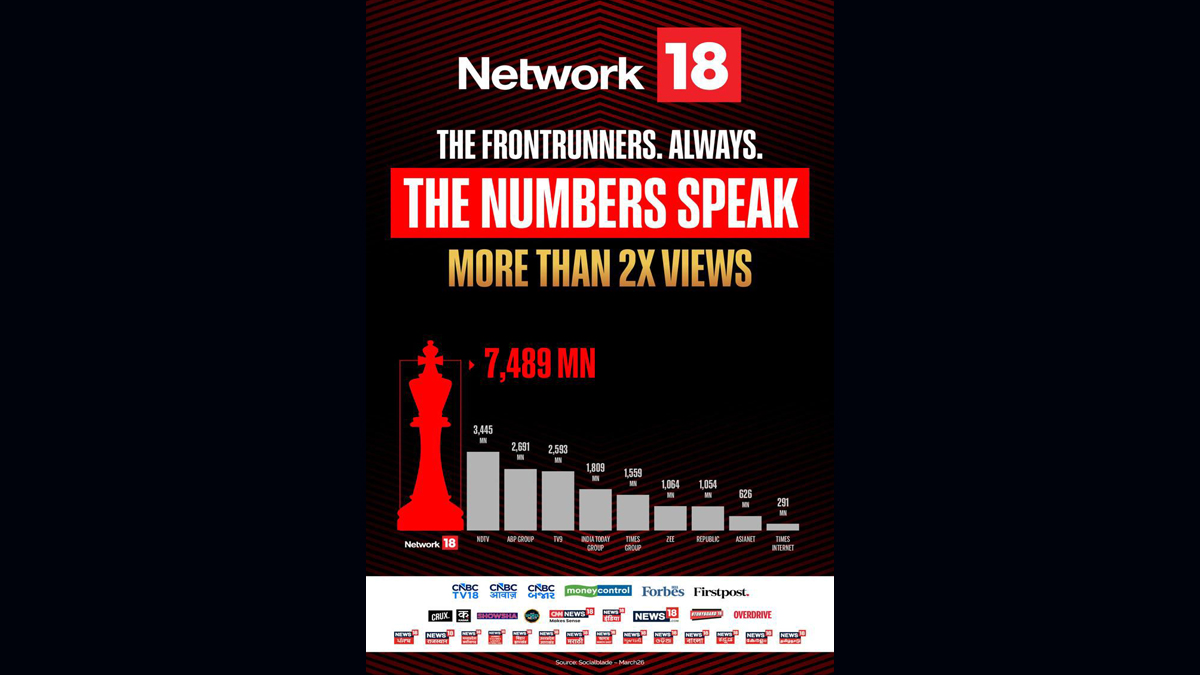
MUMBAI: When the world hit refresh on breaking news, Network18’s channels were already streaming ahead. As geopolitical tensions and war-driven headlines fuelled a surge in global news consumption, the network’s digital playbook delivered big clocking record Youtube viewership across English, Hindi and business news categories in March 2026.
At the forefront was CNN-News18, which emerged as the clear leader in the English news segment with 130 million live and video-on-demand views. The channel edged past competitors such as Times of India (126.5 million), Times Now (101.1 million), India Today (88.2 million) and NDTV (77.5 million), according to Databeings data for March.
In the Hindi news arena, News18 India delivered a commanding performance, racking up a staggering 3,297 million views on YouTube. The channel comfortably outpaced NDTV India, which recorded 3,119 million views, underlining its deep reach and consistent engagement with mass audiences, as per Playboard data.
The network’s dominance wasn’t confined to general news. In the Hindi business segment, CNBC Awaaz topped the charts with 92 million views, narrowly ahead of Zee Business (90 million) and well ahead of ET Now Swadesh (57 million). Meanwhile, its English counterpart CNBC-TV18 posted a strong 58 million views, reinforcing the network’s cross-category strength.
The spike in viewership reflects a broader shift in audience behaviour, with viewers increasingly turning to digital platforms particularly Youtube for real-time updates and in-depth coverage during high-intensity news cycles. For Network18, the numbers signal more than just scale; they underline the effectiveness of a multi-platform strategy that blends speed, credibility and continuous coverage.
In a month where the news never paused, it seems viewers chose to stay tuned where the stream never stopped.






