News Broadcasting
Network18 to hold ‘The India – China Dialogues’ in Beijing

MUMBAI: In the lead up to PM Narendra Modi’s visit to China, Network 18 has launched ‘The India – China Dialogues,’ which is an initiative that aims to mirror the emerging dynamism in bilateral policy making and reflect on the areas of mutual cooperation between India and China.
The full day conclave will be hosted on 12 May, 2015 at Park Hyatt, Beijing and broadcast across the leading Network18 channels including CNN-IBN and IBN7.

The second such initiative in a series of ‘Dialogues’ after the India-US Dialogues organised on the eve of President Barack Obama’s visit to India in January this year, the India – China Dialogues endeavours to build a critical mass – both intellectual and proper to propel this vital relationship to the next level.
With Modi’s maiden journey to Beijing, this year will see the recalibration and cementing of bilateral ties between Asia’s two leading economies – India and China. Modi’s trip is all set to be a potentially defining one, which could transform ties between the two Asian neighbours and create new opportunities for their people.
The India – China Dialogues will see distinguished dignitaries from both sides examining key areas that are pivotal in this partnership. Topics ranging from trade and investment, technology cooperation and the business prospects with Make in India, will be discussed. The expert panel will also explore the synergies for growth in the areas of tourism, healthcare and education, people to people relations.
IBN Network CEO Avinash Kaul said, “As Asia’s leading economies come together, we are looking forward to solution led discussions that will help the two nations to further cultivate their relations and script new pathways of progress for all. I’m sure that the India-China Dialogues will serve as a beneficial platform to examine key areas that will shape the relationship between the two countries and ideate out-of-the-box solutions for the two governments.”
Network 18 group president – news Umesh Upadhyay added, “We at Network18 take immense pride in announcing The India – China Dialogues after the huge success of The India-US Dialogues. Marking the prestigious occasion of our Prime Ministers visit to China, this conclave aims to give our viewers an in-depth analysis of the relationship between India and China and set the tone for PM Modi’s visit.”







News Broadcasting
Network18 channels lead YouTube news viewership in March 2026
CNN-News18, News18 India and CNBC channels top categories with record views
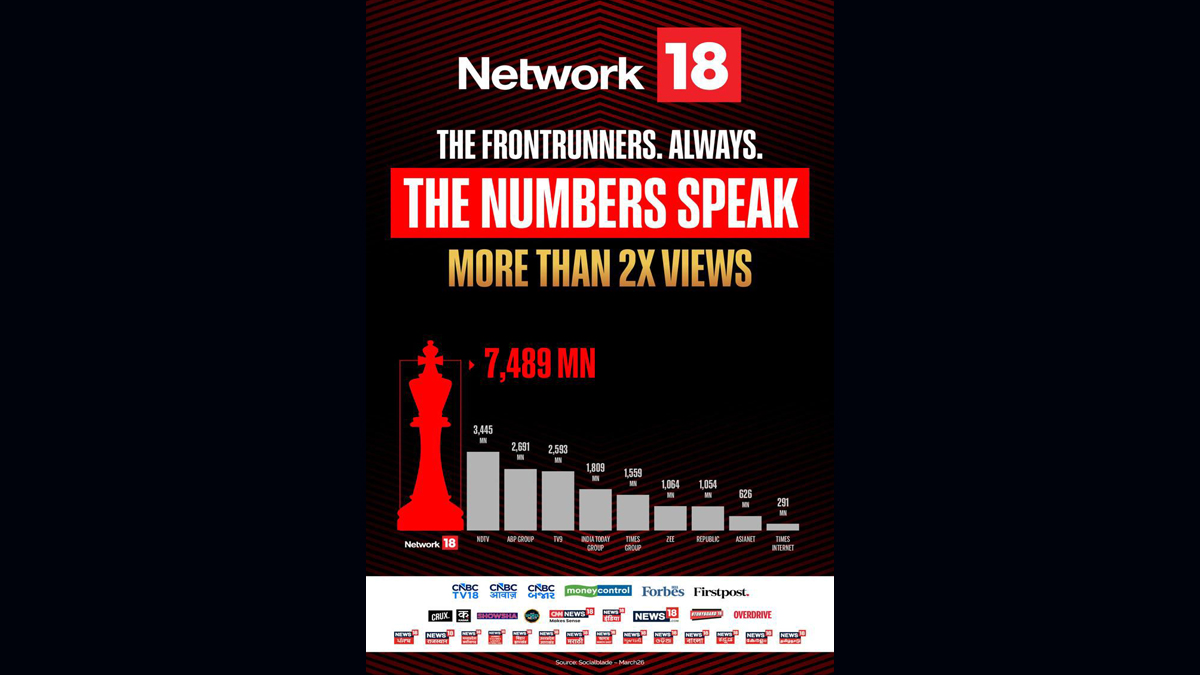
MUMBAI: When the world hit refresh on breaking news, Network18’s channels were already streaming ahead. As geopolitical tensions and war-driven headlines fuelled a surge in global news consumption, the network’s digital playbook delivered big clocking record Youtube viewership across English, Hindi and business news categories in March 2026.
At the forefront was CNN-News18, which emerged as the clear leader in the English news segment with 130 million live and video-on-demand views. The channel edged past competitors such as Times of India (126.5 million), Times Now (101.1 million), India Today (88.2 million) and NDTV (77.5 million), according to Databeings data for March.
In the Hindi news arena, News18 India delivered a commanding performance, racking up a staggering 3,297 million views on YouTube. The channel comfortably outpaced NDTV India, which recorded 3,119 million views, underlining its deep reach and consistent engagement with mass audiences, as per Playboard data.
The network’s dominance wasn’t confined to general news. In the Hindi business segment, CNBC Awaaz topped the charts with 92 million views, narrowly ahead of Zee Business (90 million) and well ahead of ET Now Swadesh (57 million). Meanwhile, its English counterpart CNBC-TV18 posted a strong 58 million views, reinforcing the network’s cross-category strength.
The spike in viewership reflects a broader shift in audience behaviour, with viewers increasingly turning to digital platforms particularly Youtube for real-time updates and in-depth coverage during high-intensity news cycles. For Network18, the numbers signal more than just scale; they underline the effectiveness of a multi-platform strategy that blends speed, credibility and continuous coverage.
In a month where the news never paused, it seems viewers chose to stay tuned where the stream never stopped.






