I&B Ministry
Net Neutrality: Reactions from the consumers provide deep insights

NEW DELHI: Issues relating to OTT and net neutrality have been in the news for almost two years now and the Telecom Regulatory Authority of India (TRAI), which had earlier issued a paper on Over-the-top (OTT) apps, came out with a paper on Net Neutrality on 30 May 2016.
TRAI’s frequent revisiting of the Net Neutrality issue highlights the fact that the regulator is under immense pressure from various stakeholders with diverse interests. TRAI had first issued a consultation paper over 18 months back and had also passed an order — hotly contested by telecom companies— banning differential pricing floated by some telcos recently, which had sounded the death gong for Facebook’s FreeBasic in India.
However as the TRAI website is seen generally only by those in the broadcasting or telecom sectors, a brief summary of TRAI’s pre-consultation paper has been placed on the mygov.in so that the general public can react and send in their feedbacks.

As a result, over 73,000 posts have already come on this site from the general public who have unanimously supported net neutrality. Some have gone to the extent of asking why TRAI or the government should ask this question.
Though indiantelevision.com firmly believes that at times the debate in India over Net Neutrality has been shrill and has clouded real and serious aspects of neutrality, there are some interesting feedbacks as well that indicate how general Indians view Net Neutrality.

For example, one writer says: “TRAI focus should be broadband speed minimum 50MBps Download/ 25MBps Upload. There should be no pollution, so focus on fiber/copper with speeds of up to 10GBps (ten GBps) and ensure that latency is very low, connectivity is much better (speed and latency are different).”
The same respondent points out that companies are offering 5GB on 4Mbps for high prices up to Rs 900 and data caps should be removed or have minimum of 1TBps. He has said that lease lines should be made affordable with customer support.
Says another respondent: “I cannot imagine an India as net partial with a discriminatory telecom structure not letting me call my kin freely, surf net with discrimination. The Governments needs to recall and emulate Dr Ambedkar’s ideas, the esteemed voice of freedom and non-discrimination of free India.”
Yet another individual says: “In the name of neutrality. Let us not stop access of net to one billion Indians. Many pay phone/net data bills (simply by transferring data) higher than electricity bills (which is consuming energy, which is costlier to produce). Let the government ensure that data service is affordable to all.”
Another consumer says, “We want freedom to choose and not Internet Service Provider choosing for us. There is also stress on removing corruption which can be done by removing interest on security deposit, seven days extra charge after disconnection refund, towers on house and low heights.”
Yet another respondent commented: “Without net neutrality, internet would go into the hands of people who can pay the ISPs to give their websites for cheaper price. This will hamper start-ups and other small players who cannot afford to pay the ISPs. For a thriving economy, it is important to have competing players in market. In the absence of net neutrality, this competition will be disrupted and monopoly will be established — which is not good for the consumers.”

But the responses are not confined to just plain feedbacks, and some people have also tried to support their theories and assertions.
A respondent has attached a presentation with diagrams to say, “Internet traffic and congestion on network problem can be sorted out by dividing the network into logistic small segments. These small logic segments can have their unique set of protocols, which when connected with the large network enable it to tackle with security and cyber issues as well as enable the large network to tackle the Internet traffic and congestion issues.
“The logical small segments should be designed and implemented in way so that they can be extended with the increase of customers as well as data demand on that network. The core of the large network can be designed/assembled in a way that its data limitations can be extended with demand (Same technique can be apply on the logistic small networks).”
The person, who seems to have some understanding of technology and its functioning, adds that designing/assembling and implementation of smart networking system will lead to a major step for providing a standard Internet facility to the individuals, having fixed rate data plan with standard accessibility and speed of the Internet facility. The diagrams show one of a road where the light poles have small boxes to pass the Internet signal from one to the next.
Incidentally, the original pre-consultation paper on net neutrality issued by TRAI on 30 May 2016 is available at http://www.trai.gov.in/Content/ConDis/20775_0.aspx on the regulator’s website does not still have any comments uploaded on the issue. The last date for submission of comments is 21 June 2016.





I&B Ministry
Doordarshan, ICCR sign MoU to boost global reach of Indian culture
Pact taps TV, radio and digital platforms to take cultural content worldwide
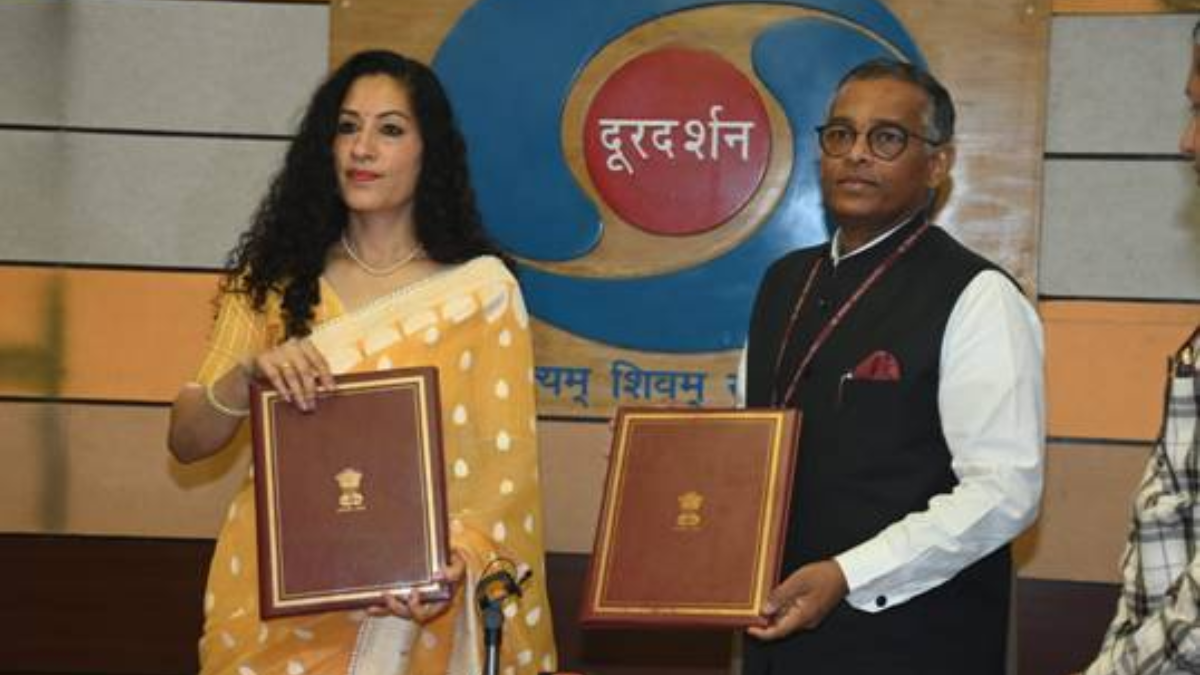
NEW DELHI: In a move aimed at taking India’s cultural story further across borders, Doordarshan under Prasar Bharati has signed a memorandum of understanding with the Indian Council for Cultural Relations to expand the global reach of Indian cultural content.
The agreement, signed on April 7 at Doordarshan Bhawan, brings together the content strength of ICCR and the wide broadcast network of Doordarshan, spanning television, radio and digital platforms.
Under the partnership, ICCR will provide a steady stream of cultural programming, including performances and events organised by Indian missions abroad such as embassies, consulates and cultural centres. Doordarshan will handle production, coverage and distribution, ensuring that these programmes find audiences not just in India but across the world.
The collaboration also opens the door for recorded cultural content from overseas missions to be aired across multiple platforms, including OTT and social media, making Indian art, music and heritage more accessible to global viewers.
A notable feature of the MoU is joint ownership of content rights in perpetuity, including digital rights. This allows both organisations to archive and reuse material over time, building a long-term cultural repository while maximising reach. Doordarshan will also support pre-event promotion and cross-platform visibility to drive engagement.
Speaking at the signing, Doordarshan director general K. Satish Nambudiripad and Indian Council for Cultural Relations director general K. Nandini Singla highlighted the potential of the partnership to strengthen India’s cultural diplomacy through modern media channels.
The agreement, initially valid for three years, also allows Doordarshan to explore monetisation opportunities from the content generated, adding a commercial layer to cultural broadcasting.
As India looks to blend tradition with technology, this partnership signals a clear intent to make its cultural voice not just heard, but seen and streamed across the globe.






