News Broadcasting
Need for govt. support to animation stressed at seminar

MUMBAI: The animation industry in India would receive a fillup if the government took steps to supports it. One of the steps could be that it mandates that animation channels carry at least 10 per cent of local content.
This was a suggestion made by Padmalaya, Zica’s Rajiv Sangari at the Broadcast India 2004 Technical Symposium. He noted that France has six animation channels. The French government’s rule is that 60 per cent of content come from Europe. Out of that 40 per cent should be from France. “In India, on the other hand, there is zero consumption of local content. Doordarshan has never bothered about local content.
“While I appreciate the fact that too much of regulation is not a good thing; if the government were to insist that just 10 per cent of local content be carried on animation channels then the industry would receive a boost,” Sangari said.

Another problem he noted was that of low skill set. There are not more than 3000 skilled animators in the country while we need 15,000 of them. Philippines on the other hand has 40,000 skilled animators. What is happening as a result is that salaries in India go up by 40 per cent a year, which is unhealthy for a nascent industry. He warned that there were no shortcuts to being a complete animator. India has 15-20 animation studios compared to 200 in South Korea.
On the positive side we get good 3D animation projects. India is in the process of applying its creativity on the right tools in this area. He noted that Indian companies do actual production work for animation projects in the US, Japan and Germany. These are the countries that outsource the most.
As per Nasscom estimates the work that Indian animation companies do is worth $550 million. It is growing at 30 per cent a year. “While there is debate on these figures even if it is accurate we still do not account for one per cent of the global animation work.”
Meanwhile Seagate Technology’s Sharad Srivastava delivered the keynote address on the storage solutions for the television and film industries. “In 2001 it took a year to fill up one terabyte of data. Today it takes a couple of hours. The global television industry produces 40,000 terabytes of data a year. Radio stations produce 14,000 terabytes. Multiple
streaming of data is possible with digital archives. In this scenario hard disc drives for storing data have assumed a greater degree of importance.”
He added that the products were getting more rugged and also allowed for multiple streaming of data. This is important for time shift capabilities and non linear editing. In time shift one data stream gets recorded while the other is viewed. He noted that these days many companies use a San Storage Area Network. Here a central pool of hard disk drives works
with different servers.
This allows the broadcaster to allocate space as and when required. This setup is important if there is a situation of data doubling every six months. Also Raid systems are expensive to upgrade. Then there are portable hard disk drives. These can store a maximum of 400 gigabytes, which is the equivalent of 400 hours of television or 2500 songs.
Digiworkz’ Loh Siu Yin spoke on streamlining television broadcasting by using open source software. According to him the most important part in a broadcast network is the playback system which relays the information from Star, Zee, Sony to the MSO. The problem is that there are databases everywhere which are not defined. Also some traffic systems do not handle secondary material like sound quality. Broadcasting is too important for it to be done manually beyond a certain point.
Information is embedded in a media database system. The source codes for the database and traffic system are kept a secret.
One alternative is using an open source code. One can look at extending public interfaces like the playlist files. Then one builds an application using visual basic. One can check the playlist against the database and then uplink to the traffic system.
He also suggested the use of database dumps. Software that he uses includes python, which understands binary files. Then there is sambam which is a Windows NT Server clone and Cron allows for the copying of files.





News Broadcasting
UDF poised to return to power in Kerala, says Manorama-CVoter survey
Massive opinion poll projects shift in Kerala politics ahead of 2026 Assembly elections.
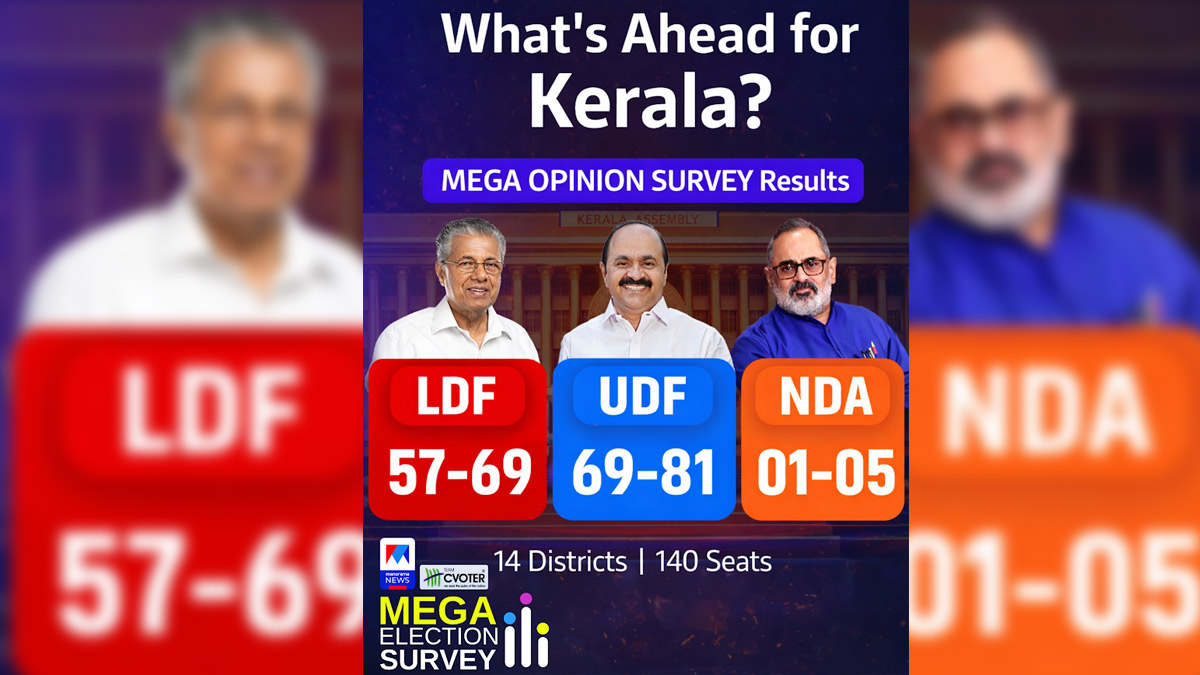
MUMBAI: The winds of change appear to be blowing through Kerala’s political landscape and this time, they seem to favour the United Democratic Front. A comprehensive mega opinion survey conducted by Manorama News in partnership with CVoter projects a potential comeback for the UDF in the upcoming Kerala Legislative Assembly Elections 2026. The survey, covering all 140 constituencies with a massive sample size of nearly 90,000 respondents, predicts the UDF could win between 69 and 81 seats.
The ruling Left Democratic Front (LDF) is expected to secure 57 to 69 seats, a significant drop from the 99 seats it won in the 2021 elections. This would mean the LDF losing 30 to 42 of its sitting seats. Meanwhile, the National Democratic Alliance (NDA), which drew a blank in 2021, is projected to open its account with 1 to 5 seats.
Region-wise, the UDF is expected to make strong gains in Malabar, winning 25 to 34 out of 48 seats, and in Central Kerala, where it could bag 29 to 33 out of 53 seats. In South Kerala, the LDF is likely to retain an edge with 21 to 25 seats, while the UDF may improve to 12 to 16 seats. The NDA could pick up 1 to 3 seats in the southern region.
The survey was conducted between 14 and 26 March 2026, with additional tracker and snap polls carried out from December 2025 to March 2026. A total of 89,693 respondents participated, ensuring representation across all demographics and social segments.
Manorama News has a strong track record of accuracy, with its previous projections closely matching the actual results of the 2019 and 2024 Lok Sabha elections as well as the 2021 Kerala Assembly polls.
In Kerala’s famously fierce political battles, this survey suggests the pendulum may be swinging back. Whether the final verdict matches these numbers or throws up another surprise, one thing is clear, the 2026 Assembly elections are shaping up to be one of the most keenly watched contests in the state’s history.






