News Broadcasting
NDTV’s Election Carnival traverses 11,000 Kilometres, across 50 cities, featuring 14 anchors

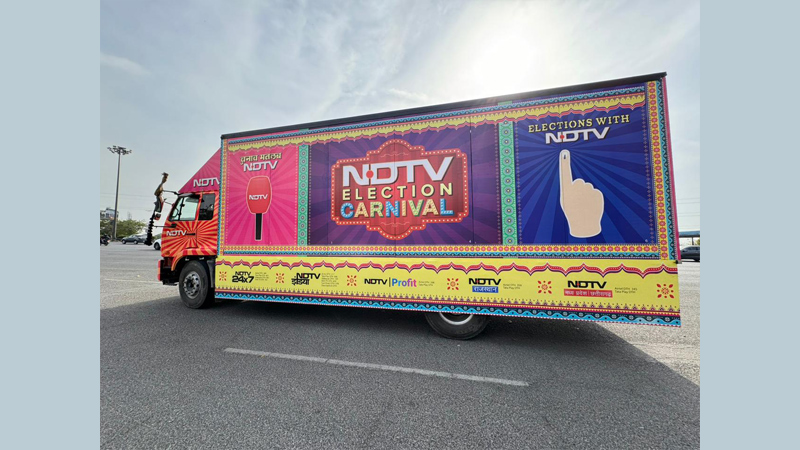
Mumbai: NDTV’s Election Carnival, a vibrant celebration of democratic enthusiasm and civic engagement, is on an extraordinary journey across India, captivating hearts and minds as it travels. Originally planned to cover 5000 kilometres, the Carnival’s overwhelming reception has led to an extended route to over 9,000 kilometres, now expanding further to 11,000 Kilometers and reaching more than 50 cities non-stop since 30 days.
In line with NDTV’s commitment to fostering informed citizenship, the Carnival has become a catalyst for change, igniting passions and inspiring action in every city it visits. It aims to promote lively discussions with political faces from that area, interactive sessions, and folk artist performances, inspiring local communities and motivating them to take an active role in the democratic process.
The Carnival kicked off its journey from the heart of Chandni Chowk in Old Delhi celebrating the diverse regional cultures of India.

Travelling through various states including Uttarakhand, Uttar Pradesh, Rajasthan, Bihar, Jharkhand, Chhattisgarh, Gujarat, Maharashtra, Karnataka, and Telangana, the Carnival has provided invaluable insights into the political landscapes and electoral dynamics of each region.
In Meerut, Uttar Pradesh, the Carnival delved into the intense political competition between SP-BSP and BJP, highlighting the journey of BJP’s candidate, Arun Govil. Moving on to Mathura, the Carnival engaged with Hema Malini’s campaign, addressing local concerns such as environmental pollution.
In Bharatpur, the Carnival witnessed a fierce electoral contest between BJP’s Ramswarup Koli and Congress’ Sanjana Jatav, focusing on critical issues like education and healthcare.
Traversing to Madhya Pradesh, NDTV’s editor-in-chief, Sanjay Pugalia, had an exclusive conversation with Madhya Pradesh chief minister Dr Mohan Yadav during the Carnival’s stop in Bhopal, where Dr Yadav emphasised the need to diversify sectors beyond farming to boost farmers’ income. Followed by discussions in Ujjain shedding light on the electoral atmosphere and pressing local issues along with insights into employment, water, and infrastructure concerns in Khandwa.
In Gujarat, Anand became a focal point for dissecting the dynamics between BJP and Congress, while in Maharashtra, the Carnival amplified the electoral fervour in Baramati, addressing issues like water scarcity and unemployment.
The Carnival also journeyed through states like Jharkhand, exploring industrial concerns in Jamshedpur and electoral trust in Surguja.
Each stop of the Carnival enriched the national political discourse by providing unique insights into local issues, electoral dynamics, and voter sentiments, reaffirming NDTV’s commitment to facilitating meaningful dialogue and strengthening the democratic fabric of India.
NDTV’s Election Carnival is not just a journey; it’s a movement toward a more informed, involved, and participative democracy – India’s awakening movement. As it continues its odyssey across India, the Carnival reaffirms its commitment to being the voice of the people, bringing them closer to their leaders and the essence of democracy itself.


News Broadcasting
Network18 channels lead YouTube news viewership in March 2026
CNN-News18, News18 India and CNBC channels top categories with record views
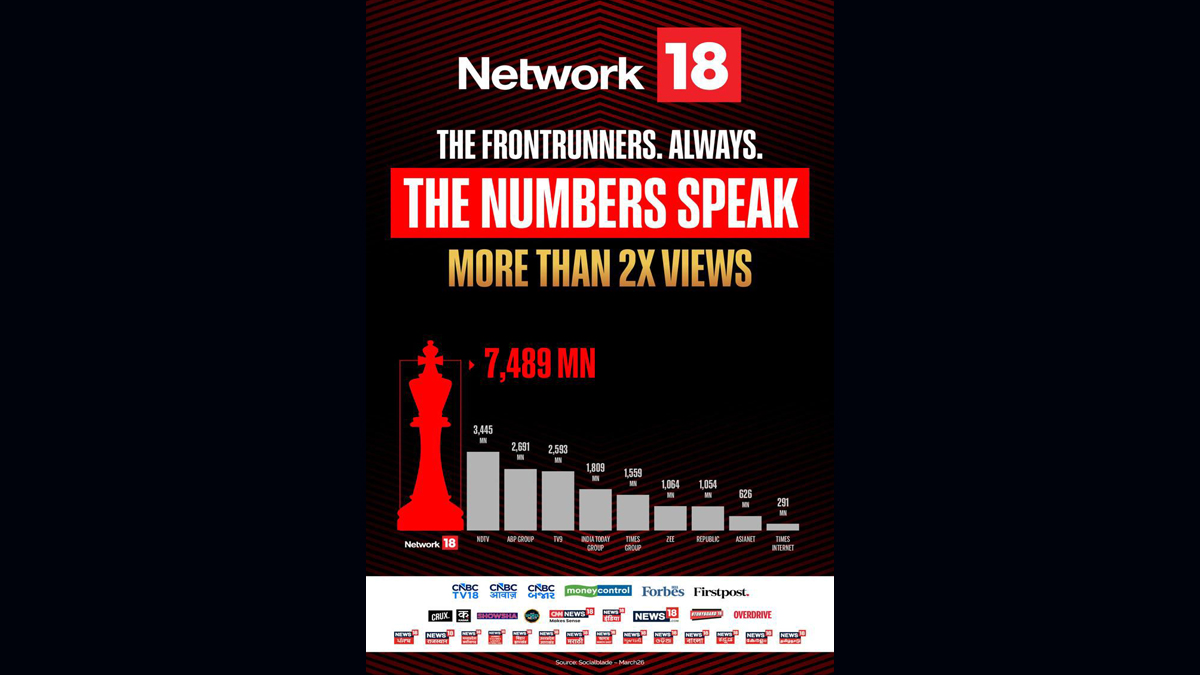
MUMBAI: When the world hit refresh on breaking news, Network18’s channels were already streaming ahead. As geopolitical tensions and war-driven headlines fuelled a surge in global news consumption, the network’s digital playbook delivered big clocking record Youtube viewership across English, Hindi and business news categories in March 2026.
At the forefront was CNN-News18, which emerged as the clear leader in the English news segment with 130 million live and video-on-demand views. The channel edged past competitors such as Times of India (126.5 million), Times Now (101.1 million), India Today (88.2 million) and NDTV (77.5 million), according to Databeings data for March.
In the Hindi news arena, News18 India delivered a commanding performance, racking up a staggering 3,297 million views on YouTube. The channel comfortably outpaced NDTV India, which recorded 3,119 million views, underlining its deep reach and consistent engagement with mass audiences, as per Playboard data.
The network’s dominance wasn’t confined to general news. In the Hindi business segment, CNBC Awaaz topped the charts with 92 million views, narrowly ahead of Zee Business (90 million) and well ahead of ET Now Swadesh (57 million). Meanwhile, its English counterpart CNBC-TV18 posted a strong 58 million views, reinforcing the network’s cross-category strength.
The spike in viewership reflects a broader shift in audience behaviour, with viewers increasingly turning to digital platforms particularly Youtube for real-time updates and in-depth coverage during high-intensity news cycles. For Network18, the numbers signal more than just scale; they underline the effectiveness of a multi-platform strategy that blends speed, credibility and continuous coverage.
In a month where the news never paused, it seems viewers chose to stay tuned where the stream never stopped.






