News Broadcasting
NBA to put in place content code based on self-regulation within 4 weeks


NEW DELHI: The News Broadcasters Association (NBA) will put systems in place for a content code based on self- regulation for news television channels within four weeks.
“The Information and Broadcasting ministry is only entitled to give the licence and the rest should be left to the industry. NBA has worked out an answer to the Content Code where it has dealt with redressal mechanism, the details of which would be released in another four week’s time”, said TV Today Network CEO and NBA president G Krishnan while speaking at the second edition of the NT Summit, organised by Indiantelevision.com.
The morning session on “The Commercial Imperative” focused on striking the right balance between the editorial and commercial imperatives.

Distribution was emerging as a large cost that was hurting news broadcasters, speakers at the session agreed.
“News channels are paying Rs 5 billion as carriage fee. The surge in distribution costs is killing the industry,” says Krishnan.
The news TV business is raking in over Rs 10 billion in revenues and is employing over 25,000 people directly,” Krishnan added.
The distribution issues, however, need to be sorted out. Times Now CEO Chintamani Rao blamed the huge pressure on cost of distribution as the major force impeding the growth process of the industry.
Digicable CEO Jagjit Singh Kohli said digitalisation through Headend-In-The-Sky (HITS) and Cas was the only way out. “In analogue mode, a cable operator has a capacity to carry 70 to 80 channels. However the numbers of channels are increasing every day. So till the time complete digitalisation takes place, the situation will remain grim.”
Kohli blamed the government for not coming out with policies on Cas extension and HITS. “We applied for HITS licence but the government said the policy was not ready yet,” he said.
The market was being spoilt by new entrants from across all sectors. The ministry of information and broadcasting ministry recently cleared 33 licences for news channels.
“A multi-media approach can only help succeed in this clutter. Single news channels will find it very difficult to exist,” said CNN IBN and IBN7 editor-in-chief Rajdeep Sardesai.
While the commercial aspect is imperative, it should not be forgotten that news is a unique product which is built over a period of time and is known for its credibility and genuineness, Sardesai added. “The ‘Chinese wall’ between content advertisements and content should be maintained.”
Star News CEO Ashok Venkataramani added, “Commercial side of the news business is very important..”
The market has to rule. Zee News CEO Barun Das said that there was space for real news, evident from the success that the relaunched Zee News channel is enjoying.
Tam India CEO L V Krishnan stated that news channels have drawn in new audiences and advertisers. The afternoon slot, for example, used to barely have any viewership. But now it has opened up women audiences. “Almost 44 per cent of viewership in the afternoon comes through women. There are 3400 new advertisers that have flocked in.”
India TV COO Rohit Bansal stressed on the reason behind showing news and non news programmes, “The family audiences have certain choices, likes or dislikes; depending on that we create our programmes. We are also scoring on real news. The ministry of Information and Broadcasting looks at us as hard as it looks at any channel. And till date we have never faced a situation where we had to apologise for showing distressing content. As a news channel our job is to satisfy the regulator, advertisers and viewers and we are all trying our best to maintain the balance.”





News Broadcasting
UDF poised to return to power in Kerala, says Manorama-CVoter survey
Massive opinion poll projects shift in Kerala politics ahead of 2026 Assembly elections.
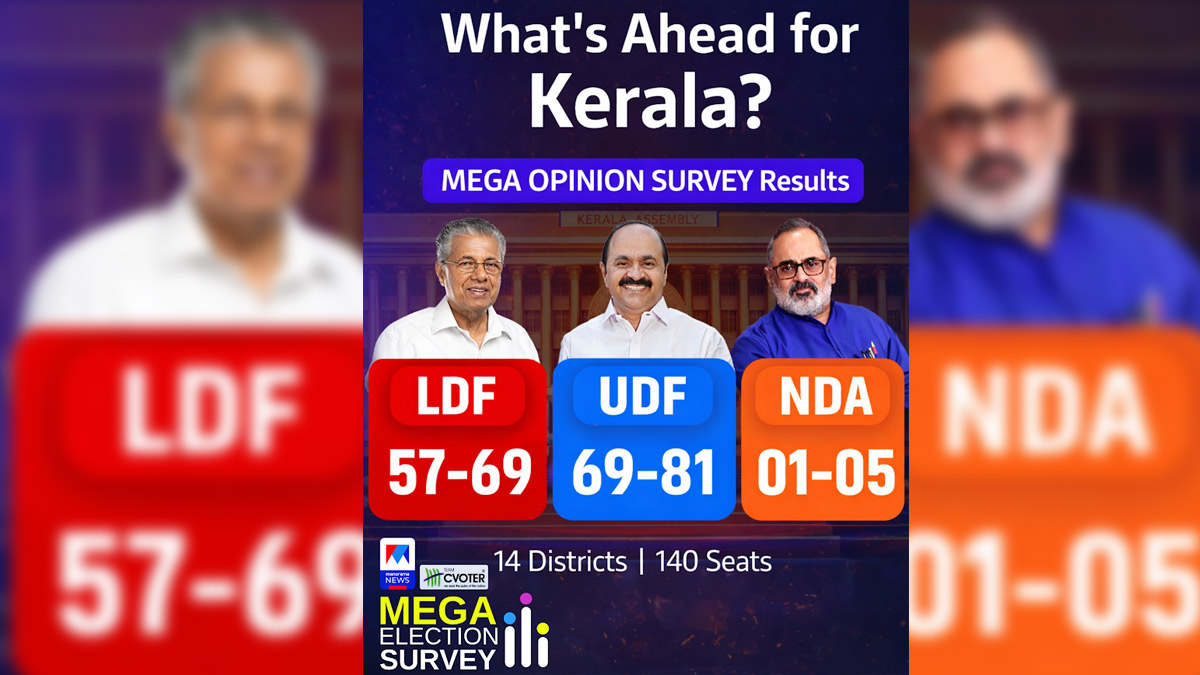
MUMBAI: The winds of change appear to be blowing through Kerala’s political landscape and this time, they seem to favour the United Democratic Front. A comprehensive mega opinion survey conducted by Manorama News in partnership with CVoter projects a potential comeback for the UDF in the upcoming Kerala Legislative Assembly Elections 2026. The survey, covering all 140 constituencies with a massive sample size of nearly 90,000 respondents, predicts the UDF could win between 69 and 81 seats.
The ruling Left Democratic Front (LDF) is expected to secure 57 to 69 seats, a significant drop from the 99 seats it won in the 2021 elections. This would mean the LDF losing 30 to 42 of its sitting seats. Meanwhile, the National Democratic Alliance (NDA), which drew a blank in 2021, is projected to open its account with 1 to 5 seats.
Region-wise, the UDF is expected to make strong gains in Malabar, winning 25 to 34 out of 48 seats, and in Central Kerala, where it could bag 29 to 33 out of 53 seats. In South Kerala, the LDF is likely to retain an edge with 21 to 25 seats, while the UDF may improve to 12 to 16 seats. The NDA could pick up 1 to 3 seats in the southern region.
The survey was conducted between 14 and 26 March 2026, with additional tracker and snap polls carried out from December 2025 to March 2026. A total of 89,693 respondents participated, ensuring representation across all demographics and social segments.
Manorama News has a strong track record of accuracy, with its previous projections closely matching the actual results of the 2019 and 2024 Lok Sabha elections as well as the 2021 Kerala Assembly polls.
In Kerala’s famously fierce political battles, this survey suggests the pendulum may be swinging back. Whether the final verdict matches these numbers or throws up another surprise, one thing is clear, the 2026 Assembly elections are shaping up to be one of the most keenly watched contests in the state’s history.






