Hindi
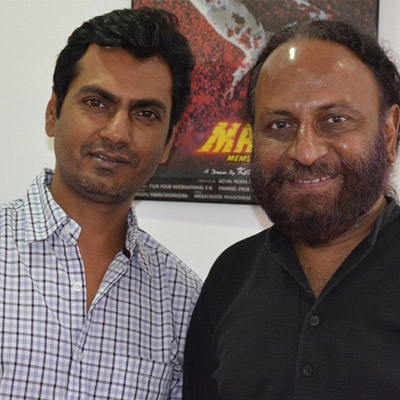
Nawazuddin Sidiqqui stars as Manjhi in Ketan Mehta’s next directorial

MUMBAI: Taj Mahal was constructed in the loving memory of Mumtaz Mahal by the Mughal emperor Shah Jahan. This monument took 21 years to build and thousands of artisans and craftsmen worked tediously to erect the magnificent structure.
Then there is Manjhi, an inspiring love story of a poor Shah Jahan, Dashrath Manjhi. Over 22 years, with just a hammer and a chisel, he carved out a path through a mountain, in memory of his beloved wife who had fallen down while trying to cross it. He did it so that no one else would have to suffer her fate.
“The story of Manjhi is truly inspiring, and for a man to actually break a mountain with just a hammer and a chisel for 22 years for his lost love just gave me goosebumps”, said director Ketan Mehta. “This has certainly been the toughest shoot of my life; we shot in Naxal infested areas on actual location in Bihar.”

Marking the occasion of Dashrath Manjhi’s sixth death anniversary, renowned director Ketan Mehta announced the completion of his movie Manjhi – The Mountain Man. A biopic on Dashrath Manjhi, famous for being the man who broke a mountain for love, is a co-production between Maya Movies and National Film Development Corporation (NFDC).
The movie is co-written and directed by Ketan Mehta and produced by Deepa Sahi and Nina Lath Gupta, with an ensemble cast. The movie has been shot on actual locations in remote areas of Bihar.
“It was one of the most difficult films to shoot, with the unit having to climb a mountain on foot, every day literally”, said Manjhi – The Mountain Man producer Deepa Sahi. “The movie is looking very nice with brilliant performances by all the artists. We have completed the post-production and are looking forward to release it by the end of this year”, she further added.

Acclaimed actor, Nawazuddin Sidiqqui, who has won the hearts of audience and critics alike, for his commendable performances in Gangs of Wasseypur, Talaash, Kahaani and Bombay Talkies, will be essaying the role of Dashrath Manjhi. Actress Radhika Apte, will be seen as Manjhi’s wife. Tigmanshu Dhulia, Pankaj Tripathi, Prashant Narayan, Gaurav Dwivedi, amongst others round up the ensamble cast.
“I wanted the character of Manjhi to be as real as possible and after considering a few actors Nawaz suited the bill perfectly”, Ketan expounded. “The feel of the movie is really raw, intense and earthy; I am really pleased with the final product and am confident the audience will be too.”
NFDC was approached with the script and they agreed to co-produce the feature film. The complete film has been shot in digital and Ketan is really pleased with the outcome. “This is the first time that I have shot with Red Epic cameras and the result is just amazing.” The duration of the film is just over two hours and should be releasing by end of the year or early next year.
On being asked if he is confident of the film raking in the moolah at the box-office, here is what Ketan had to say, “Cinema is not just a numbers game. I make movie for the sheer passion of cinema. This is not just a movie, but a triumph of human spirit and to prove that nothing in this world is impossible.”
Ketan Mehta’s magnum opus – Rang Rasiya – that has been stuck in the doldrums for quite sometime now has also finally got the green signal and should see the light of day by end of this year.
Ketan has been off the radar for quite sometime now, hope with Manjhi and Rang Rasiya his fans can again have the opportunity to connect with him on the silverscreen.




Hindi
India’s telecom subscribers cross 1.32 billion in February 2026
Broadband base swells past 1.06 billion as Jio and Airtel tighten grip on the market.
MUMBAI: India’s telecom sector is ringing in steady growth once again adding millions of new connections every month while the race for broadband supremacy continues to heat up like a fiercely contested cricket match. According to the latest data released by the Telecom Regulatory Authority of India (TRAI) on 1 April 2026, the total telephone subscriber base in the country reached 1,321.31 million at the end of February 2026. This marked a net addition of 7.31 million subscribers during the month, translating into a monthly growth rate of 0.56 per cent.
Wireless subscribers (including mobile and Fixed Wireless Access) stood at 1,273.31 million, registering a net addition of 6.97 million and a growth rate of 0.55 per cent. Within this, urban wireless connections grew to 730.75 million (growth 0.70 per cent), while rural wireless subscribers reached 542.56 million (growth 0.35 per cent).
Wireline subscribers, though much smaller in scale, showed slightly faster growth. The total wireline base increased to 47.99 million, with a net addition of 0.34 million and a monthly growth rate of 0.70 per cent. Urban areas continued to dominate wireline connections with a share of 89.41 per cent.
Overall tele-density in India improved to 92.66 per cent. Urban tele-density stood at 150.68 per cent, while rural tele-density edged up to 60.02 per cent.
The broadband subscriber base crossed a significant milestone, reaching 1,059.05 million at the end of February 2026. This reflected a healthy net addition of 6.33 million subscribers and a monthly growth rate of 0.60 per cent from January’s figure of 1,052.72 million.
Segment-wise, mobile wireless access continued to drive the majority of growth with 996.52 million subscribers. Fixed Wireless Access (including 5G FWA) added 16.51 million, while wired broadband stood at 46.02 million.
Reliance Jio Infocomm Ltd. maintained its commanding lead with 519.64 million broadband subscribers. Bharti Airtel Ltd. followed with 364.14 million, Vodafone Idea Ltd. with 129.36 million, Bharat Sanchar Nigam Ltd. with 28.70 million, and Atria Convergence Technologies Ltd. with 2.38 million.
Together, these top five players command a massive 98.60 per cent share of the total broadband market.
In the wireless (mobile) segment, private operators continued to dominate with 92.59 per cent market share, leaving public sector undertakings (BSNL and MTNL) with just 7.41 per cent.
Out of the total 1,257.29 million wireless (mobile) subscribers, 1,177.60 million were active on the peak Visitor Location Register (VLR) date, representing an impressive 93.66 per cent activity rate. Bharti Airtel led in this metric with 99.42 per cent of its subscribers active.
Meanwhile, 14.47 million subscribers submitted requests for Mobile Number Portability (MNP) in February, indicating healthy competition and customer churn across zones.
While urban areas still lead in absolute numbers, rural connectivity is slowly catching up. Rural wireless tele-density stood at 59.46 per cent, compared with the much higher urban figure of 142.32 per cent.
Fixed Wireless Access using 5G technology also showed promising traction, growing to 11.93 million subscribers. Reliance Jio and Bharti Airtel are the primary players driving this segment.
The data paints a picture of a maturing yet still rapidly expanding telecom ecosystem. With total telephone subscribers now well past the 1.32 billion mark and broadband users comfortably above 1.06 billion, India continues to solidify its position as one of the world’s largest and most dynamic digital markets.
From bustling city streets to remote villages, more Indians are staying connected than ever before proving that when it comes to telecom, the country’s appetite for growth shows no signs of hanging up anytime soon.






