News Broadcasting
Murdoch ‘Outfoxed’ by doc accusing Fox of slanting news

MUMBAI: It is not just Michael Moore’s Bush bashing documentary Farenheit 9/11 that is stirring controversy. Rupert Murdoch is understandably less than pleased with a new documentary.
Outfoxed, which recently released on DVD and VHS in the US, criticises Fox News for allegedly slanting its news.
Outfoxed is being promoted by the liberal advocacy group MoveOn and has been directed by Robert Greenwald. The documentary takes potshots at Fox News’ claim of being a fair and balanced network. Greenwald has reportedly offered Fox the opportunity to air his film for free. Greenwald also made The Crooked E: The Unshredded Truth about Enron, which aired recently in India on Hallmark.
Greenwald has been quoted in the US media as saying, “We examine how media empires, led by Rupert Murdoch’s Fox News, have been running a ‘race to the bottom’ in television news. This film provides an in-depth look at Fox News and the dangers of ever-enlarging corporations taking control of the public’s right to know.”

The film explores Murdoch’s burgeoning kingdom and the impact on society when a broad swathe of media is controlled by one person. Media experts, including veteran anchor Walter Cronkite, Jeff Cohen (Fair) Bob McChesney (Free Press), Chellie Pingree (Common Cause), Jeff Chester (Center for Digital Democracy) and David Brock (Media Matters) provide context and guidance for the story of Fox News and its effect on society.
Fox offered a strong rebuttal to the documentary at a press conference in New York. The Murdoch-owned broadcaster also launched a full-frontal attack on The New York Times, which had published an article on 11 July about the movie.
Fox News issued a statement claiming illegal copyright infringement actions on the part of of moveon.org in cooperation with The New York Times. This included cutting a deal not to give Fox News adequate time to react to the film. Fox went on to accuse the NYT of corrupting the journalistic process.
The documentary allegedly reveals the secrets of former Fox News producers, reporters, bookers and writers who expose what it’s like to work for Fox News. These former Fox employees talk about how they were forced to push a “right-wing” point of view or risk their jobs.
Some have even chosen to remain anonymous in order to protect their current livelihoods. As one employee said “There’s no sense of integrity as far as having a line that can’t be crossed.”
Coming back to the NYT issue, the publication had quoted from internal memos sent to Fox staffers by a senior vice-president. They seemed to illustrate a conservative bias. While Fox said that they had been given just one day to respond before publication of the article, the NYT claimed that a three-day notification had been issued.
As far as the employees who appear on the film are concerned, Fox referred to them as being in the low level category, adding that some left due to incompetence. Moreover, none of them had expressed differences about the editorial policy of the broadcaster.
In an interview to iwantmedia.com Greenwald added, “The goal of my film was to tell a story that we haven’t seen told in film before. We used Fox News’ own words, images and sound bites. I used the material that Fox News sends out to the US every day to make the case that they are a biased network.”




News Broadcasting
Network18 channels lead YouTube news viewership in March 2026
CNN-News18, News18 India and CNBC channels top categories with record views
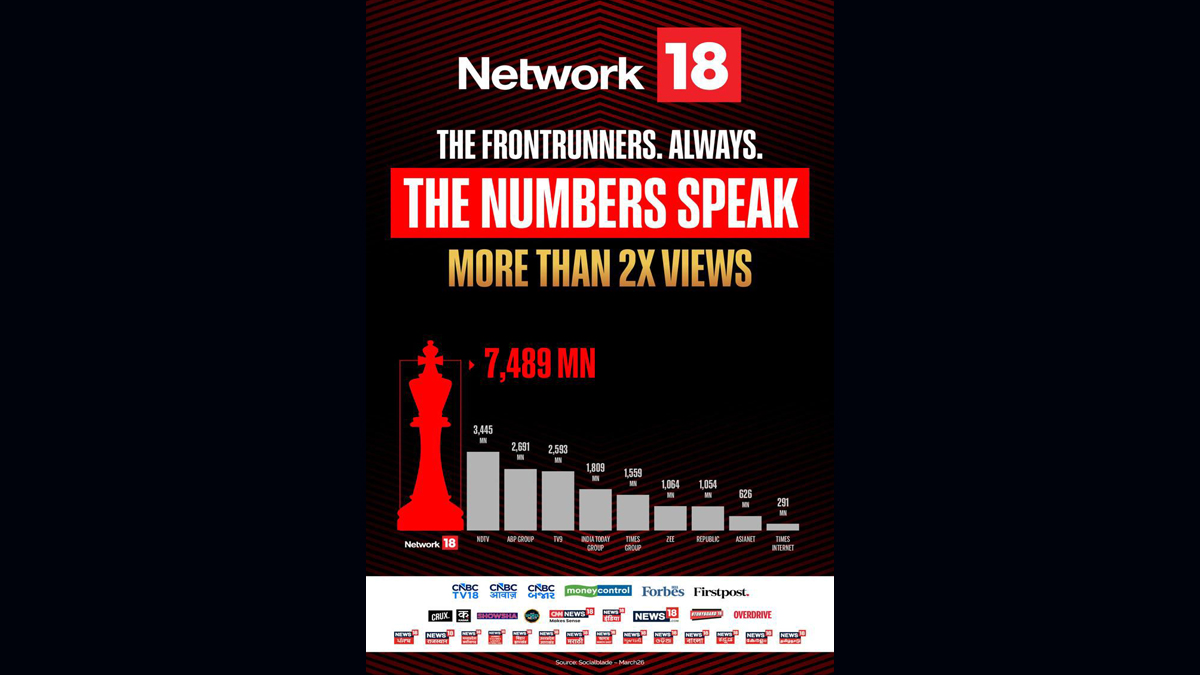
MUMBAI: When the world hit refresh on breaking news, Network18’s channels were already streaming ahead. As geopolitical tensions and war-driven headlines fuelled a surge in global news consumption, the network’s digital playbook delivered big clocking record Youtube viewership across English, Hindi and business news categories in March 2026.
At the forefront was CNN-News18, which emerged as the clear leader in the English news segment with 130 million live and video-on-demand views. The channel edged past competitors such as Times of India (126.5 million), Times Now (101.1 million), India Today (88.2 million) and NDTV (77.5 million), according to Databeings data for March.
In the Hindi news arena, News18 India delivered a commanding performance, racking up a staggering 3,297 million views on YouTube. The channel comfortably outpaced NDTV India, which recorded 3,119 million views, underlining its deep reach and consistent engagement with mass audiences, as per Playboard data.
The network’s dominance wasn’t confined to general news. In the Hindi business segment, CNBC Awaaz topped the charts with 92 million views, narrowly ahead of Zee Business (90 million) and well ahead of ET Now Swadesh (57 million). Meanwhile, its English counterpart CNBC-TV18 posted a strong 58 million views, reinforcing the network’s cross-category strength.
The spike in viewership reflects a broader shift in audience behaviour, with viewers increasingly turning to digital platforms particularly Youtube for real-time updates and in-depth coverage during high-intensity news cycles. For Network18, the numbers signal more than just scale; they underline the effectiveness of a multi-platform strategy that blends speed, credibility and continuous coverage.
In a month where the news never paused, it seems viewers chose to stay tuned where the stream never stopped.






