News Broadcasting
Mumbai HC postpones CAS hearings to June


MUMBAI: Even the courts appear to be waiting for the Telecom Regulatory Authority of India (Trai) offer some clarity of the vexed issue of conditional access. On 30 January, the Mumbai High Court postponed its hearing on several CAS cases to June.
While deferring the hearing, the court noted that Trai has been mandated to settle complicated issues involved with the cable ops and the broadcasters. However the HC has also stated that it has not stayed the implementation of CAS in the city.
Readers may recall that no sooner had Trai been appointed to regulate the cable industry than it went into high gear. Last month Trai had released a “consultation note” for the industry freezing the prices of cable services in respect of free to air (FTA) and pay channels as on 26 December 2003 for all areas. Trai had indicated that it wanted written responses by 30 January. It wanted clarity on issues such as norms for fixing rates (or ceiling rates). Another issue is whether the distribution of free-to-air channels; should be uniform in areas under CAS and non-CAS areas. The Indian Broadcaster’s Foundation (IBF) responded asking Trai to leave revenue aspects to the market forces.

Meanwhile, consumer organisations in Mumbai are a divided lot. One side that includes the Consumer Action Network filed petitions in favour of CAS. On the other side Citizens For a Just Society have opposed the legislation. In Chennai which was the first city to undergo the CAS process the going has not been smooth on account of distribution bottlenecks.
There were complaints from Chennai consumers that pay broadcasters like ESPN Star Sports were asking subscribers to sign an agreement for a year failing which they would not receive signals.
With elections at hand, politics has come into play as well with Tamil Nadu chief minister and recent entrant into the NDA fold Jayalalitha telling I&B minister Ravi Shankar Prasad that she wanted CAS to be withdrawn.
Prasad, meanwhile, has left it all to the Trai. Prasad, who was on Sunday in Chennai a few hours before the launch of Anna University’s first community FM radio, has been quoted in media reports as saying a decision on whether or not CAS would stay in Chennai depended solely on what the regulator’s report would recommend.






News Broadcasting
News18 India launches Command Centre war explainer with Arya
New show shifts from debates to decoding global conflicts and impacts
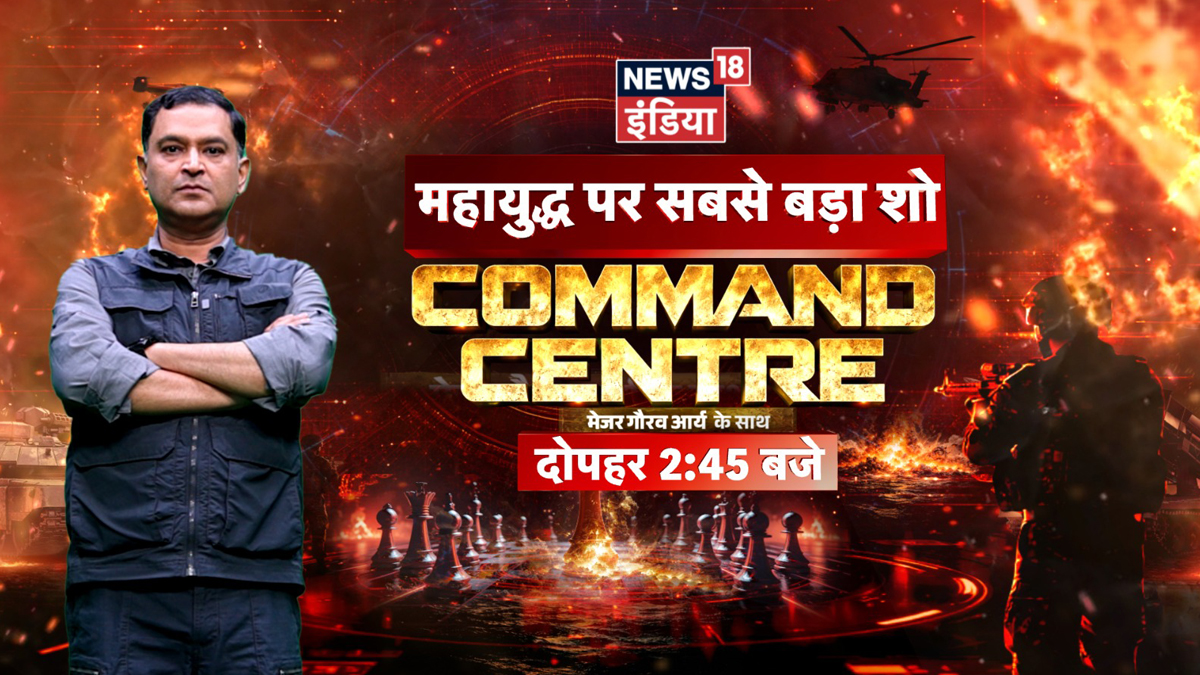
MUMBAI: News18 India has rolled out a new war-focused programme, Command Centre, featuring Gaurav Arya, as it looks to offer viewers a sharper, more grounded take on global conflicts amid rising tensions in West Asia.
Positioned as an “insider war room”, the show moves away from conventional panel debates and instead focuses on explaining military developments, decoding strategy and connecting global events to their everyday impact, from fuel prices to economic shifts.
The format leans heavily on visuals and data. The studio has been designed like a command hub, complete with large LED war maps, real-time graphics and an alert system to track developments as they unfold.
At the centre of it all is Arya, who brings his military background to simplify complex war strategies for viewers. His signature line, “Seedhi baat samjhiye”, anchors the show’s promise of clarity over noise.
News18 India managing editor Jyoti Kamal said, “Command Centre, featuring Major Gaurav Arya is designed to deliver accurate insights and a clear perspective on how evolving conflicts impact everyday life, from household budgets to national security. With expert voices analysing every development in real time, the show goes beyond headlines to decode what’s happening now, what it means, and what could come next.”
Echoing the intent, Gaurav Arya added, “In times of war, confusion is the biggest threat. With News18 India’s Command Centre, we are bringing viewers inside the war room, decoding strategies, tracking every escalation, and explaining, in the simplest terms, what it means for India and for every household. Seedhi baat samjhiye, this is where you understand not just what is happening, but what happens next.”
The weekday show will air in the afternoon slot and will also feature Gaurav Shukla, adding to its editorial depth.
With its mix of analysis, visuals and a clear focus on impact, the show reflects a broader shift in news consumption. Viewers are no longer just watching events unfold, they are looking to understand what those events mean for them.







