News Broadcasting
Morgan Stanley sees 29% annual revenue growth for Zee, valuation as attractive


NEW DELHI: JM Morgan Stanley (JMMS) feels that the valuation of Zee Telefilms, India’s largest vertically integrated media and entertainment company, “looks attractive” in the Indian market context as well as the global media sector.
JMMS has also predicted that considering the strategy adopted by Zee, including its overseas presence and a huge library of programmes, the company’s earnings are expected to grow 29 per cent annually over the next three years. The key driver will likely be the growth in subscription revenues in the domestic market that is expected to grow 43 per cent CAGR (compound aggregate growth rate) over the next three years.
In a report, dated early August and titled “Zee Telefilms: Down, But Definitely Not Out”, JMMS, said: “The absence of any media company of comparable size and equally diversified business profile has led us to compare Zee with other Indian corporates of significant size, strong brand equity and high growth rates (this would give a flavour of the company’s valuation in the Indian context).”

Zee Group chairman Subhash Chandra’s company can bounce back anytime
The report goes on to add: “The valuation (of Zee) looks attractive compared with the large Indian corporates, with Zee trading at an 18 to 42 per cent discount on EV/E (enterprise value to EBIDTA) and P/E (price to earning) ratio for financial year 2003.”
When JMMS research estimates took four Indian companies for comparison, it was found that Zee’s 31 per cent earnings growth is one of the highest, second only to Ranbaxy (59 per cent). The other companies taken for comparison included Hindustan Lever, Infosys and Bharti.
Zee is India’s largest vertically integrated media company with revenues of $ 220 million and a presence in film, music and education. It is a large producer and aggregator of Hindi programming with an extensive library. Zee is also one of the largest cable distributors in the country through its wholly owned subsidiary, Siti Cable, which services nearly 6.5 million cable homes and nationally enjoys 16.2 per cent market share.
Listing out the investment positives, the JMMS report, which also mentions that it does not provide individually tailored investment advise, states that since Zee’s programme library is one of the largest in the country – according to the Zee management it comprises 30,000 hours of programmes and 3,000 movies – “multiple delivery” is highly profitable.
Revenues from recycled software comprised 5 to 10 per cent of the total revenue over the past three years, the report says, adding: “The company has been exploiting the library across various distribution channels to optimise revenue.”
JMMS also feels that the regional bouquet of channels in the Zee stable is part of a good flanking strategy and the strong regional foray not only enables the company to command higher viewership, but also enables it to offer advertisers focussed solutions to their advertising needs.
Zee’s revenue of Rs. 2.05 billion in financial year 2002 from offshore subscribers comprised pay revenues and could “grow 19 per cent over the next three years by our estimates,” the Morgan Stanley report points out.
Programming improvisation may unlock the TRPs for Zee Group broadcasting CEO Sandeep Goyal
The JMMS report, of course, lists out investment concerns too and since indiantelevision.com believes in presenting both sides of the saga, here’s the flip side of the story. JMMS has noted that concerns include loss of viewership by Zee, current slowdown in ad market growth, need for improvisation in programming, high receivable days, some methods of accounting, attrition in top management and weak corporate governance in the past.
Pointing out that due to a slowdown in the growth of the overall ad market, Zee’s ad revenues too, for the first time in the past decade, had declined 7.5 per cent in the FY 2002, the report optimistically points out a slow and gradual recovery in ad revenue over the next two-three years is expected. But Zee has to watch out for the cricket World Cup next year where the matches are expected to “clash with prime time shows.”
The report also admits that Zee has ceded leadership to Star (which has managed to capture the eyeballs through blockbusters KBC, Kyunki and Kahaani) and adds: “We believe that Star, Sony and Zee will likely dominate and command 75-80 per cent of the ad market (with) Zee’s share to stabilise at 25-30 per cent.”






News Broadcasting
Network18 channels lead YouTube news viewership in March 2026
CNN-News18, News18 India and CNBC channels top categories with record views
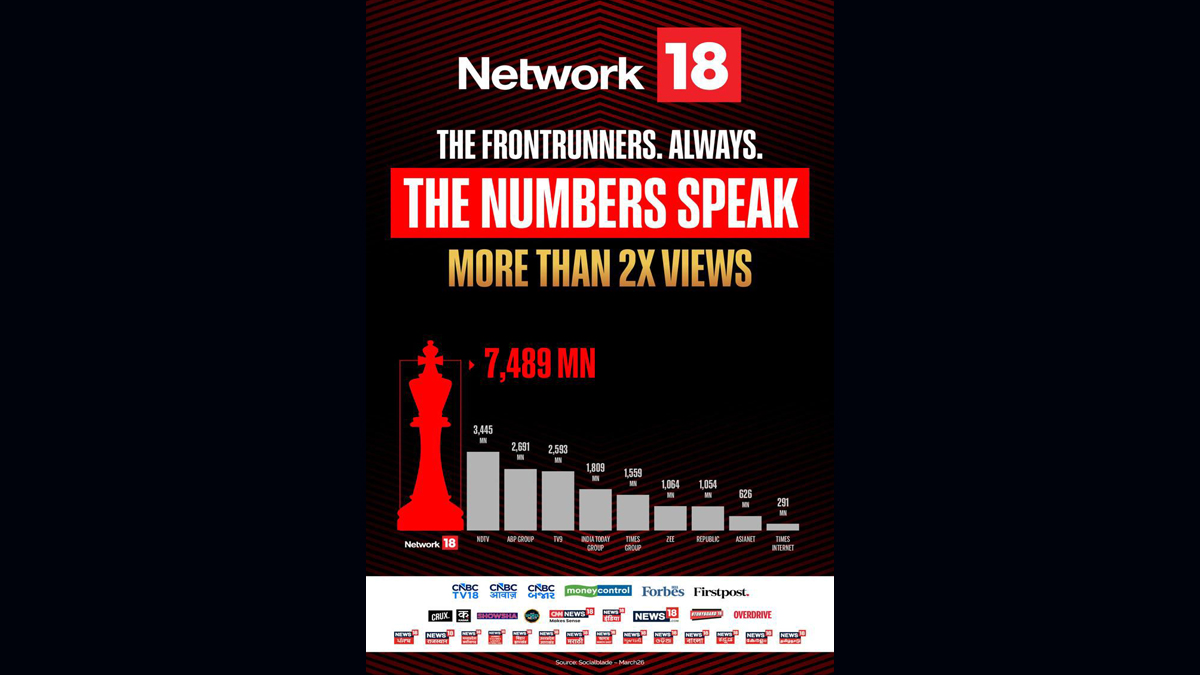
MUMBAI: When the world hit refresh on breaking news, Network18’s channels were already streaming ahead. As geopolitical tensions and war-driven headlines fuelled a surge in global news consumption, the network’s digital playbook delivered big clocking record Youtube viewership across English, Hindi and business news categories in March 2026.
At the forefront was CNN-News18, which emerged as the clear leader in the English news segment with 130 million live and video-on-demand views. The channel edged past competitors such as Times of India (126.5 million), Times Now (101.1 million), India Today (88.2 million) and NDTV (77.5 million), according to Databeings data for March.
In the Hindi news arena, News18 India delivered a commanding performance, racking up a staggering 3,297 million views on YouTube. The channel comfortably outpaced NDTV India, which recorded 3,119 million views, underlining its deep reach and consistent engagement with mass audiences, as per Playboard data.
The network’s dominance wasn’t confined to general news. In the Hindi business segment, CNBC Awaaz topped the charts with 92 million views, narrowly ahead of Zee Business (90 million) and well ahead of ET Now Swadesh (57 million). Meanwhile, its English counterpart CNBC-TV18 posted a strong 58 million views, reinforcing the network’s cross-category strength.
The spike in viewership reflects a broader shift in audience behaviour, with viewers increasingly turning to digital platforms particularly Youtube for real-time updates and in-depth coverage during high-intensity news cycles. For Network18, the numbers signal more than just scale; they underline the effectiveness of a multi-platform strategy that blends speed, credibility and continuous coverage.
In a month where the news never paused, it seems viewers chose to stay tuned where the stream never stopped.






