News Broadcasting
Moneycontrol Startup Conclave 2024: Insights from policymakers, investors & entrepreneurs


Mumbai: The Moneycontrol Startup Conclave 2024 presented valuable insights and strategic discussions, attracting industry giants, visionary entrepreneurs, and thought leaders from across the country. Held at ITC Gardenia in Bengaluru, the conclave, themed “Persist | Reset | Rebuild,” captured the essence of resilience and innovation needed to navigate today’s challenging startup landscape.
The event was organised to spotlight the transformative growth of India’s startup ecosystem. As innovation and entrepreneurship reach new heights, the conclave provided a crucial platform for key stakeholders to engage in meaningful dialogue. By facilitating the exchange of ideas and the formation of strategic partnerships, the event played a pivotal role in shaping the future trajectory of startups in India, underscoring the nation’s role as a global hub for entrepreneurial excellence.

To give a boost on the rise of the startup eco-system in Bengaluru, minister of electronics, IT & BT and rural development & panchayat raj, government of Karnataka – Priyank Kharge highlighted the state’s role in supporting the startup ecosystem, stating, “Karnataka continues to be at the forefront of innovation, and our government is committed to supporting startups with progressive policies and world-class infrastructure.”
India’s G20 Sherpa Amitabh Kant underscored the importance of startups in driving economic growth. “The future of India’s economy lies in the success of our startups. Their innovation and job creation capabilities are key to our nation’s progress,” Kant emphasised.
The day featured dynamic panel discussions with prominent entrepreneurs such as Zepto co-founder and CEO Aadit Palicha; Swiggy co-founder and group CEO Sriharsha Majety; Sorin Investments founder and chairman Sanjay Nayar; Delhivery co-founder and CEO Sahil Barua; PhonePe co-founder and CEO Sameer Nigam; Curefoods founder and CEO Ankit Nagori; Groww co-founder and CEO Lalit Keshre; Ixigo co-founder and group CEO Aloke Bajpai and SoftBank Investment Advisers managing partner Sumer Juneja. Topics ranged from quick commerce and workspace evolution to fintech innovations and the future of AI in startups. These sessions provided a wealth of knowledge, highlighting the achievements of industry leaders and offering a glimpse into the future of business in India.
Narayana Health founder and chairman Dr. Devi Shetty discussed the pivotal role of startups in healthcare. “Startups are revolutionizing healthcare, making it more accessible and affordable. Their contributions in the next decade will be groundbreaking,” Shetty observed.
SoftBank Investment Advisers managing partner Sumer Juneja highlighted the significant impact of their investments in India. “India has been an exceptional market for us, both in terms of investments and exits. Our focus now is on identifying the next wave of visionary leaders who can drive the future of innovation.”
Swiggy co-founder and group CEO Sriharsha Majety emphasised the unique dynamics of quick commerce in India, stating, “As the sector grows, we expect a significant reconfiguration in the supply chain, likely impacting traditional retail. A substantial portion of our revenue now comes from D2C brands, and as we prepare for our IPO, our focus remains on clear communication and long-term growth.”
The Moneycontrol Startup Conclave 2024 successfully created a platform for meaningful dialogue and collaboration among stakeholders. The event witnessed several in-person attendees, with many others joining via livestream.
Moneycontrol expresses its gratitude to all the distinguished speakers, esteemed guests, and partners, including IDFC FIRST Bank – Always You First (banking partner), DTDC (exclusive logistics partner), Peak XV (VC partner), IndiQube (workplace partner), and associate partners Games24x7, Share.Market, Adobe, Tally, Reliance India Ltd, KITS (state partner), Da Milano Italia (Luxury Partner), and Townhall (event technology partner). The participation of these partners and media personnel contributed significantly to the success of the Startup Conclave 2024. The event stands as a testament to the resilience, innovation, and determination of the Indian startup community.






News Broadcasting
UDF poised to return to power in Kerala, says Manorama-CVoter survey
Massive opinion poll projects shift in Kerala politics ahead of 2026 Assembly elections.
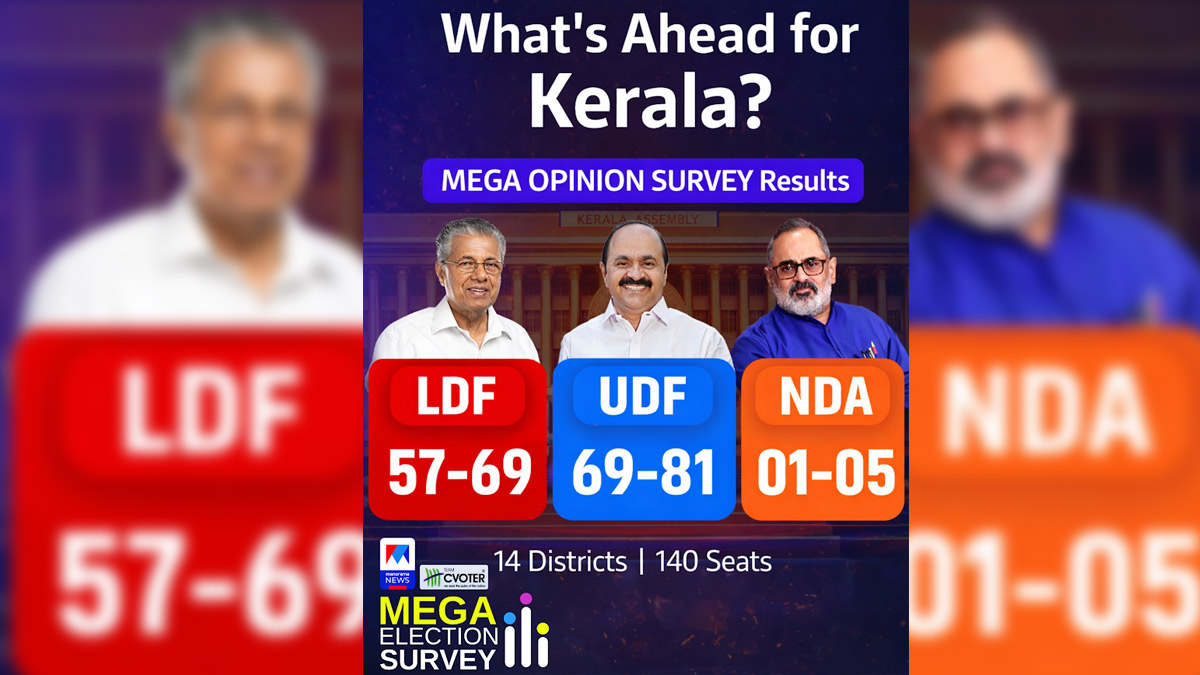
MUMBAI: The winds of change appear to be blowing through Kerala’s political landscape and this time, they seem to favour the United Democratic Front. A comprehensive mega opinion survey conducted by Manorama News in partnership with CVoter projects a potential comeback for the UDF in the upcoming Kerala Legislative Assembly Elections 2026. The survey, covering all 140 constituencies with a massive sample size of nearly 90,000 respondents, predicts the UDF could win between 69 and 81 seats.
The ruling Left Democratic Front (LDF) is expected to secure 57 to 69 seats, a significant drop from the 99 seats it won in the 2021 elections. This would mean the LDF losing 30 to 42 of its sitting seats. Meanwhile, the National Democratic Alliance (NDA), which drew a blank in 2021, is projected to open its account with 1 to 5 seats.
Region-wise, the UDF is expected to make strong gains in Malabar, winning 25 to 34 out of 48 seats, and in Central Kerala, where it could bag 29 to 33 out of 53 seats. In South Kerala, the LDF is likely to retain an edge with 21 to 25 seats, while the UDF may improve to 12 to 16 seats. The NDA could pick up 1 to 3 seats in the southern region.
The survey was conducted between 14 and 26 March 2026, with additional tracker and snap polls carried out from December 2025 to March 2026. A total of 89,693 respondents participated, ensuring representation across all demographics and social segments.
Manorama News has a strong track record of accuracy, with its previous projections closely matching the actual results of the 2019 and 2024 Lok Sabha elections as well as the 2021 Kerala Assembly polls.
In Kerala’s famously fierce political battles, this survey suggests the pendulum may be swinging back. Whether the final verdict matches these numbers or throws up another surprise, one thing is clear, the 2026 Assembly elections are shaping up to be one of the most keenly watched contests in the state’s history.






