News Broadcasting
Mirrow Now aims to engage viewers in 34-36 urban cities

MUMBAI: A short-term void is being turned into an opportunity. Times Network seems to be upping its news game with more, distinct and differentiated channels, creating more intellectual properties, with the involvement of the most critical stakeholder – the viewer. Strategies and leadership at the network have seen a significant change in the last few months which has enabled them to achieve sustainable growth despite growing competition in the news space.
With Mirror Now reaching to 3,65,000 viewers per week in five weeks and Times Now leading the general news category week by week, the nation’s most affluent television network is geared up for another successful year. “Mirrow Now’s aim is to involve and engage the viewers in the 34-36 urban cities with a million-plus population in India,” Times Network MD and CEO MK Anand told indiantelevision.com.
Mirror Now, which claims to have a relative percentage growth of 6% since its launch on 22 March, is committed to making lives better for the people of the nation each day. Being a channel which takes up the consumer’s issues and discussing and analysing government policies which directly impact the common man, it is differentiated by its content. “Discussing the everyday issues of life, from crime and corruption to roads and traffic congestion and to grave issues such as women’s safety, Mirror Now aims to demand accountability from powers that can drive improvement,” Mirrow Now editor Faye D’Souza said. Her distinctive news reporting with the ability to simplify complex concepts with ease has made every news story impactful.

With an aim to mobilise and actualise the plans, Mirror Now takes into consideration the citizen’s opinion to look for an opportunity for action and ensures accountability at all levels. Mirror Now is striving to work on the agenda for change and works towards giving better living conditions to the citizens of India. “We would actually track how much time it takes for an office-goer driving from Churchgate or Bandra to reach his home, say, in Borivali — and bring this to the notice of the concerned authorities,” D’Souza said.
The channel has already started making the difference that it set out to make with a lot of results driven through impactful stories on Mirror Now. As viewers relate to stories that have closely have a bearing on them — physically and emotionally, Mirror Now is aiming to reach the ideal average viewership per week required to stabilise a channel (4,50,000 – 5,00,000). To a question on a general lack of rigorous follow-ups of news stories, Anand reassured that all the critical stories were being definitely followed up.
Discussing threadbare and questioning policies that impact people at the city-level and taking up the real-life issues of the common man is uncommon on a national English channel. Mirror Now seems to be doing just that.
Also Read:
Times Now leadership continues, new launches notwithstanding, says MK Anand
Times Network MD & CEO MK Anand speaks out on l’affaire Arnab





News Broadcasting
News18 India launches Command Centre war explainer with Arya
New show shifts from debates to decoding global conflicts and impacts
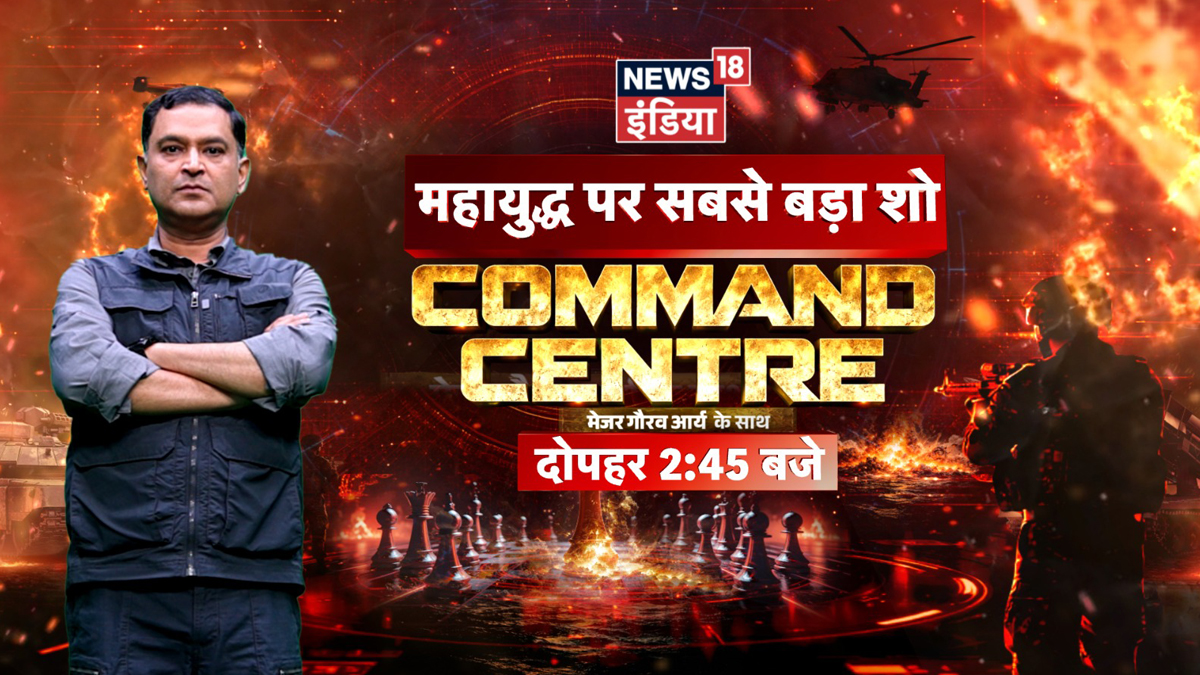
MUMBAI: News18 India has rolled out a new war-focused programme, Command Centre, featuring Gaurav Arya, as it looks to offer viewers a sharper, more grounded take on global conflicts amid rising tensions in West Asia.
Positioned as an “insider war room”, the show moves away from conventional panel debates and instead focuses on explaining military developments, decoding strategy and connecting global events to their everyday impact, from fuel prices to economic shifts.
The format leans heavily on visuals and data. The studio has been designed like a command hub, complete with large LED war maps, real-time graphics and an alert system to track developments as they unfold.
At the centre of it all is Arya, who brings his military background to simplify complex war strategies for viewers. His signature line, “Seedhi baat samjhiye”, anchors the show’s promise of clarity over noise.
News18 India managing editor Jyoti Kamal said, “Command Centre, featuring Major Gaurav Arya is designed to deliver accurate insights and a clear perspective on how evolving conflicts impact everyday life, from household budgets to national security. With expert voices analysing every development in real time, the show goes beyond headlines to decode what’s happening now, what it means, and what could come next.”
Echoing the intent, Gaurav Arya added, “In times of war, confusion is the biggest threat. With News18 India’s Command Centre, we are bringing viewers inside the war room, decoding strategies, tracking every escalation, and explaining, in the simplest terms, what it means for India and for every household. Seedhi baat samjhiye, this is where you understand not just what is happening, but what happens next.”
The weekday show will air in the afternoon slot and will also feature Gaurav Shukla, adding to its editorial depth.
With its mix of analysis, visuals and a clear focus on impact, the show reflects a broader shift in news consumption. Viewers are no longer just watching events unfold, they are looking to understand what those events mean for them.







