News Headline
MIB nod to TV channels on hold till TRAI uplink, downlink suggestions

MUMBAI: It’s official now. The Indian government has put on hold, since January 2018, clearances of new applications for TV channels till the Telecom Regulatory Authority of India (TRAI) comes out with recommendations on issues relating to uplinking and downlinking of TV channels.
According to government sources, in a note circulated mid-January 2018 by the Ministry of Information and Broadcasting (MIB) it was proposed to keep in “abeyance” permissions to all new TV channels till a “new policy” was put in place after studying recommendations from broadcast and telecoms regulator TRAI.
TRAI had floated a consultation paper on issues relating to uplink and downlink of TV channels in India mid-December 2017 on receiving a reference from the MIB to study the particular aspect and come out with suggestions. This consultation was initiated even as the regulator had been discussing various other issues with stakeholders of the broadcast and cable sectors on ease of doing business and inputs for the National Telecom Policy 2018. Subsequently, it submitted its recommendations to the government on ease of doing business and the NTP.

Even as the TRAI is yet to formulate its recommendations on uplink and downlink of TV channels, as an indirect fallout of the MIB proposal—as also certain other feedback from agencies like the Ministry of Corporate Affairs (MCA)—the government has also put on hold processing any change being sought by existing TV channels.
The sources indicated that out of the 97-odd applications from TV channels under-process, 30 are fresh applications. Show-cause notices have also been issued by the MIB to some 100 companies on the advice of the MCA for various irregularities. Out of the companies asked to explain, three had applied for clearances for additional TV channels.
Meanwhile, in its consultation paper on uplink and downlink of TV channels, amongst various other points, the TRAI had raised the following issues also:
· Should net-worth requirement of the applicant company for granting uplinking permission, and/or downlinking permission be increased?
· Should there be different net-worth requirements for uplinking of news and non-news channels?
· Whether auction of satellite TV channels as a complete package, similar to FM radio channels, is feasible?
· Is it technically feasible to auction individual legs of satellite TV broadcasting, that is uplinking space spectrum, satellite transponder capacity, and downlinking space spectrum?
· Is it feasible to auction satellite TV channels without restricting the use of foreign satellites, and uplinking of signals of TV channels from foreign soil?
· If it is decided to continue granting of licenses for satellite TV channels on administrative basis, as is the case presently, what should be the entry fee for grant of license for uplinking of TV channels from India, downlinking of TV channels uplinked from India, and downlinking of foreign TV channels?
· What should be the license fees structure, that is fixed, variable, or semi-variable, for uplinking and downlinking of satellite TV channels? Please elaborate if any other license fee structure is proposed, with appropriate justification.
· If the variable license fee structure is proposed, then what should be rate of license fee for TV channels uplinked from India and TV channels uplinked from abroad, and what should be the definition of AGR (annual gross revenue)?
· If the semi-variable license fee structure is proposed, then what should be the minimum amount of license fee per annum for domestic channels (uplinked and downlinked in India), uplink only channels, and downlinking of foreign channels (uplinked from abroad)?
· If the fixed license fee structure is proposed, then what should be the license fee per annum for domestic channels, uplink only channels, and downlinking of foreign channels?
· What should be the periodicity for payment of the license fee to the government? Please support your answer with justification.
· What should be the periodicity for review of the entry fee and license fee rates?
. Should all TV channels, i.e, pay as well as FTA satellite TV channels, be broadcasted through satellite in encrypted mode?
Also Read :
Regulatory hurdles prompt Star to telecast IPL’s Kannada feed on Star Suvarna Plus
Broadcasters, DPOs oppose TV channel auction proposal
No new channels added in December 2017
MIB, DoS nudge TV channel to use Indian satellites
MIB reverts to earlier norms of seeking nod from ISRO on uplink/downlink of TV channels





NEW DELHI: Hamdard Laboratories gathered a cross-section of India’s achievers in New Delhi on Friday, handing out the Hakeem Abdul Hameed Excellence Awards to figures who have left their mark across healthcare, education, sport, public service and the arts.
The ceremony, attended by minister of state for defence Sanjay Seth and senior officials from the ministry of Ayush, celebrated individuals whose work blends professional success with a sense of public purpose. It was as much a roll call of achievement as it was a reminder that influence is not measured only in profits or podiums, but in people reached and lives improved.
Among the headline awardees was Alakh Pandey, founder and chief executive of PhysicsWallah, recognised for turning affordable digital learning into a mass movement. On the sporting front, Arjuna Awardee and kabaddi player Sakshi Puniya was honoured for her contribution to the game and for pushing women’s participation onto bigger stages.
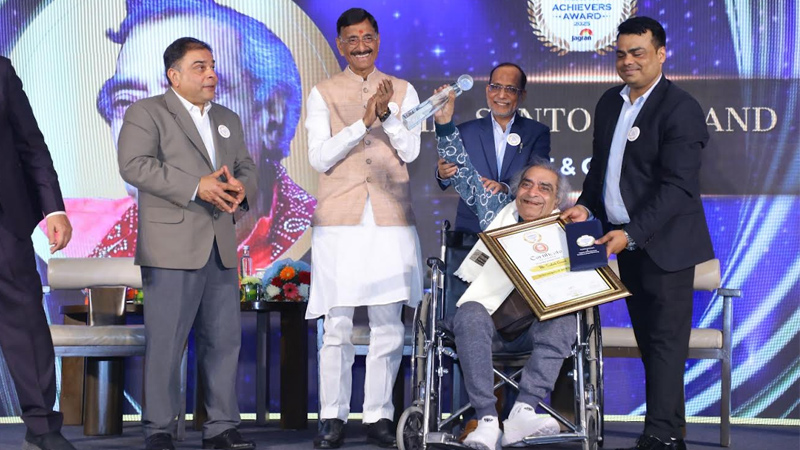
The cultural spotlight fell on veteran lyricist and poet Santosh Anand, whose songs have echoed across generations of Hindi cinema. At 97, Anand accepted the honour with characteristic humility, reflecting on a life shaped by perseverance and hope.
Healthcare honours spanned both modern and traditional systems. Manoj N. Nesari was recognised for strengthening Ayurveda’s place in national and global health frameworks. Padma shri Mohammed Abdul Waheed was honoured for his research-backed work in Unani medicine, while padma shri Mohsin Wali received recognition for his long-standing contribution to patient-centred care.
Education and social development also featured prominently. Padma shri Zahir Ishaq Kazi was honoured for decades of work in education, while former Meghalaya superintendent of Police T. C. Chacko was recognised for public service. Goonj founder Anshu Gupta received an award for his dignity-centred rural development initiatives, and the Hunar Shakti Foundation was honoured for empowering women and young girls through skill development.
The Lifetime Achievement Award went to former IAS officer Shailaja Chandra for her long career in public healthcare and governance, particularly in the traditional systems under Ayush.
Speaking at the event, Hamdard chairman Abdul Majeed said the awards were a tribute to those who combine excellence with empathy. “These awardees reflect Hakeem Sahib’s belief that healthcare, education and public service must ultimately serve humanity,” he said.
Minister Seth struck a forward-looking note, saying India’s young population gives the country a unique opportunity to become a global destination for learning, health and wellness by 2047.
The ceremony also featured the trailer launch of Unani Ki Kahaani, an upcoming documentary starring actor Jim Sarbh, set to premiere on Discovery on 11 February.
Instituted in memory of Unani scholar and educationist Hakeem Abdul Hameed, the awards have grown into a national platform that celebrates those building a more inclusive and resilient India. For one evening at least, the spotlight was not just on success, but on service with substance.






