I&B Ministry
‘M&E industry’s $100 billion dream remains elusive with choking of investment:’ Star India COO Sanjay Gupta

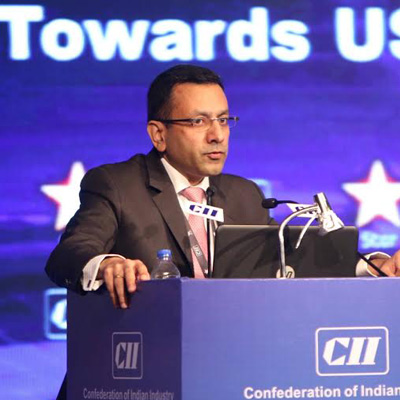
MUMBAI: Despite the India Shining and Digital India waves that the country has been witnessing, the $100 billion dream has remained elusive for the Indian media and entertainment (M&E) industry.
Speaking at a CII conclave in New Delhi today, Star India COO Sanjay Gupta lamented this fact that saying that from 0.8 per cent of GDP three years ago, the industry had resolved to grow to 1.5 per cent within a decade. However, in the past three years, media as a percentage of GDP has instead fallen by two basis points and the $100 billion dream has continued to remain distant.
“The biggest hurdle has been the choking of investment. To meet ambitious targets, a business either needs to generate large profits internally, which are then invested back into the business or they grow on the back of external investments – national or international. But the M&E industry boasts of neither,” he said

CII National Committee on Media and Entertainment and Group CEO, Viacom 18 Group CEO and CII National Committee on Media and Entertainment chairman Sudhanshu Vats, Prasar Bharati CEO Jawahar Sircar, Information and Broadcasting Ministry special secretary JS Mathur and Minister of State for Information and Broadcasting Rajyavardhan Singh Rathore were among those present at the summit.
During the past 15 years, the M&E sector has barely seen any new entrants and only around $4 billion in foreign direct investment (FDI). To garner $100 billion, the industry needs to invest at least $50 billion over the next decade – something that seems farfetched, given the present circumstances. “With M&E remaining an unattractive destination for investments, investors have no interest to invest in a fragmented and unprofitable business. Despite the 12 per cent year-on-year growth touted for the industry, the sector is paradoxically riddled with a host of unprofitable verticals. For example, sports is a $2 billion industry that could easily grow to around $10 in the next five years. Be it Hockey, Football, Kabaddi or Badminton, the new sporting leagues are being lapped up by the audiences,” Gupta said.
Yet, the M&E industry has been unable to take off on the back of these investments. “Although Star India has been investing almost Rs 200 crore every season for the past two years, dividends are not commensurate. For this to happen, one needs to scale up the volume of content. In other words, more teams, more players and more days of Kabaddi are required annually to capitalize on this opportunity,” Gupta added.
“A bizarre challenge confronts us here, however. Although Punjab and Haryana contribute large numbers of Kabaddi players, one cannot add more teams based in either of these two states because they do not have a single indoor stadium that could host a Kabaddi match. In Mumbai, the game is hosted at the NSCI Dome, but the biggest constraint is the availability of this facility for a reasonably long period of time. One venue for a city with more than 1,000 Kabaddi clubs simply does not make sense. In this case, consumer interest and the ability to invest are no hurdles, but the fact that the sporting infrastructure required is simply non-existent. Worse, there are no plans to address this situation,” Gupta continued.
The movie business is no different. With around 7,000 screens, India has one of the world’s lowest screen densities. Despite breakthrough movies such as Queen, PK or Bajrangi Bhaijaan, revenues are stagnant, although the cost of producing these movies has soared dramatically in the past decade. Therefore, a $2 billion industry that sets a billion hearts racing earns zero profits.
Even news channels fare no better. Without a robust business model, news channel have no money to invest in their business. Whether English or regional, number one channel or last, none of the channels make any money because none earn any money from subscription. Globally, subscription contributes as much as 60-70 per cent of the total earnings of a news channel.
Television distribution is roughly a third of the total value of the media industry. In the past few years, immense investments have been made in both direct to home (DTH) and the cable business. But the tragedy of this sector is that even after many years of continued investment not a single company or business makes any money. Since the sector is considered a basic need from a consumer viewpoint, the prices at which content is sold by creators to platforms is regulated – prices frozen in 2003 haven’t changed in the past 12 years. In the same 12-year period, even the price of milk has jumped from Rs 12-15 a litre to Rs 35-40 a litre.
“Such anomalies are making the sector bleed. But no one seems to care,” Gupta lamented. “In Delhi, for example, the new government has doubled entertainment tax. Consequently, almost 30 per cent of revenue is paid as entertainment tax. The lack of political alignment and consistency of policy in the sector makes it impossible to plan a sustainable business model.”
In 2015, where millions across the country receive their daily dose of news from Facebook feed, radio broadcasters can only air news snippets from All India Radio (AIR). “In the US, radio has gone hyper local and people spend an hour daily listening to radio. This gives a fillip to local brands since a quick and cheap platform is available to build their business. In India, conversely, there are a limited number of radio stations and limited content that can be aired – and without any news. It is no surprise then that even in large cities where FM exists, the time spent on radio per person is five minutes. Can any industry on Earth make money in such circumstances?” he asked.
Gupta concluded by asserting, “Unless we unblock minds, we cannot unblock capital.”
Accordingly, there is an urgent need to make distribution profitable, position animation as the next wave of export-oriented growth, support a serious scale-up of exhibition screens and sports stadiums and allow content innovation in radio. A hugely attractive pitch for domestic and international investors is required, giving them clarity on the policy environment for the next 10 years and confidence of generating sizeable returns on the investments.
All stakeholders, businesses, policymakers and regulators need to stop being happy with the status quo and incrementalism. In the new era backed by technology, every sector from automobiles to financial institutions and even grocery shopping have witnessed dramatic growth and serious disruptions on the back of serious flow of capital.
“M&E too needs to see brave new entrepreneurs, disruptive ideas and unconventional business models but this will only happen if we unblock the capital,” stressed Gupta.







I&B Ministry
India turns up the heat on piracy, orders Telegram to axe 3,142 channels and blocks 800 websites
New legal teeth, nodal officers and notices to intermediaries signal that the government is done playing nice with copyright thieves

NEW DELHI: India’s war on film piracy just got significantly more aggressive. The government has ordered Telegram to remove 3,142 channels distributing pirated content, blocked access to around 800 websites through internet service providers, and put the full weight of freshly sharpened legislation behind the crackdown. The message from New Delhi is unambiguous: the free ride for copyright thieves is over.
Minister of state for information and broadcasting L. Murugan spelled out the legal architecture to the Lok Sabha on Wednesday. The Cinematograph (Amendment) Act, 2023, he said, now contains specific provisions designed to make piracy a genuinely painful proposition. Sections 6AA and 6AB prohibit unauthorised recording and transmission of films, with violations attracting a minimum of three months’ imprisonment and a fine of Rs 3 lakh. At the upper end, offenders face three years behind bars and fines of up to 5 per cent of a film’s audited gross production cost — a figure that, for a big-budget production, could run into crores.
The legislation also gives the government powers to act against intermediaries hosting infringing content, by notifying them under Section 79(3) of the Information Technology Act, 2000, and compelling takedowns and blocking actions. Under Section 79(3)(b), intermediaries are legally required to remove or disable access to unlawful content upon receiving government notice or court orders. The Information Technology (Intermediary Guidelines and Digital Media Ethics Code) Rules, 2021, add a further layer of obligation, requiring platforms to ensure their services are not used to host or distribute content that violates copyright or proprietary rights.
To put enforcement into practice, the Ministry of Information and Broadcasting has established a dedicated institutional mechanism, complete with nodal officers to receive complaints. Copyright holders, authorised representatives or individuals can report piracy through a prescribed format, after which the government issues notices to intermediaries to disable access to infringing links.
The most headline-grabbing action came on 11 March 2026, when Telegram was formally notified under Section 79(3)(b) of the IT Act and directed to remove and disable 3,142 channels found to be distributing unauthorised content belonging to OTT platforms, content owners and producers. The complaints that triggered the action came from OTT platforms including JioCinema and Amazon Prime Video, which alleged that copyrighted films, web series and other material were being shared on the platform on a massive scale. Telegram’s architecture, with its large file-sharing limits and capacity for user anonymity, has made it a favoured vehicle for exactly this kind of large-scale piracy.
The Telegram action sits within a broader pattern of escalating enforcement. Just days before the Lok Sabha statement, the ministry banned five OTT platforms for streaming obscene content: MoodXVIP, Koyal Playpro, Digi Movieplex, Feel and Jugnu. In July 2025, the Centre ordered the blocking of 25 OTT platforms accused of streaming obscene, vulgar or pornographic material, a list that included ALTT, ULLU, Big Shots App, Desiflix, Boomex, Navarasa Lite, Gulab App, Kangan App, Bull App, Jalva App, ShowHit, Wow Entertainment, Look Entertainment, Hitprime, Feneo, ShowX, Sol Talkies, Adda TV, HotX VIP, Hulchul App, MoodX, NeonX VIP, Fugi, Mojflix and Triflicks.
Rule 3(1)(b) of the IT (Intermediary Guidelines and Digital Media Ethics Code) Rules, 2021, provides the regulatory hook for those actions, prohibiting platforms from hosting content that is obscene, pornographic, invasive of privacy, gender-harassing, racially or ethnically objectionable, or that promotes hatred and violence.
For an industry that loses billions of rupees annually to piracy, the direction of travel is welcome. The question, as always, is not whether the laws exist, but whether the enforcement machinery can keep pace with the ingenuity of those determined to circumvent it. Three thousand channels down, and the pirates are already busy opening three thousand more.







