Cable TV
MCOF takes Maharashtra govt to court on ent tax


MUMBAI: The Maharashtra Cable Operators’ Federation (MCOF) moved the Bombay High Court on 13 December challenging the Maharashtra state government’s amended gazette resolution (GR) regarding entertainment tax. The association will send a notice to the state government on 14 December.
Both MCOF and the Nashik District Cable Operators Federation had in April challenged the first GR issued by the government on 7 March in the courts, according to which multi-system operators (MSOs) were made responsible for paying entertainment tax. Now, MCOF has challenged the second GR which the government released in November as an interim solution.
“What we don’t understand is that how can the government come out with an amended GR when the first GR is already in court,” asks MCOF president Arvind Prabhoo.

The association has filed the petition on two issues. “The first issue is on renewal of licence for last mile owners (LMOs) according to section 4(2)(b) of the Entertainment Duty Act, Bombay 1923. Second, is the amended GR, which makes it compulsory for the LMOs to file a joint affidavit with the MSOs to pay entertainment tax,” informs Prabhoo.
The Maharashtra government issued the new GR, stating it was losing out on tax collections. “What is the need for a joint affidavit, when with digitisation the whole system has become transparent? Also when we are depositing the entertainment tax to the court, till no verdict is announced, why this GR?” he questions.
MCOF has filed the petition to ensure that the government doesn’t indulge in anymore GRs till the verdict is declared. The earlier petition filed in April is up for hearing in the Bombay High Court on 10 January.
“We hope that while the first issue is resolved in the coming hearing, our new petition comes up for hearing soon,” he adds. The case will be represented by advocate-High Court Sudeep Nargolkar.
It should be noted, that the joint affidavit means that in case of any irregularity in paying the entertainment tax, both the MSOs and LMOs will be either jointly or separately made responsible.
“We are ready to pay the tax directly to the government. Why should the LMOs suffer, if the MSO doesn’t deposit the entertainment tax to the government collected by the LMOs?” asks Prabhoo.






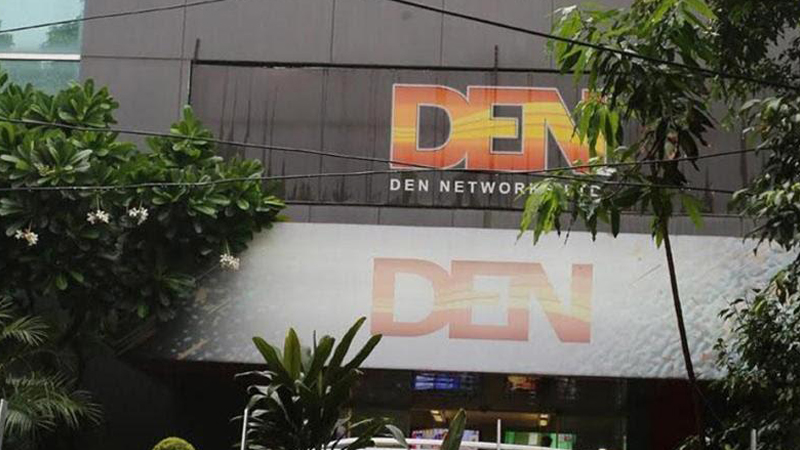
MUMBAI: When margins wobble, liquidity talks and in Q3 FY25-26, cash did most of the talking. Den Networks Limited closed the December quarter with consolidated revenue of Rs.251 crore, marginally higher than the previous quarter but down 4 per cent year-on-year, even as profitability stayed resilient on the back of strong cash reserves and disciplined cost control.
Subscription income softened to Rs.98 crore, slipping 3 per cent sequentially and 14 per cent from last year, while placement and marketing income offered some cheer, rising 15 per cent quarter-on-quarter to Rs.148 crore. Total costs climbed faster than revenue, up 7 per cent QoQ to Rs.238 crore, driven largely by higher content costs and operating expenses. As a result, EBITDA dropped sharply to Rs.13 crore from Rs.19 crore in Q2 and Rs.28 crore a year ago, pulling margins down to 5 per cent.
Yet, the bottom line refused to blink. Profit after tax stood at Rs.40 crore, up 15 per cent sequentially and only marginally lower than last year’s Rs.42 crore. A healthy Rs.57 crore in other income helped cushion operating pressure, keeping profit before tax at Rs.48 crore, broadly stable quarter-on-quarter despite the tougher cost environment.
The real headline-grabber, however, sits on the balance sheet. The company remains debt-free, with cash and cash equivalents swelling to Rs.3,279 crore as of December 31, 2025. Net worth rose to Rs.3,748 crore, while online collections accounted for 97 per cent of total receipts, underscoring strong cash discipline across operations, including subsidiaries.
In short, while Q3 showed signs of operating strain, the financial backbone remains solid. With zero gross debt, steady profits and a formidable cash war chest, the company enters the next quarter with flexibility firmly on its side proving that in uncertain markets, balance sheet strength can be the best growth strategy.






