News Broadcasting
Mallikarjun Kharge at ABP ‘Shikhar Sammelan’: BJP repeats lies until they are believed as truth


Mumbai: Congress leader and leader of the opposition in Rajya Sabha, Mallikarjun Kharge candidly addressed critical issues and priorities facing the nation in an insightful session at the ABP ‘Shikhar Sammelan’. Speaking about Bharatiya Janata Party, Mallikarjun Kharge said, “BJP repeats lies until they are believed as truth. Many promises like two crore jobs, 15 lakh rupees, double MSP for farmers, and increased scholarships for students remain unfulfilled. Modi ji is a marketing genius, focusing solely on infrastructure while ignoring unemployment. We must check ground realities, not just believe TV ads.”
“Congress is not in the habit of telling lies. In India, where there was no power to produce a needle, we made rockets here. We fought with Pakistan, and liberated Bangladesh,” he added.
Kharge on BJP’s accusations of corruption and nepotism in Congress, commented, “BJP cleans its image using a ‘washing machine’ when caught in scandals. After 1989, no family members from the Gandhi family has become prime minister, chief minister, or held significant positions. BJP’s attacks a family that sacrificed their lives for the country. Youngsters don’t know why Indira Gandhi was killed. They just know what Modi is saying and believe that. The Congress party built India’s foundations; BJP just advertises on clean sheets.”

Reflecting upon Congress’ handling of election pressure, Kharge said, “If faced with unlawful actions, we must resist to protect fundamental rights and democracy. BJP leaders like Nirmala Sitharaman (minister of finance of India) claim financial shortages despite massive donations. They target the opposition with penalties, locking our accounts, and creating an unfair playing field. Modi ji’s priorities seem to be misplaced, focusing on trivial matters while ignoring serious issues like law and order problems in Manipur. BJP benefits most from electoral bonds and misuses institutions like ED and CBI. Their actions resemble deception rather than governance.”
Speaking about why many leaders from the opposition and Congress are joining the BJP, he said, “Some leaders leave despite getting what they want, showing they lack ideological commitment. Our focus is on uniting and strengthening India, regardless of the number of supporters.”
Speaking about the chances of the INDIA alliance winning the next election, Kharge said, “We acknowledge challenges in alliance management but emphasise unity for democracy’s sake. We are determined to win the necessary seats to defeat BJP’s dominance. We highlight BJP’s failures compared to our contributions post-independence. BJP’s promises like job creation and increased income for farmers remain unfulfilled, while they suppress dissent and focus on fear tactics. Our alliance prioritizes democracy, constitution, and citizens’ rights over personal ambitions. We aim to eradicate BJP’s ideology for a better India.”
The ‘Shikhar Sammelan’ crystallised ABP News’ unwavering commitment to invigorating democratic dialogue and fostering an informed electorate poised to shape the nation’s destiny. As the herald of democracy reverberates across the land, ABP News remains steadfast in its mission to illuminate the path forward, emboldening citizens with the power of knowledge and civic engagement.







News Broadcasting
UDF poised to return to power in Kerala, says Manorama-CVoter survey
Massive opinion poll projects shift in Kerala politics ahead of 2026 Assembly elections.
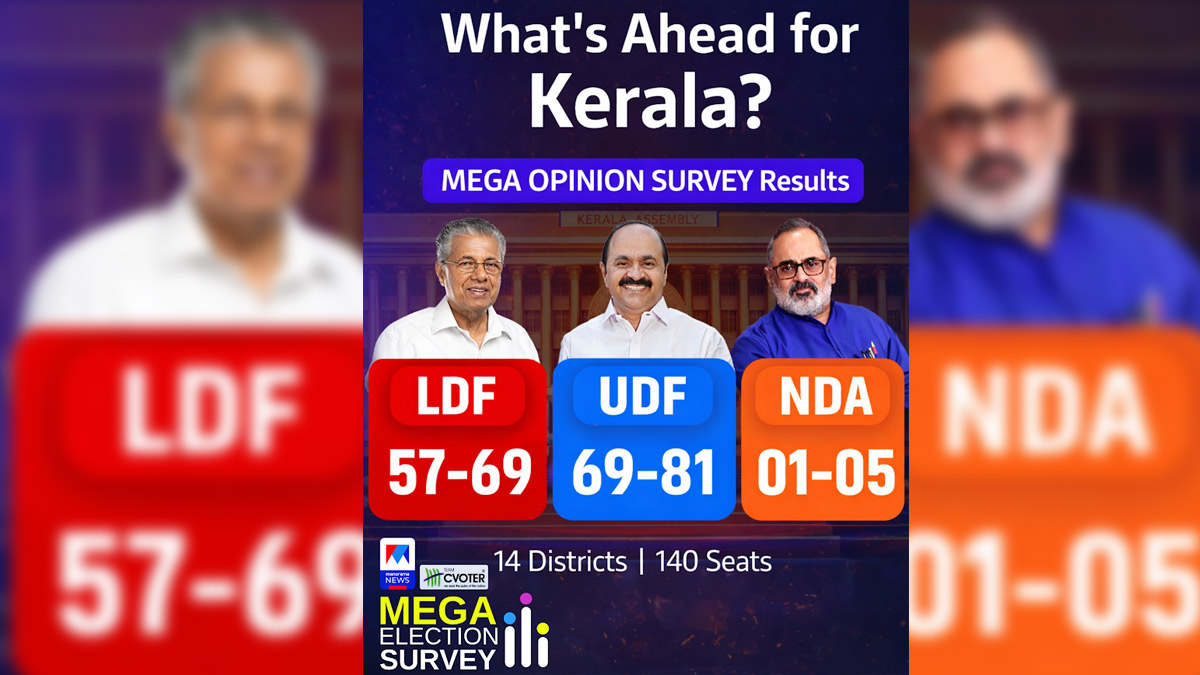
MUMBAI: The winds of change appear to be blowing through Kerala’s political landscape and this time, they seem to favour the United Democratic Front. A comprehensive mega opinion survey conducted by Manorama News in partnership with CVoter projects a potential comeback for the UDF in the upcoming Kerala Legislative Assembly Elections 2026. The survey, covering all 140 constituencies with a massive sample size of nearly 90,000 respondents, predicts the UDF could win between 69 and 81 seats.
The ruling Left Democratic Front (LDF) is expected to secure 57 to 69 seats, a significant drop from the 99 seats it won in the 2021 elections. This would mean the LDF losing 30 to 42 of its sitting seats. Meanwhile, the National Democratic Alliance (NDA), which drew a blank in 2021, is projected to open its account with 1 to 5 seats.
Region-wise, the UDF is expected to make strong gains in Malabar, winning 25 to 34 out of 48 seats, and in Central Kerala, where it could bag 29 to 33 out of 53 seats. In South Kerala, the LDF is likely to retain an edge with 21 to 25 seats, while the UDF may improve to 12 to 16 seats. The NDA could pick up 1 to 3 seats in the southern region.
The survey was conducted between 14 and 26 March 2026, with additional tracker and snap polls carried out from December 2025 to March 2026. A total of 89,693 respondents participated, ensuring representation across all demographics and social segments.
Manorama News has a strong track record of accuracy, with its previous projections closely matching the actual results of the 2019 and 2024 Lok Sabha elections as well as the 2021 Kerala Assembly polls.
In Kerala’s famously fierce political battles, this survey suggests the pendulum may be swinging back. Whether the final verdict matches these numbers or throws up another surprise, one thing is clear, the 2026 Assembly elections are shaping up to be one of the most keenly watched contests in the state’s history.






