I&B Ministry
Maharashtra LCO associations release a statement on AIDCF vs Broadcasters fight

Mumbai : Maharashtra LCO associations MCOF and DCOAM have released a statement to clear their stand on the ongoing tussle between AIDCF and broadcasters.
The release from LCO associations is as follow
Broadcasters like Star, Sony & Zee have shut off AIDCF members who have taken a stand that they will not sign the Interconnect agreements with Broadcasters due to their asking for exorbitant rate hikes. They then go on to give a press release that says that increases could be as high as 60 per cent . But they do not show a single case of such an increase which any customer can see and understand.

As an LCO Association DCOAM was corresponding with Hathway but they find that their Association’s official email id is blocked by Hathway. Thereafter individual members have been writing emails but not a single email has ever been responded to yet.
Right now we have received news that KCCL, one of the 2 petitioners in that case in Kerala HC has signed the agreement.
Now that broadcasters are also joining the litigation, this matter is going to get extended. A HC judge has little experience of Broadcasting and Distributions laws, so he/she has to first understand the Regulations first before passing any orders. The double standards of MSOs to says that since matter is sub judice, hence no action should be taken by any Broadcasters goes entirely against them, as when they wanted the NTO to be rolled out in Feb 2019 they forced NTO 1.0 on LCOs when so many pending cases where filed in different High Courts.
That all MSOs turned PAT positive immediately thereafter shows how they have profited at the cost of LCOs who’s revenue streams have dwindled due to their muscle power. If we refer to the Table 2.3 TRAI Consultation Paper on Market Structure and Competition in CATV dated 25 october 2021 , one will observe that MSOs serve direct customers only in upto 2 per cent cases and the rest 98 per cent is served by LCOs. Hence it is we who have been facing the brunt of customer calls in the past 6 days. The most basic question that every customer asks is What is the revised pricing going to be for my existing pack ?
When we seek answers to this Question there is not one person ready to provide answers in any MSO. Second question they ask is I have paid already but why did you disconnect services without any prior notice. This is a very difficult situation for us as MSOs have introduced prepaid wallet system for all of us. So we need to pay the MSO immediately and then only can any pack/channel be activated. MSOs get around 2 months of activation to pass on the payments to Broadcasters due to the submission of weekly reports and then calculating the invoice amounts. Even today when channels are not there we continue to pay MSOs the full rates for packages with no sign of refunds. But our customers are demanding reductions for lack of services.
Even during the first wave of Covid all LCOs paid in spite of not being able to send staff for collections and we had many bad debts as many customers had fled to native places. Those bad debts have been borne by LCOs only. The third question that customers ask is why are the channels available on DTH and some MSOs? When DTH and many MSOs have signed up already, AIDCF is unwilling to say in Court that they will abide by Court orders as and when the matter is decided, hence please get signals restored. Hence we ventured out to see the impact of additional content cost if we are to retain same package structure. The results for Maharashtra where Hindi & Marathi are the dominant languages is shown below

We have seen that in any industry when prices increase, the Co. tries to retain the same product but will reduce the weight and/or size so that the impact to customers is nil/minimal. In the above case too we can sit and work out what customers will find critical and what is expendable to minimize rate increases. But are MSOs ready to talk with us. ? So that brings us to the Question of what is this fight all about ? A reading of their petition filed in Kerala HC indicates that their major grouse is : “7(4) It shall be permissible to a broadcaster to offer discounts, on the maximum retail price of pay channel or bouquet of pay channels, to distributors of television channels, not exceeding fifteen percent of the maximum retail price:”
This revenue is not at all shared with LCOs and is the point of dispute with the Broadcasters. Price increase is a mere façade. Customers and LCOs are just being used as pawns to help them achieve their MSO revenues
Today is the 6th day of a blackout that we have little control over and we wish that through this Press Release we can convey to customers the helpless situation that we face in a highly competitive market. As LCOs we will be taking our legal steps too and will be filling our grouses in appropriate forums. This event should never happen again.

I&B Ministry
CBFC speeds up film certification; average approval time cut to 22 days
Over 71,900 films cleared in five years as digital system shortens approval timelines
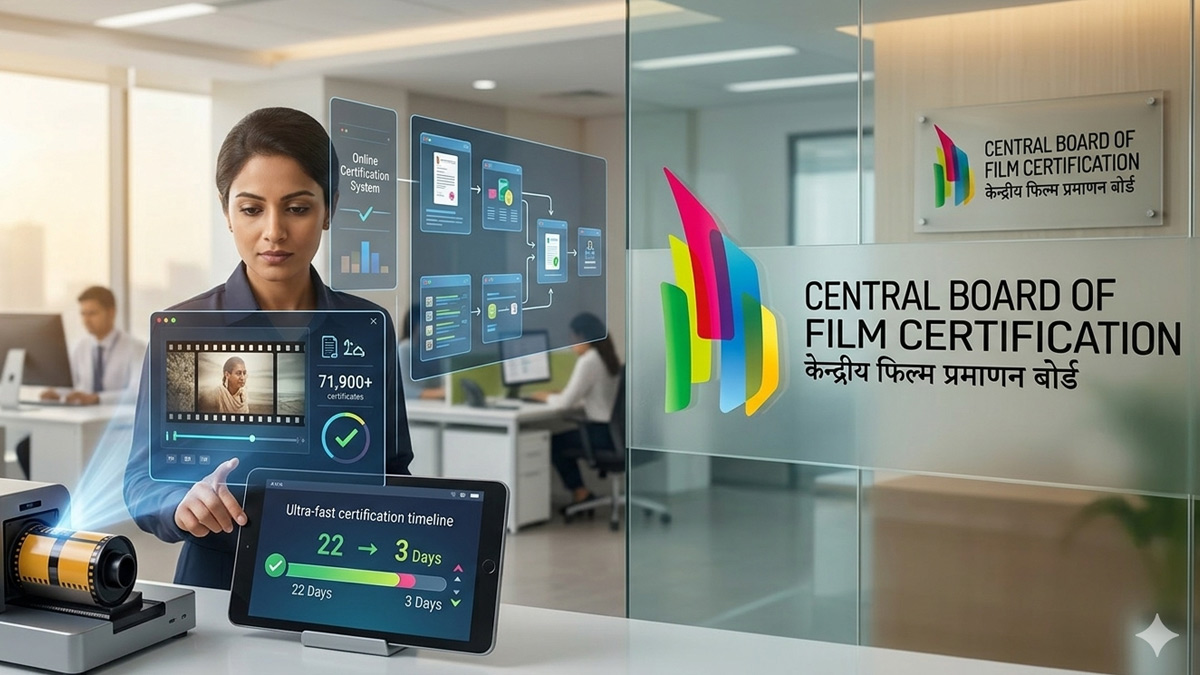
MUMBAI: The Central Board of Film Certification (CBFC) has significantly reduced the time taken to certify films, with the average approval timeline now down to 22 working days for feature films and just three days for short films.
Operating under the Ministry of Information and Broadcasting, the statutory body certifies films for public exhibition in line with the Cinematograph Act, 1952 and the Cinematograph (Certification) Rules, 2024. The rules prescribe a maximum certification period of 48 working days, though the adoption of the Online Certification System has sharply accelerated the process.
Over the past five years, from 2020-21 to 2024-25, the board certified a total of 71,963 films across formats. Of these, the majority fell under the U category with 41,817 titles, followed by UA with 28,268 films and A with 1,878 films. No films were certified under the S category during the period.
Film approvals have also steadily risen in recent years. The CBFC cleared 8,299 films in 2020-21, a figure that peaked at 18,070 in 2022-23 before settling at 15,444 films in 2024-25. During the same period, 11,064 films were certified with cuts or modifications.
Despite the high volume of certifications, outright refusals remain rare. Only three films were denied certification over the last five years, with one refusal recorded in 2022-23 and two in 2024-25.
The board may recommend cuts or modifications if a film violates statutory parameters relating to the sovereignty and integrity of India, security of the state, friendly relations with foreign states, public order, decency or morality, defamation, contempt of court or incitement to an offence.
Filmmakers can challenge CBFC decisions in court. Data shows that such disputes remain limited but have seen some fluctuation. Between 2021 and 2025, a total of 21 certification decisions were challenged before High Courts, with the number rising to 10 cases in 2025.
Responding to a question in the Rajya Sabha, minister of state for information and broadcasting L. Murugan shared the data. The question was raised by Mallikarjun Kharge.
With faster timelines and a largely digital workflow, the certification process appears to be moving at a far brisker pace, signalling a shift towards quicker clearances for India’s growing film output.