High Court
Madras HC to hear Star India’s rejoinder in TRAI challenge today

NEW DELHI: Following the completion of arguments of the All-India Digital Cable Federation and Videocon d2h, the Madras High Court will today commence hearing a rejoinder by the petitioners — Star India and Vijay TV.
Concluding his arguments in the petition by Star India and Vijay TV challenging the jurisdiction of TRAI to issue tariff orders on the ground that the subject of content fell under the Copyright Act, counsel for AIDCF A R L Sundaresan explained how the Telecom Regulatory and Copyright Law do not infringe upon each other. AIDCF had intervened in the matter.
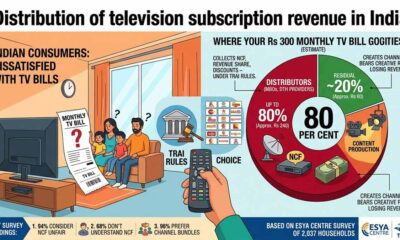
AIDCF also explained the flow of revenue and the breakup, and what is carriage, network capacity fee, distribution fee etc. It told the court how the money would be divided amongst different stakeholders including broadcasters under the new tariff regulations. The concept of carriage fee, distribution fee and network capacity fees were explained with help of charts.

Videoco d2h counsel Vijay Raman said the petition militates against the right of stakeholders to do business as guaranteed in Article 19 (1) of the Constitution. The new tariff order had asked broadcasters to declare their minimum retail price per channel to consumers and give ‘a la carte’ price for pay channels. This would give greater choice to the consumer.
Earlier last week, TRAI counsel Saket Singh had said that, prior to the tariff order, the broadcaster would sell distribution right to the multi-system operators at wholesale price level, and MSOs would accordingly sell to the consumers. Thus, the consumer had no direct link with the pricing.
The new tariff had taken away the power of distributors in terms of pricing and that has been given to the broadcaster. Hence, they are the master of their channel and can price the consumer, accordingly. The consumer also got the right to refuse to pay for channels he did not watch. Singh also explained the concept of carriage fee.
Although the Supreme Court had, in early May, while staying the tariff order directed the Madras High Court to complete hearing within four weeks, the high court had commenced the hearing in the last week of June. The hearing had commenced with the pleadings of counsel for the petitioners.
Meanwhile, TRAI TV reference interconnect offer (RIO) and Quality of service order (QoS) came into effect from 2 May following the order of the High Court.
In the hearing in April-end, it had said Section 3 of the Tariff order and all other consequences of such implementation/enforcement would be subject to the outcome of the main petition.
Apart from the Tariff order which had originally been issued on 10 October last year, the regulator also issued the DAS Interconnect Regulations which had been issued on 14 October last year, and the Standards of Quality of Service and Consumer Protection (Digital Addressable Systems) Regulations which had been issued on 10 October last year.
The orders can be seen at:
http://trai.gov.in/sites/default/files/Tariff_Order_English_3%20March_20…
http://www.trai.gov.in/sites/default/files/QOS_Regulation_03_03_2017.pdf
http://www.trai.gov.in/sites/default/files/Interconnection_Regulation_03…
Also Read :Decks cleared for TRAI tariff order implementation as HC declines stay (updated)
Star India case questioning TRAI jurisdiction over content postponed





High Court
Delhi HC blocks illegal IPL 2026 streams, backs JioStar rights
Court orders swift takedowns, expands crackdown on piracy apps
NEW DELHI: In a timely move ahead of the cricketing season, the Delhi High Court has granted interim relief to JioStar India Private Limited, clamping down on illegal streaming of the TATA Indian Premier League 2026.
The court passed ex parte ad interim injunctions in two separate suits, restraining rogue websites and mobile applications from broadcasting IPL matches without authorisation. The tournament is set to begin on 28 March, making the timing of the order particularly significant.
Recognising JioStar’s exclusive digital and broadcast rights for the IPL cycle from 2023 to 2027, the court observed that unauthorised streaming would infringe its statutory and proprietary rights, potentially causing irreparable losses.
In one case, the court directed several identified websites to immediately stop hosting or streaming IPL content. It also issued a dynamic injunction, allowing JioStar to flag new infringing platforms in real time, which must then be blocked swiftly by domain registrars and internet service providers.
In a parallel order, the court turned its attention to piracy through mobile apps, particularly Android-based platforms distributing content via APK files. A broader dynamic+ injunction was granted, extending to future variants, mirror links and related interfaces, signalling a tougher stance on evolving piracy tactics.
The court also directed domain name registrars to suspend offending domains and share registrant details, including KYC and payment information. Internet service providers and telecom operators have been instructed to block access within strict timelines, in some instances within 36 hours. Both the Department of Telecommunications and the Ministry of Electronics and Information Technology have been asked to facilitate enforcement through necessary notifications.
Noting the fast-changing nature of digital piracy, the court emphasised the need for real-time enforcement tools to keep pace with anonymous and constantly shifting networks. It also underlined the commercial impact of piracy on legitimate rights holders.
The ruling reinforces the judiciary’s firm stance on protecting intellectual property in the digital age. For viewers, it is a reminder to stick to official platforms as the IPL season kicks off under tighter watch.






