Movies
LPU student honoured at Dadasaheb Phalke Film Festival


NEW DELHI: Lovely Professional University (LPU) student Ahsif Khan from Bangladesh has been honoured with the ‘Dada Saheb Phalke 2014 Award’ for his ‘brilliantly executed’ short piece of the year ‘The Poster’.
The award was given on the conclusion of the Dadasaheb Phalke Film Festival in Delhi, aimed at recognising the enlightening, entertaining and progressive new age cinema of youth and experienced filmmakers every year.

The 15-minutes low-budget film ‘The Poster’ won “Special Festival Mention Award” in short film category for students. Ahsif received ‘Certificate of Excellence’ from national award winning producer Savita Raj Hirmath.
Ahsif’s production has been adjudged excellent over other entries from all across India and 45 other countries. The LPU forwarded itself as title sponsor of the film.
‘The Poster’ is a moving depiction of everyday anguish of common man, his endangered dreams, frustration over work and family, and the final march toward social reform. ‘The Poster’ is based on the story of Zahir Raihan-a legendary and revolutionary figure in the annals of Bangladesh, and is directed and produced by Ahsif khan.
The film is in Bengali language with sub-titles in English and has earned success under various shows.
LPU identified Ahsif’s creative power when he was motivated for a documentary, ‘Song of Padma’ in 2013, and it bagged the title of “Best Documentary” at the LPU Film Festival (India).
The documentary was further appreciated at the 6th International Film Festival in Dhaka (Bangladesh). He has also won the first prize at Youth Vibe 2013 (India) for ad making and architectural photography.
LPU chancellor Ashok Mittal said, “We are happy that our talented student put up his passion in a well-knit manner, and got such a prestigious award. We always inspire the students who reveal their zeal to do something innovative, creative and research oriented. We further make such students to reach to global heights for the ultimate benefit of the society. We wish all the best to the creative student to enable himself to get nominated for prestigious Oscar award!”
Ahsif said, “I got admission at LPU on scholarship basis. My financial condition was not good and on getting help from LPU, I came thousands of miles away from my country to join LPU. Here I got the best opportunity to get wings to my passion. In spite of my being a student of medical field, my LPU teachers motivated me to carry on my film-making creation. LPU sponsored my project and result is before all. I have no words to thank my teachers and LPU top administration which has raised my status from a simple without any resource-student to an acclaimed director, writer, and even as an actor.”
The central character of the film, ordinary middle class man Amzad, believes that the government is doing everything for its people until the day he falls in a trap. He learns about the drawback of capitalism as he loses his job. A salaried government employee, Amzad lives his life with resigned acceptance. He is a critic of the likes of Afzal – a firm believer in the revolutionary zeal of the youth. However, it sketches Amzad’s final disillusionment as he is fired for no reason from his job.
The festival celebrates the cinema and work of aspiring, young, independent and professional filmmakers. The festival attracts filmmakers from across India and 45 nations across the world. The festival has sections for feature films, short films, documentaries, animations, music videos and ad films. The festival awards the filmmakers in production, creative and performance categories.

Movies
Green Gold Animation creates CG character for Telugu film Rākāsā
Chhota Bheem studio expands into mainstream VFX with dialogue-free digital lead.
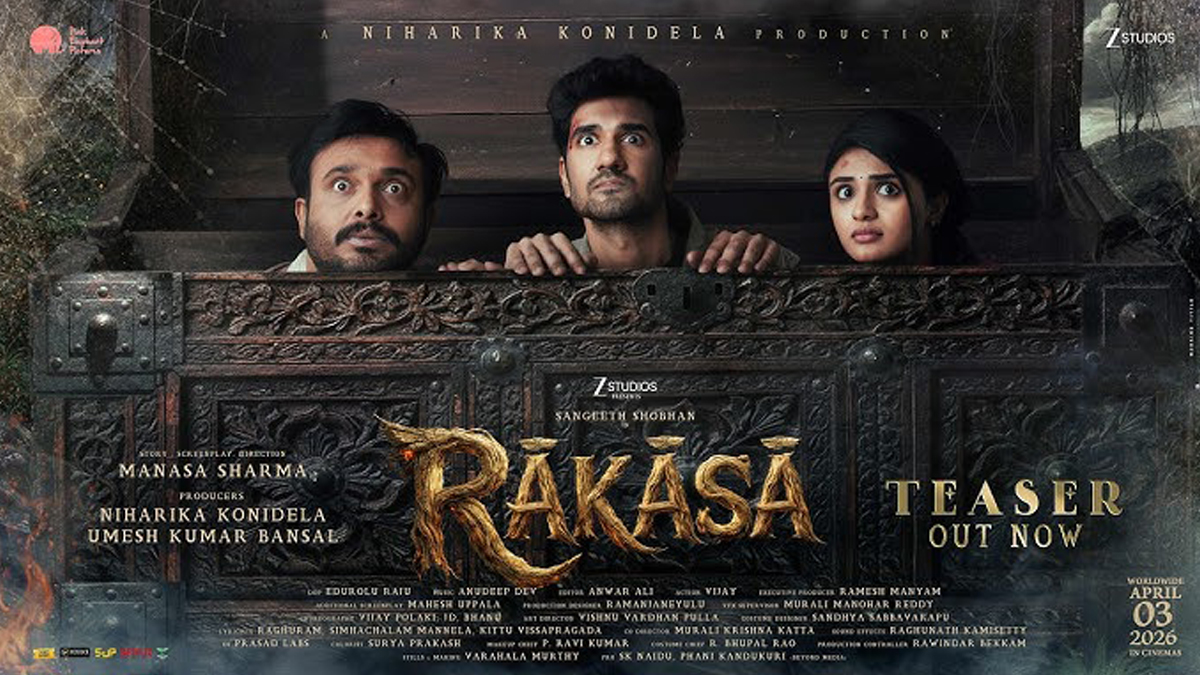
MUMBAI: Green Gold Animation, the house that gave India Chhota Bheem, is now stepping out of the kids’ zone and into the big screen with a rather silent but powerful performer. The Hyderabad-based studio’s VFX division has delivered a fully computer-generated character for the upcoming Telugu-language comedy-fantasy thriller Rākāsā, set for theatrical release on 3 April 2026. Directed by Manasa Sharma and produced by Niharika Konidela under Pink Elephant Pictures in collaboration with Zee Studios, the film marks a notable move for Green Gold into complex, character-driven work for mainstream cinema.
What makes the project stand out is its ambitious central character, a completely digital creation that does not speak a single line. Instead, the character relies entirely on animation, movement, facial expressions and body language to convey emotion and connect with audiences. This is a relatively unexplored approach in Telugu cinema at this scale.
Green Gold’s VFX team was involved from early pre-production through to final delivery, completing over 750 CG shots with a team of more than 100 artists. The work included detailed character animation, performance design and fluid simulations, all executed within tight timelines and practical budgets through strong planning and close collaboration.
Green Gold Animation founder & CEO Rajiv Chilaka said the project pushed the team to approach character creation differently. “Building a fully digital character where every emotion had to come through performance and detailing was very meaningful,” he noted.
Green Gold VFX supervisor and VFX creative director Murali Manohar Reddy added that the emotional depth had to be communicated entirely through visual performance. “This wasn’t about reinventing technology, but about using our tools and processes with precision to serve the story,” he said.
Producer Niharika Konidela praised the collaboration, saying the Green Gold VFX team understood the vision and brought strong detail and emotion to the character while working within practical constraints.
The film blends humour, action and mythological elements, following an NRI protagonist on a chaotic and magical adventure. It stars Sangeet Shobhan, Nayan Sarika, Vennela Kishore, Brahmaji and Ashish Vidyarthi, with music by Anudeep Dev.
For a studio best known for colourful kids’ animation, delivering a silent, emotionally expressive CG lead for a mainstream theatrical release is quite the plot twist. With Rākāsā, Green Gold Animation is quietly proving it can speak volumes even without dialogue.






