Hindi
Lights Fantastic as Ravi Varman Shows How Emotion Steals the Scene

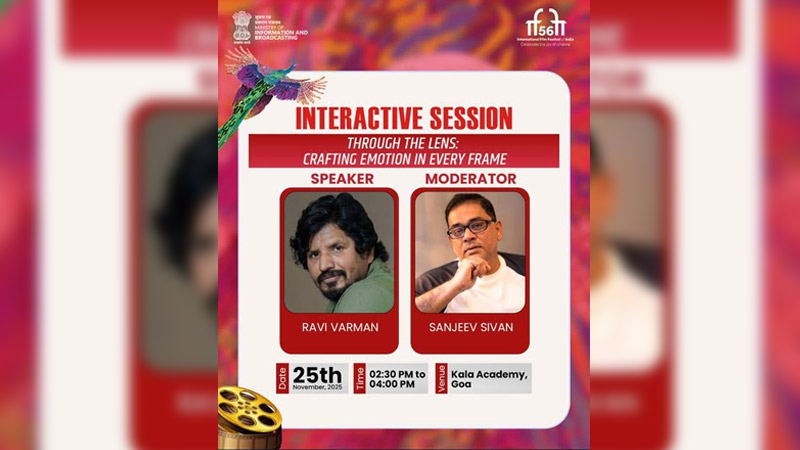
MUMBAI: If the magic of cinema lies somewhere between light and emotion, Ravi Varman seems to live right in that sliver, a place where morning sun, falling shadows, and sudden inspiration share equal billing. Over an expansive conversation, the cinematographer peeled back the curtain on his craft, revealing the quirks, philosophies, battles, and happy accidents that shape his imagery. And with every anecdote, he proved why filmmakers describe him as “a painter who uses light instead of brushes”.
From the very first moment of the interaction, Varman made it clear that nothing about his visual world is accidental. Even recreating Ramlila’s Haveli lighting that iconic hard sun slicing through dusty windows was not about dramatic flourish but discipline. Early mornings spent observing the way light broke across ageing walls became his personal laboratory. When Sanjay Leela Bhansali’s Ram Leela needed that look, he didn’t imitate it; he simply repeated what he had already trained his eyes to see.
Yet for someone so obsessed with light, he is dismissive of the “good light–bad light” binary. Light, for him, is like breath universal, impartial, constant. It becomes “good” or “bad” only because the human mind labels it so. Every second, he insists, holds a meaningful light if one learns how to look. The cinematographer who has shot epics, period dramas, and romantic fables speaks the way poets speak about the sea with awe, but also with ownership.

Even natural light, he argues, isn’t the unpredictable enemy filmmakers fear. The sun’s inconsistency is, for him, consistency itself. “Inconsistency is a consistency,” he says, almost amused at the contradiction, yet deadly serious. With enough observation and instinct, a filmmaker can make harsh noon and tender dawn coexist in the same world.
But magic doesn’t appear on set by accident, it is engineered. One of Varman’s most revealing anecdotes came from Ram Leela, where Bhansali wanted to shoot a song exclusively in morning and evening light. Twenty-five days were allotted just to chase those two windows. Varman’s solution was practical genius: build an engineered overhead canopy system fitted with movable flaps, controlled remotely, allowing him to soften, open, or block light at will. It took lakhs, iron pillars, engineers, improvisation, and doubt — but it turned an unpredictable outdoor set into a perfectly modulated stage. After that, he says, “India started using these cranes and systems.” He didn’t invent the idea, he insists. He simply brought it home.
Shifts between natural and artificial light, between harshness and glow, come to him instinctively but never without preparation. Before shooting any film, he collects 10 to 15 paintings, and from them, derives the visual compass for the movie. On set, he revisits each frame mentally and checks whether the image he is capturing mirrors the reference he has internalised. He may work with spontaneity, but it is spontaneity constructed on a bedrock of meticulous pre-visualisation.
Even colour something he once avoided became a chapter of reinvention. Early in his career, people called his frames “grey”. At first, he believed he disliked colour. Only later did he realise colour was not the enemy; indifference was. Today, he treats colours as emotional carriers, embracing surreal hues and heightened palettes because, as he puts it simply, “Life is surreal.” If magic can exist in real life, why shouldn’t it exist in the frame?
Despite his reputation for sweeping canvases and lavish films, Varman’s roots lie in small, near-zero-budget movies. His first films cost 7 lakhs and 12 lakhs. He shot them with minimal lights, often with no lights at all, a training ground that still shapes his work on the biggest sets. Even Ponniyin Selvan, a mammoth production, was lit with barely 20 kW because he relied on the studio’s natural sunlight. Blackened pillars, open doors, a few supplementary bulbs simplicity dressed up as grandeur.
What pushes him forward, however, is not scale but challenge. He recalls being battered by high waves during a Tamasha shoot in Croatia, holding a film camera for 45 minutes as everyone else gave up. Imtiaz Ali suggested returning. Varman insisted on shooting. Another time, on a film with Manisha Koirala, he shifted exposure 18 times in a single shot swinging from T2.5 to T22.5 and back while tracking a warplane soaring over a singing protagonist. The face looked seamless, but the background pulsed with changing light. Such risks fascinate him; comfort never does.
His philosophy extends to working with directors as well. Contrary to the industry’s “director–cameraman marriage” metaphor, he prefers respectful independence. He will fight, argue, disagree but only for the frame, never the ego. “I fight for quality, honesty,” he says. He has fought with directors, sometimes daily, but only because the moment demands that stubbornness. He cares nothing for temporary friction; he cares deeply for what remains: “The frame is what will stay. Not me. Not the fight.”
His journey from Kerala shaped him in more ways than one. Kerala’s culture of minimalism, punctuality, and blunt honesty became the bedrock of his discipline. He recalls light men telling directors: “Clip is gone close the shop.” It taught him to work fast, with little equipment, and trust instinct over machinery. “We have only six balls; we must hit six runs,” he says, likening Kerala’s filmmaking grit to a last-over chase.
Cinematographers worldwide inspired him especially Sergey Urusevsky (The Cranes Are Flying) and Néstor Almendros (Days of Heaven) but he admits he still cannot decipher how they achieved their frames with the technology of their time. Their films remain his reset button: whenever he watches a bad film, he revisits those classics to cleanse his palette.
Technology, though, does not intimidate him. He shot Ponniyin Selvan using both film and digital formats, sometimes switching lenses mid-scene cinema scope one moment, spherical the next purely to study differences. Digital, he believes, democratised filmmaking; without it, today’s generation of filmmakers wouldn’t exist. “The format doesn’t matter. The thought matters.”
Artificial intelligence, however, brings different questions not fear. AI is a support tool, he says, a fast reference, not a threat. “AI pretends to be real, but it is unreal. Mind is more important than AI.” He traces the history of painters who feared extinction when the camera arrived, only to become more celebrated later. AI, he insists, will follow the same pattern. Tools don’t eclipse creators; creators redefine tools.
And if there is one emotion that threads through his storytelling, it is humility. Even when talking about heartbreak, as he does while referencing the poignant scene involving the imagined children Rohan and Rohini, he quickly shifts back to craft. For him, art and life fold into each other constantly. The frame is not just an image, it is a lived moment. He doesn’t shoot scenes; he lives inside them.
In the end, that may be Ravi Varman’s secret: he treats light like memory, colour like emotion, exposure like rhythm. He approaches filmmaking not as labour but as meditation relaxed, empty, present. He may be known for grandeur, but his foundation lies in simplicity. The big canvas, the magical light, the monumental sets, they are only extensions of the small boy from Kerala who learned to shoot with no lights, no budget, and no fear.
And in every film, in every frame, the boy is still there chasing the morning light.



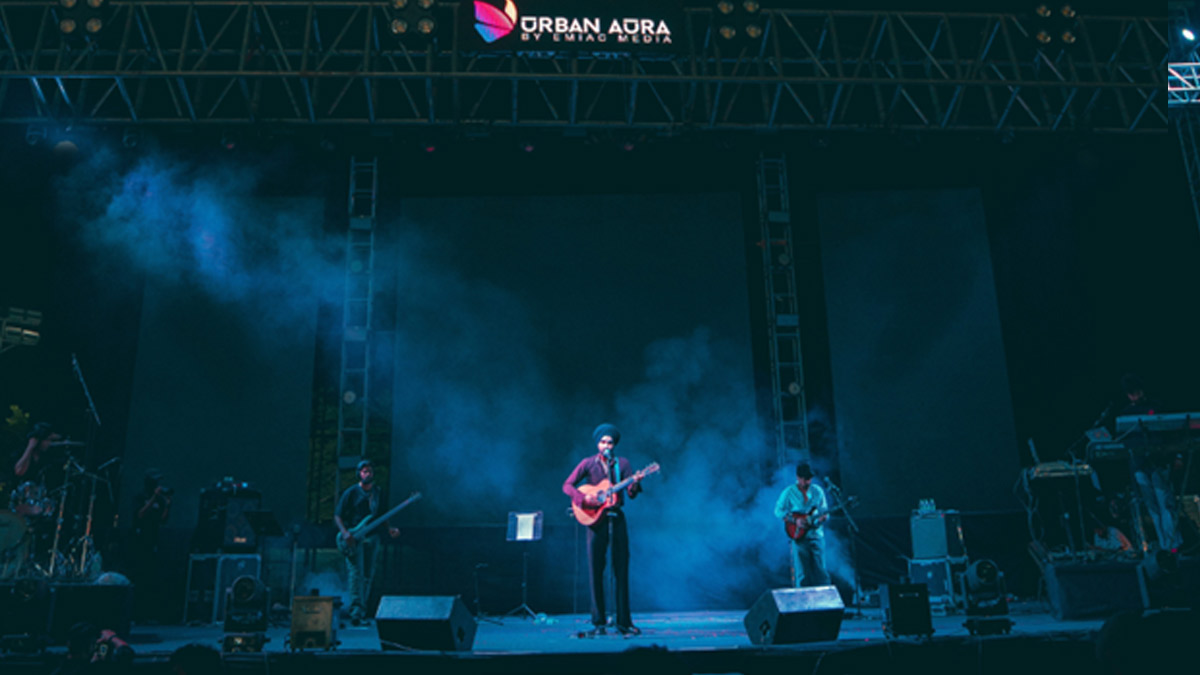
In a music industry that often rewards speed, spectacle, and instant recall, Navjot Ahuja’s journey feels refreshingly different. His story is not built on noise. It is built on patience, discipline, emotional honesty, and a quiet commitment to becoming better with every passing year. After 14 years of struggle, learning, performing, and writing, Navjot stands today as an artist whose success has not changed his centre. If anything, it has only made his purpose clearer.
For Navjot, music has never been about chasing fame alone. It has always been about expression. It is about writing more truthfully, singing more skillfully, understanding himself more deeply, and becoming a kinder human being in the process. That rare clarity is what gives his journey its beauty.
Where It All Began: A Writer Before a Singer
Indian singer and songwriter Navjot Ahuja’s musical journey began in the most familiar of places: school assemblies. But even then, what was growing inside him was not only the desire to sing. It was the need to write.
Long before he saw himself as a performer, he had already discovered the emotional release that writing offered him. For Navjot, words became the first true channel for feeling. Songwriting came before singing because writing was the only way he could let emotions flow through him fully. That inner pull shaped his artistic identity early on.
Like many young musicians, he sharpened his craft by creating renditions of popular songs.
Those experiments became his training ground. But the turning point came in 2012, when he wrote his first original song. That moment did not just mark the beginning of songwriting. It marked the beginning of self-definition.
A Calling He Did Not Chase, But Accepted
What makes the latest Indian singer-songwriter Navjot’s story especially compelling is the way he describes his relationship with music. He does not frame it as a career he aggressively pursued. In his own understanding, music was not something he chose. It was something that chose him.
There was a time when he imagined a very different future for himself. He wanted to become a successful engineer, like many young people shaped by ambition and conventional expectations. But life had a different script waiting for him. During his college years, around 2021, music entered his life professionally and began taking a firmer shape.
That shift was not driven by image-building or industry ambition. It came from acceptance. Navjot embraced the fact that music had claimed him in a way no other path could. That sense of surrender continues to define the artist he is today.
An Artist Guided by Instinct, Not Influence
Unlike many singers who speak openly about idols, icons, and musical role models, Navjot’s creative world is built differently. He does not believe his music comes from imitation or inherited influence. He listens inward.
He has never considered himself shaped by ideals in the traditional sense. In fact, he admits that he does not particularly enjoy listening to songs, especially his own. His decisions as a songwriter and singer come from instinct. He writes what feels right. He trusts what his inner voice tells him. He positions his music according to what he honestly believes in, not what trends demand.
That creative independence gives his work a distinct emotional sincerity. His songs do not feel calculated. They feel alive.
The Long Years of Invisible Struggle

Every artist carries a chapter of struggle, and Navjot’s was long, demanding, and deeply formative. One of the biggest challenges he faced was building continuity as the best new indian singer songwriter in an era where musical collaboration is increasingly fluid.
For emerging singers, especially those trying to build with a band, consistency can be difficult. Instrumentalists today have more opportunities than ever to freelance and perform with multiple artists. While that growth is positive and well deserved, it can make things harder for singers who are still trying to establish a steady team and sound around their work.
For Navjot, one of the most difficult phases came during 2021 and 2022, when he was doing club shows almost every day. It was a period of relentless performance, but not always personal fulfillment. He was largely singing covers because clubs were not open to original songs that audiences did not yet know.
For a new Indian singer and songwriter, that can be a painful compromise. To perform constantly and still not have the freedom to share your own voice requires not just resilience, but restraint.
“Khat” and the Grace of Staying Unchanged
After 14 years of effort, Navjot’s new love song Khat became a defining milestone. Professionally, he acknowledges that the song changed how society viewed him as a musician. It strengthened his place in the public eye and altered his standing in meaningful ways.
Yet personally, he remains unchanged.
That is perhaps the most striking part of his story. Navjot says his routine is still the same. His calm is still the same. His writing process is still the same. He does not want success or failure to interfere with the purity of his art. For him, emotional detachment from public outcomes is essential because the moment an artist becomes too attached to validation, the writing begins to shift.
His joy comes not from numbers, but from the attempt. If he has tried to improve his skill today, if he has written his heart out more honestly than before, then he is at peace.
Growth, Not Glory, Remains the Real Goal
Even now, Navjot is not consumed by labels such as singles artist, performer, or digital success story. His focus remains deeply personal. He wants to sing better. He wants to play instruments better. He wants to understand himself more. And he wants to become a kinder person.
That is what makes Navjot Ahuja’s journey so moving. It is not simply the story of a musician finding recognition. It is the story of an artist who continues to grow inward, even as the world begins to look outward at him. In an age obsessed with applause, Navjot reminds us that the most meaningful success often begins in silence, honesty, and the courage to remain true to oneself.






