News Broadcasting
Lifespan of content is opening up in every direction: BBC’s Roly Keating


MUMBAI: The linear TV channel – even as actual viewing habits shift – can continue to hold its place as what you might call the central organising principle of broadcasting, for audiences and professionals alike, the engine of instant, incremental scale and impact.
But either side of that moment of premiere transmission, something weird is happening to one’s sense of time. It seems to be stretching and bending in unexpected ways. It’s no longer enough to ask of a particular programme ‘when is it on?’, because the lifespan of content is opening up in every direction.
This was the message that BBC Two controller Roly Keating had for attendees at the Broadcast Digital Channels Conference 2008 in the UK. He notes that increasingly, for instance, the public life of a programme is beginning long, long before the moment of transmission, or even the start of its marketing campaign.

“In the case of Ewan MacGregor’s and Charley Boorman’s Long Way Down adventure, we took a decision to open for business pretty much as soon as the show was commissioned, with a continuously updated website giving full details of the unfolding journey and regular blogs from the presenters. We didn’t just let it sit on the web either – we advertised the fact on air.
“I can’t pretend that this didn’t freak me out a bit. To effectively disclose in advance the whole narrative of a series like this ran counter to most of my established assumptions about the sanctity of first tx. Isn’t it insane to effectively tell people the whole story before we’ve even broadcast?
“But of course the opposite was true: the series massively outperformed expectations, bringing a pre-built audience of addicted fans who’d been spreading word of mouth and building expectation across the web.”
The BBC he notes has been doing something similar with Bruce Parry’s new series Amazon. The official process of promotion hasn’t remotely begun yet – it’ll be a highlight of our new season launch next month and won’t be on air till the autumn.
“But for nearly a year now on the web we’ve been effectively broadcasting an evolving, on-demand version of the whole adventure, which in the real world concluded a couple of days ago.” While this stretching forward of the timeline of programmes ahead of their broadcast is significant enough, but it’s nothing compared with what’s beginning to happen at the other end of the process he explains.
“The idea that a programme only has real value at its moment of transmission has been on life-support since the invention of the VCR, but – in our small universe at least – it feels like it died once and for all on Christmas Day last year with the full consumer launch of iPlayer.”
He says that next week the BBC’s iplayer will have broken through the barrier of 100 million requests to view. It has indisputably, and almost instantly, made itself an icon for a new way of viewing.
But one of the ironies about iPlayer is that – unlike the Tardis – it’s really bigger on the outside than the inside.
“What I mean is that for something which has had such impact on people’s habits and imaginations, the actual volume of content it can make available at any one time is pretty small by the standards of what’s about to hit us in the new world of non-linear media.
“As consumers have already learnt, most content disappears after a week and even with the new ‘series stacking’ provisions – which will keep a selection of series available for the duration of their run – iPlayer by itself will only ever boast a strictly limited inventory of programmes. Users will continue to encounter messages like this, apologising for the unavailability of a particular piece of content.”
Commercial sites such as the proposed Kangaroo venture will of course go some way to meeting the pent-up demand, but our whole way of thinking about this kind of programme access is still based around a ‘windowing’ metaphor.
He says that the concept of the ‘window’ has a long pedigree. It’s the basis on which the secondary market has flourished, and it’s the key mechanism by which producers have benefited from the value of their work and distributors and multichannel broadcasters in particular have built their businesses.
Broadcasters he says need to keep in mind that while windows are not about to disappear, but they were only ever a device built to suit the nature of linear channels and the managed scarcity they represented. “I’d say that we’re just beginning to see the first tremors of a new way of thinking about value – commercial and public value – in the aftermath of transmission.
“The internet has made us all greedier and more demanding for information and content of all kinds. Put it simply, if something’s published people increasingly want and expect it to stay published. Whether it’s ad-funded, subscription, licence-fee funded or whatever is important, of course, but in some ways it’s a second-order issue: first and foremost they just want to be able to find it – and by and large they’ll expect it to remain accessible to them indefinitely.
“Whether you call it the principle of permanence, or perpetuity, or continuous availability, this feels like an emerging rule of media, and it’s something that will gradually affect all the key decisions we make about platforms and programmes.
Some of our most common terms will change their meaning: ‘transmission’ will evolve into ‘release’, which in its turn is becoming something not unlike ‘publishing’.”
He adds that free and in the public domain, the cumulative mass of information has the potential to become a great public resource – especially when we find ways to link it as seamlessly as possible with all the data we have in the Catalogue about the previous 80 years or so of BBC content.
And as possibilities emerge to link them in turn to programmes themselves – whether in the commercial domain or the public – the potential contribution to knowledge building is almost unlimited.
He offers the example of the India Pakistan season on BBC Two, where as a trial experiment the new programmes on air were supplemented online with a range of carefully selected audio and video archive content from more than six decades of broadcasting, covering everything from art and architecture to cooking and cricket.
“The prize here is the chance for TV to become, at last, a medium with a mature relationship to its own past – as opposed to one that either knows nothing about it at all, or keeps harking back to imaginary golden ages. It will also be a sure way to identify content with really lasting value, while in commissioning there’ll be an increasing premium for programmes that are genuinely built to last.”




News Broadcasting
Network18 channels lead YouTube news viewership in March 2026
CNN-News18, News18 India and CNBC channels top categories with record views
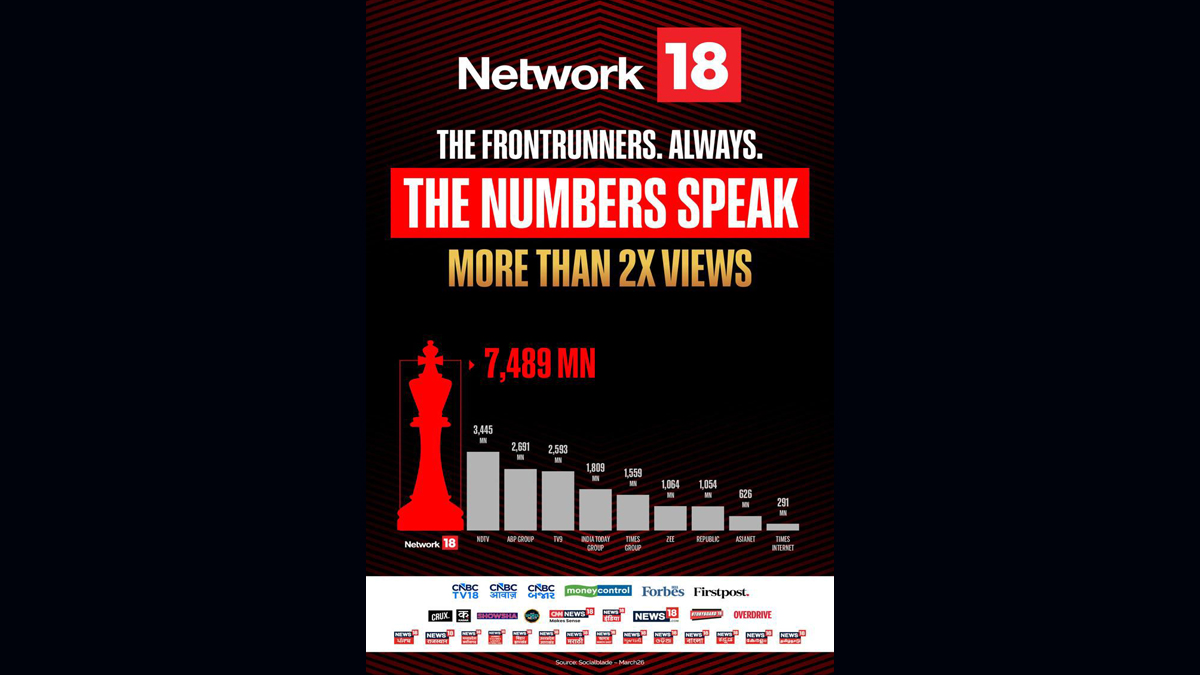
MUMBAI: When the world hit refresh on breaking news, Network18’s channels were already streaming ahead. As geopolitical tensions and war-driven headlines fuelled a surge in global news consumption, the network’s digital playbook delivered big clocking record Youtube viewership across English, Hindi and business news categories in March 2026.
At the forefront was CNN-News18, which emerged as the clear leader in the English news segment with 130 million live and video-on-demand views. The channel edged past competitors such as Times of India (126.5 million), Times Now (101.1 million), India Today (88.2 million) and NDTV (77.5 million), according to Databeings data for March.
In the Hindi news arena, News18 India delivered a commanding performance, racking up a staggering 3,297 million views on YouTube. The channel comfortably outpaced NDTV India, which recorded 3,119 million views, underlining its deep reach and consistent engagement with mass audiences, as per Playboard data.
The network’s dominance wasn’t confined to general news. In the Hindi business segment, CNBC Awaaz topped the charts with 92 million views, narrowly ahead of Zee Business (90 million) and well ahead of ET Now Swadesh (57 million). Meanwhile, its English counterpart CNBC-TV18 posted a strong 58 million views, reinforcing the network’s cross-category strength.
The spike in viewership reflects a broader shift in audience behaviour, with viewers increasingly turning to digital platforms particularly Youtube for real-time updates and in-depth coverage during high-intensity news cycles. For Network18, the numbers signal more than just scale; they underline the effectiveness of a multi-platform strategy that blends speed, credibility and continuous coverage.
In a month where the news never paused, it seems viewers chose to stay tuned where the stream never stopped.






