Cable TV
Liberty eyeing investment in Indian cable company


MUMBAI: As the CAS story firms up, so too does the interest with which big international cable companies view the Indian scenario.
The most active on this front appears to be John Malone’s Liberty Media Corp, which is eyeing an investment into the cable TV business in India. The company has initiated talks with Hinduja-owned IndusInd Media and Communications Ltd (IMCL) but no breakthrough has been reached thus far, sources say.
Late last year, a senior team visited IMCL headquarters in Mumbai but talks have stalled after that. A preliminary agreement on the valuations couldn’t be reached, sources say.

When contacted, Hinduja TMT Ltd MD K Thiagarajan said the cable business of the company was attracting a “lot of interest from strategic and financial investors.” But he refused to comment on whether the company was in talks with Liberty Media. “I can’t comment specifically on any investor,” he said. IMCL, which operates the cable business under Incablenet brand, is a subsidiary company of HTMT.
Sources say HTMT was looking at a valuation of around $900 million for its cable TV business. Interestingly, Zee Telefilms Ltd chairman Subhash Chandra said, in an interview to a business channel, that the value of his cable assets ought to be in the region of $800-900 million.
Liberty, however, is waiting to see how conditional access system (CAS) rolls out. Investors feel digital cable TV will help organise the industry and bring subscribers under the addressable system. Average revenue per users (ARPUs) would also go up.
If Liberty does make an entry into India, then it will be Malone’s second big entry into the Asian market after Japan. According to the latest report by Hong Kong-based Media Partners Asia (MPA), Liberty-controlled J:COM, the most successful broadband cable TV operation in Asia and in Japan, will April 15 launch HDR services (High Definition Recorder capabilities with a High Spec Double Tuner Recorder), a new J:COM digital service available in all J:COM franchises, which pass 7.9 million homes.
Zee Telefilms has already announced its plans to de-merge Siticable, a wholly owned subsidiary, into a separate company called Wire and Wireless (India) Limited (WWIL). This would bring specific focus into the cable business and be attractive to investors.
Queried by Indiantelevision.com earlier as to whether he saw the demerged cable business (Siticable) and the direct consumer services business (Dish TV) as being the most likely to invite international interest for strategic and financial partnerships, Chandra had replied in the affirmative.
HTMT is also planning to de-merge the company’s IT/BPO and media businesses into separate entities. “It couldn’t be done this year because of certain taxation issues. The programme is still alive and we hope to de-merge early next fiscal. A committee of directors are looking into the issue,” said Thiagarajan.
When asked whether HTMT would de-merge after selling its stake in Hutchison Essar Ltd, Thiagarajan said he wouldn’t like to comment on the issue. HTMT, together with its wholly owned subsidiary InNetwork Entertainment Ltd, is holding 91.54 per cent of IndusInd Telecom Network Ltd (ITNL) corresponding to a 4.68 per cent effective stake in Hutch. HTMT plans to exit from the telecom business and sale out its entire stake before Hutchison Essar goes for an initial public offering (IPO).
With Zee de-merging its cable subsidiary, foreign companies may now turn their eyes on WWIL. And with CAS rollout imminent, Liberty, Comcast and Time Warner Cable may seriously look at setting up a footprint in India.





Cable TV
Hathway Cable appoints Gurjeev Singh Kapoor as CEO
Leadership change comes as cable TV faces shrinking subscriber base and modest earnings pressure
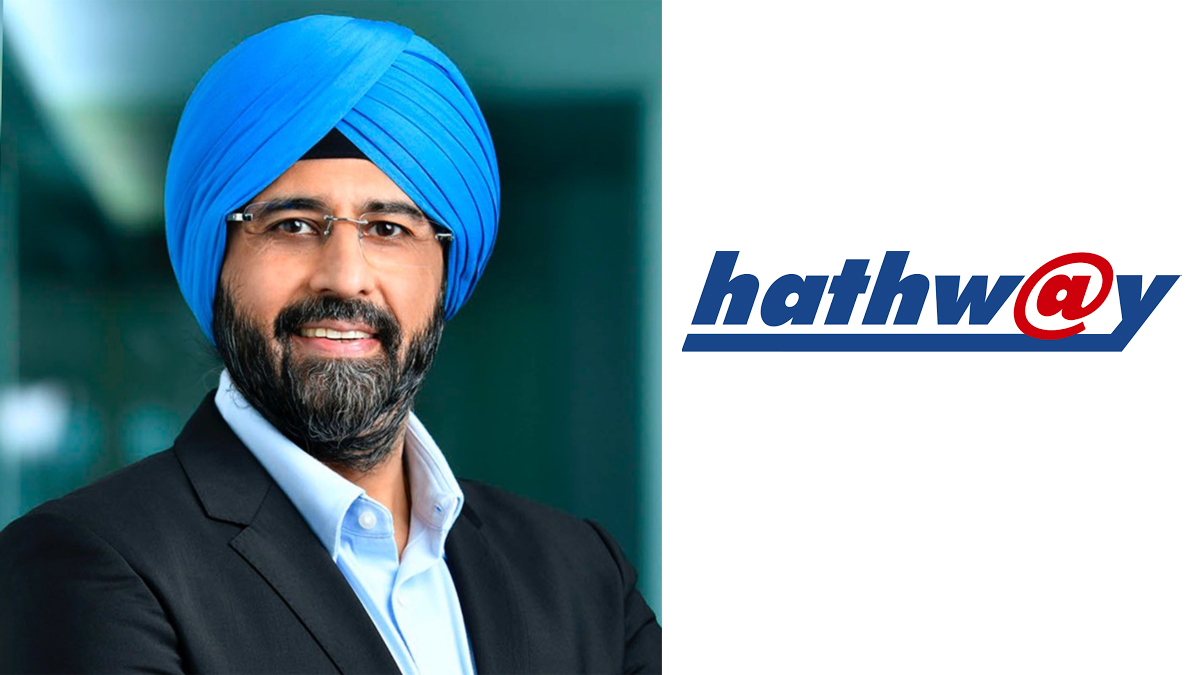
MUMBAI: Hathway Cable and Datacom has tapped industry veteran Gurjeev Singh Kapoor as chief executive officer, marking a leadership pivot at a time when India’s cable television business is under mounting strain.
Kapoor will take over from Tavinderjit Singh Panesar, who is set to retire in August after a long innings with the company. Panesar, chief executive since 2023, has held multiple leadership roles at Hathway, including his latest stint beginning in 2022.
Kapoor brings more than three decades of experience in media and entertainment. He most recently led distribution at The Walt Disney Company’s Star India business, now part of JioStar. His career spans television distribution and affiliate partnerships, with stints at Sony Pictures Networks India, Discovery Communications and Zee Entertainment.
Panesar, with over three decades in the industry, has worked across strategic planning, distribution and business development in media, broadcasting and manufacturing. His past associations include ESPN Star Sports, Star India, Apollo Tyres and JK Industries.
The transition lands as the cable sector grapples with structural disruption. Traditional operators are losing ground to streaming platforms, while telecom and broadband players tighten the squeeze with bundled offerings.
An EY report estimates India’s pay-TV base could shrink by a further 30 to 40 million households by 2030, taking the total down to 71 to 81 million. The slide follows a loss of nearly 40 million homes between 2018 and 2024, a contraction that has already wiped out more than 37,000 jobs in the local cable operator ecosystem.
Hathway’s numbers reflect the strain. The company reported a consolidated net profit of Rs 93 crore for FY25, down from Rs 99 crore a year earlier. Revenue inched up to Rs 2,040 crore from Rs 1,981 crore. As of December 2025, it had about 4.7 million cable TV subscribers and roughly 1.02 million broadband users.
Kapoor steps in with a familiar brief but a shrinking playbook. In a market where viewers are cutting cords faster than companies can reinvent them, the new chief executive inherits a business fighting to stay plugged in.







