Cable TV
LCOs demand access to SMS from MSOs


KOLKATA: The process of shifting from analogue to digital feed is not without its share of problems; a key issue being the resultant tug-of-war between local cable operators (LCOs) and multi system operators (MSOs) over access to the subscriber management system (SMS).
The Digital Addressable Cable TV Systems (DAS) requires MSOs to establish a subscriber management system (SMS), where details of all subscribers, along with their choice of services including channels and bouquets, are maintained.
While cable and entertainment analysts feel, “This brings in addressability and consequently, complete transparency in the whole system,” LCOs have a different take on the matter. They are of the opinion that once MSOs start billing consumers directly, they may end up losing control over their hard-won subscribers. Hence, they’re now asking MSOs to allow them access to the SMS to avoid such an eventuality.

Says Rajiv Sharma, lead analyst (telecom and media), HSBC Securities: “LCOs are worried about losing control over their subscribers if MSOs bill directly. They are of the view that MSOs should allow LCOs access to subscriber management systems, which are similar to what is being done for airline ticketing.”
A city-based cable op told indiantelevision.com, on condition of anonymity, that he had worked very hard for the last 20 years and it would be very unprofessional if his business and database were to go out of his hand and to the MSO whom he would then have to depend on totally.
Meanwhile, an MSO questioned as to how he could allow LCOs access to the SMS which his company had spent a few crores on. Typically, it’s the MSOs that invest in infrastructure including network, encryption, ERP, call centers and SMS.
Director Manthan Broadband Services pointed out the benefits of SMS as enabling subscribers exercise their choice of services and budget their bills accordingly. “It also helps us in managing their accounting and billing of the services rendered effectively in the long term,” said he.
Cable analyst Namit Dave suggested that MSOs and LCOs should work hand-in-hand for mutual benefit. While Sharma pointed out that the battle between MSOs and LCOs was sending out wrong signals to the investor community. “Gross billing remains a deterrent for MSOs and we anticipate some delay as we don’t expect clarity on the entertainment tax issue anytime soon,” he said. News is Hathway has suggested it expects to move to gross billing not before phase I i.e. the fourth quarter of the current fiscal.




Cable TV
Hathway Cable appoints Gurjeev Singh Kapoor as CEO
Leadership change comes as cable TV faces shrinking subscriber base and modest earnings pressure
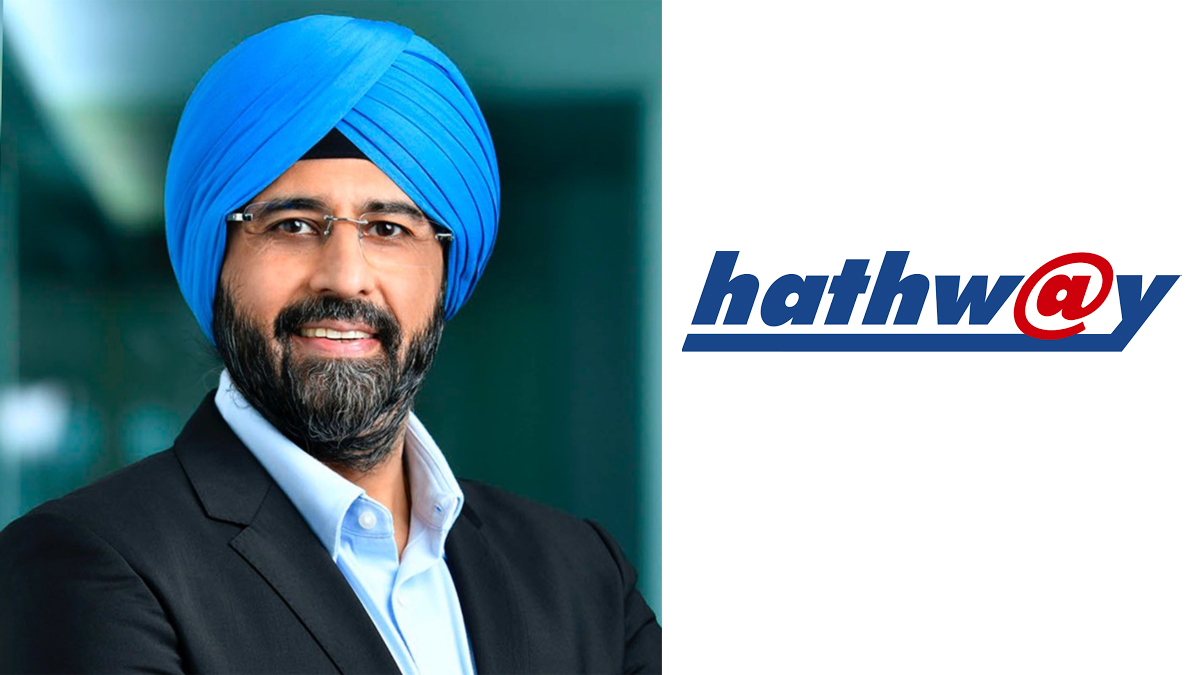
MUMBAI: Hathway Cable and Datacom has tapped industry veteran Gurjeev Singh Kapoor as chief executive officer, marking a leadership pivot at a time when India’s cable television business is under mounting strain.
Kapoor will take over from Tavinderjit Singh Panesar, who is set to retire in August after a long innings with the company. Panesar, chief executive since 2023, has held multiple leadership roles at Hathway, including his latest stint beginning in 2022.
Kapoor brings more than three decades of experience in media and entertainment. He most recently led distribution at The Walt Disney Company’s Star India business, now part of JioStar. His career spans television distribution and affiliate partnerships, with stints at Sony Pictures Networks India, Discovery Communications and Zee Entertainment.
Panesar, with over three decades in the industry, has worked across strategic planning, distribution and business development in media, broadcasting and manufacturing. His past associations include ESPN Star Sports, Star India, Apollo Tyres and JK Industries.
The transition lands as the cable sector grapples with structural disruption. Traditional operators are losing ground to streaming platforms, while telecom and broadband players tighten the squeeze with bundled offerings.
An EY report estimates India’s pay-TV base could shrink by a further 30 to 40 million households by 2030, taking the total down to 71 to 81 million. The slide follows a loss of nearly 40 million homes between 2018 and 2024, a contraction that has already wiped out more than 37,000 jobs in the local cable operator ecosystem.
Hathway’s numbers reflect the strain. The company reported a consolidated net profit of Rs 93 crore for FY25, down from Rs 99 crore a year earlier. Revenue inched up to Rs 2,040 crore from Rs 1,981 crore. As of December 2025, it had about 4.7 million cable TV subscribers and roughly 1.02 million broadband users.
Kapoor steps in with a familiar brief but a shrinking playbook. In a market where viewers are cutting cords faster than companies can reinvent them, the new chief executive inherits a business fighting to stay plugged in.







